THE CLASSIC COLLECTION✦The Story of Francis CluddeCLASSIC FREE BOOKS
The Story of Francis Cludde
Stanley John Weyman
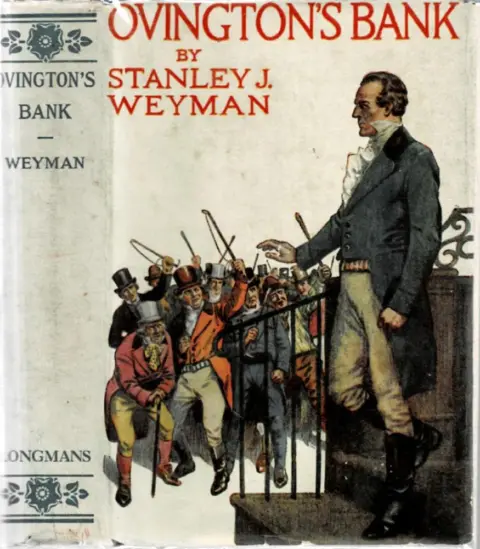
THE CLASSIC COLLECTION · 1922
"Ovington's Bank" by Stanley John Weyman is a novel published in 1922. Set during the British Panic of 1825, the story follows two English communities as a banking crisis threatens to destroy their way of life. Weyman explores the clash between traditional landed gentry and the rising business class, as customers' panic endangers a carefully run bank. This tale of honesty, love, and social transformation depicts how fear and self-interest can drive even solvent institutions toward ruin during financial turmoil.
Introduction adapted from the source catalogue; source summaries may be automatically generated.
Free to read · English · 162,553 words · No account needed
MAKE TIME FOR A GOOD BOOK
On by default. Untick to stop anonymous reading totals. Each page counts after 10 seconds in view. How this works.
Anonymous counting is on unless you have switched it off.
“I don’t mind whether you understand or not,” the Squire retorted. “Ha’ you done, girl?” after an interval of silence.
“Not quite, sir. I have five heaps of ten.”
“Well, well, get on. We are keeping the young man.”
He spoke as he would have spoken of any young man in a shop, and Clement winced, and Josina knew that he winced and she reddened. But she went on with her work. “There are sixty-one, sir,” she said. “That makes——”
“Six thousand one hundred pounds. Ay, it’s right so far. Right so far. And the gold”—he paused and seemed to be at a nonplus—“I’m afraid ’twould take too long to count it. Well, let it be. Get some paper and write a receipt as I tell you.”
“There is no need, sir,” Clement ventured.
“There’s every need, young man. I’m doing business. Ha’ you got the pen, girl? Then write as I tell you. ‘I, George Griffin of Garth, in the County of Aldshire, acknowledge that I have this 16th day of December 1825 received from Messrs. Ovington of Aldersbury, six thousand one hundred pounds in Bank of England notes, and’—ha’ you got that? Ha’ you got that?—‘two bags stated by them to contain five thousand pounds in gold.’ Ha’ you got that down? Then show me the place, and——”
But as she put the pen in his hand he let it drop. He sat back in his chair. “Ay, he showed me the place before,” he muttered, his chin on his breast. “It was he gave me the pen, then, girl. And how be I to know? How be I to know?”
It came home to them—to them both. In his voice, his act, his attitude was the pathos of blindness, its helplessness, its dependence, its reliance on others—on the eyes, the hand, the honesty of others. The girl leant over him. “Father,” she said, tears in her voice, “I wouldn’t deceive you! You know I wouldn’t. I would never deceive you!”
“Ha’ you never deceived me? Wi’ that young man?” sternly.
“But——”
“Ay, you have! You have deceived me—with him.”
She could not defend herself, and, suppressing her sobs, “I will call Calamy,” she said. “He can read. He shall count the notes.”
But he put out his hand and grasped her skirts. “No,” he said. “What’ll I be the better? Give me the pen. If you deceive me in this, wench—what matter if the notes be short or not, or what comes of it?”
“I would cut off my hand first!” she cried. “And Clement——”
“Eh?” He sat up sharply.
Your reading position is saved on this browser. Take it to another device with a library code. Reading pages adapt to text, rather than matching a printed edition.
Stanley John Weyman
Stanley John Weyman
Stanley John Weyman
Stanley John Weyman
BEHIND THE BOOK
This eBook is for the use of anyone anywhere in the United States and most other parts of the world at no cost and with almost no restrictions whatsoever. You may copy it, give it away or re-use it under the terms of the Project Gutenberg License included with this eBook or online at www.gutenberg.org. If you are not located in the United States, you will have to check the laws of the country where you are located before using this eBook. Read the source licence.
The original source file, including credits and licence, is retained by this library. Request an original-format copy at no charge. Please include the book title and Project Gutenberg identifier #38990.
KEEP YOUR CURIOSITY GOING
Cécile Tormay

Moritz Busch
Coulson Kernahan
John L. Ransom

Maurice Baring
Frances Wright