THE CLASSIC COLLECTION✦The Story of Francis CluddeCLASSIC FREE BOOKS
The Story of Francis Cludde
Stanley John Weyman
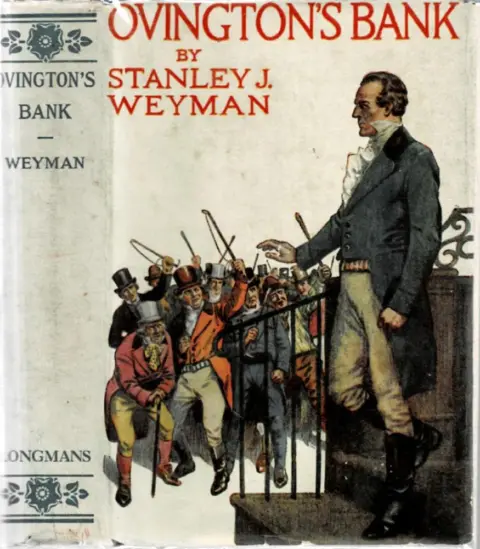
THE CLASSIC COLLECTION · 1922
"Ovington's Bank" by Stanley John Weyman is a novel published in 1922. Set during the British Panic of 1825, the story follows two English communities as a banking crisis threatens to destroy their way of life. Weyman explores the clash between traditional landed gentry and the rising business class, as customers' panic endangers a carefully run bank. This tale of honesty, love, and social transformation depicts how fear and self-interest can drive even solvent institutions toward ruin during financial turmoil.
Introduction adapted from the source catalogue; source summaries may be automatically generated.
Free to read · English · 162,553 words · No account needed
MAKE TIME FOR A GOOD BOOK
On by default. Untick to stop anonymous reading totals. Each page counts after 10 seconds in view. How this works.
Anonymous counting is on unless you have switched it off.
“True. But he’s a man who cannot bear to see money lost. He thinks a
good deal of it.”
“He is not alone in that,” Betty exclaimed. “Sometimes I feel that I hate money! People grow so fond of it. They think only of themselves, even when you’ve been ever so good to them.”
“Well, it’s human nature,” the banker replied equably. “I don’t know who it is that you have in your mind, my dear, but it applies to most people.” He was going to say more when the door opened.
“Mr. Rodd is here, asking for Mr. Clement, sir,” the maid said. “He was to meet him at half after six, and——”
“Ask Mr. Rodd to come in.”
The cashier entered shyly. In his dark suit, with his black stock and stiff carriage, he made no figure, where Arthur, or even Clement, would have shone. But there were women in Aldersbury who said that he had fine eyes, eyes with something of a dog’s gentleness in them; and Arthur so far agreed that he dubbed him a dull, mechanical dog, and often made fun of him as such. But perhaps Arthur did not always see to the bottom of things.
Ovington pushed the decanter and a glass towards him. “A glass of wine, Rodd,” he said genially. He was not of those who undervalued his cashier, though he knew his limitations. “The bank!” he said.
“And those who have stood by it!” Betty added softly.
Rodd drank the toast with a muttered word.
“Mr. Rodd has not the same reason to be thankful that we have,” Betty continued carelessly, holding her knitting up to the lamp.
“Why not?” Her father did not understand.
“Why,” innocently, as she lowered the knitting again, “he does not stand to lose anything, does he?”
“Except his place,” the cashier objected, his eyes on his glass.
“Just so,” the banker rejoined. “And in that event,” moved to unusual frankness, “we should have been all out together. And Rodd might not have been the worst off, my girl.
“Exactly,” Betty said. “I’m sure that he would take care of that.”
The cashier opened his mouth to speak, but checked himself, and drank off his wine. Then, as he rose, “If you know where Mr. Clement is, sir——”
“I don’t. I can’t think what has become of him,” the banker explained. “He went out about four, and since then—hallo! That’s some one in a hurry. It sounds like a fire.”
Your reading position is saved on this browser. Take it to another device with a library code. Reading pages adapt to text, rather than matching a printed edition.
Stanley John Weyman
Stanley John Weyman
Stanley John Weyman
Stanley John Weyman
BEHIND THE BOOK
This eBook is for the use of anyone anywhere in the United States and most other parts of the world at no cost and with almost no restrictions whatsoever. You may copy it, give it away or re-use it under the terms of the Project Gutenberg License included with this eBook or online at www.gutenberg.org. If you are not located in the United States, you will have to check the laws of the country where you are located before using this eBook. Read the source licence.
The original source file, including credits and licence, is retained by this library. Request an original-format copy at no charge. Please include the book title and Project Gutenberg identifier #38990.
KEEP YOUR CURIOSITY GOING
Cécile Tormay

Moritz Busch
Coulson Kernahan
John L. Ransom

Maurice Baring
Frances Wright