THE CLASSIC COLLECTION✦The Story of Francis CluddeCLASSIC FREE BOOKS
The Story of Francis Cludde
Stanley John Weyman
THE CLASSIC COLLECTION · 1922
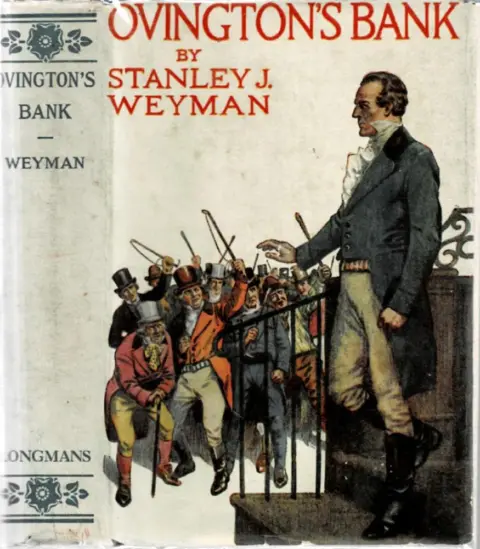
"Ovington's Bank" by Stanley John Weyman is a novel published in 1922. Set during the British Panic of 1825, the story follows two English communities as a banking crisis threatens to destroy their way of life. Weyman explores the clash between traditional landed gentry and the rising business class, as customers' panic endangers a carefully run bank. This tale of honesty, love, and social transformation depicts how fear and self-interest can drive even solvent institutions toward ruin during financial turmoil.
Introduction adapted from the source catalogue; source summaries may be automatically generated.
Free to read · English · 162,553 words · No account needed
MAKE TIME FOR A GOOD BOOK
On by default. Untick to stop anonymous reading totals. Each page counts after 10 seconds in view. How this works.
Anonymous counting is on unless you have switched it off.
“One three seven, Rodd, three and six.” And while the customer, laboriously and with a crimsoning face, scrawled his signature on the cheque, Arthur opened a drawer and counted out the amount in Ovington’s notes. “Twenty-seven fives, and two, three, six,” he muttered, pushing it over. “You’ll find that right, I think.”
Brownjohn had had his lesson from Wolley, who put up at his house, but he had not learnt it perfectly. He took the notes, and thumbed them over, wetting his thumb as he turned each, and he found the tale correct. “Much obliged, gentlemen,” he muttered, and with a perspiring brow he effected his retreat. Already he doubted—so willingly had his money been paid—if he had been wise. He was glad that he had left the five pounds.
But the door had hardly closed on him before Arthur asked the cashier how much gold he had in the cash drawer.
“The usual, sir. One hundred and fifty and thirty-two, thirty-three, thirty-four—one hundred and eighty-four.”
“Fetch up two hundred more before Mr. Brownjohn comes back,” Arthur said. “Don’t lose time.”
Rodd did not like Arthur, but he did silent homage to his sharpness. He hastened to the safe and was back in two minutes with twenty rouleaux of sovereigns. “Shall I break them, sir?” he asked.
“Yes, I think so. Ah!” as the door swung open and one of the Welsh brothers entered. It was Mr. Frederick. Arthur nodded. “Good day, Welsh, I was thinking of you. I fancy Clement wants to see you.”
“Right—in one moment,” the lawyer replied. “Just put that——”
But Arthur saw that he had a cheque to pay in—he banked at Dean’s but had clients’ accounts with them—and he broke in on his business. “Clement,” he said, “here’s Welsh. Just give him your father’s message.”
Clement came forward with his father’s invitation—oysters and whist at five on Friday—and his opinion on a glass of ’20 he was laying down? He kept the lawyer in talk for a minute or two, and then, as Arthur had shrewdly calculated, the door opened and Brownjohn slid in. The man’s face was red, and he looked heartily ashamed of himself, but he put down his notes on the counter. He was going to speak when, “In a moment, Brownjohn,” Arthur said. “What is it, Mr. Welsh?”
“Just put this to the Hobdays’ account,” the lawyer answered recalled to his business. “Fifty-four pounds two shillings and five-pence. And, by the way, are you going to Garth on Saturday?”
“On Saturday, or Sunday, yes. Can I do anything for you!”
Your reading position is saved on this browser. Take it to another device with a library code. Reading pages adapt to text, rather than matching a printed edition.
Stanley John Weyman
Stanley John Weyman
Stanley John Weyman
Stanley John Weyman
BEHIND THE BOOK
This eBook is for the use of anyone anywhere in the United States and most other parts of the world at no cost and with almost no restrictions whatsoever. You may copy it, give it away or re-use it under the terms of the Project Gutenberg License included with this eBook or online at www.gutenberg.org. If you are not located in the United States, you will have to check the laws of the country where you are located before using this eBook. Read the source licence.
The original source file, including credits and licence, is retained by this library. Request an original-format copy at no charge. Please include the book title and Project Gutenberg identifier #38990.
KEEP YOUR CURIOSITY GOING
Cécile Tormay

Moritz Busch
Coulson Kernahan
John L. Ransom

Maurice Baring
Frances Wright