THE CLASSIC COLLECTION✦The Story of Francis CluddeCLASSIC FREE BOOKS
The Story of Francis Cludde
Stanley John Weyman
THE CLASSIC COLLECTION · 1922
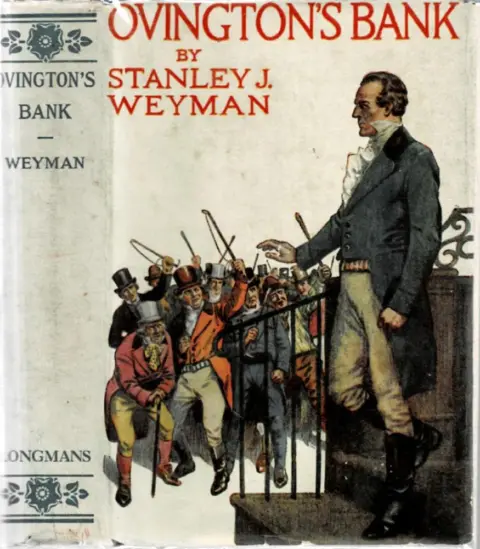
"Ovington's Bank" by Stanley John Weyman is a novel published in 1922. Set during the British Panic of 1825, the story follows two English communities as a banking crisis threatens to destroy their way of life. Weyman explores the clash between traditional landed gentry and the rising business class, as customers' panic endangers a carefully run bank. This tale of honesty, love, and social transformation depicts how fear and self-interest can drive even solvent institutions toward ruin during financial turmoil.
Introduction adapted from the source catalogue; source summaries may be automatically generated.
Free to read · English · 162,553 words · No account needed
MAKE TIME FOR A GOOD BOOK
On by default. Untick to stop anonymous reading totals. Each page counts after 10 seconds in view. How this works.
Anonymous counting is on unless you have switched it off.
“No.” The banker shook his head. “That won’t do, Rodd. You had this in your mind before he came in. You are pat with Wolley and Mr. Acherley; bad accounts both, as all banks have bad accounts here and there. But it’s true—we’ve been giving our customers rope, and they have bought things that may fall. Still, they’ve made money, a good deal of money, and we’ve kept a fair margin and obliged them at the same time. All legitimate business. There must be something in your mind besides this, I’m sure. What is it, lad?”
The cashier turned a dull red, but before he could answer the door behind him opened. Arthur came in. He looked at the banker, and from him to Rodd, and his suspicions were aroused. “It’s four o’clock, sir,” he said, and looked again at Rodd as if to ask what he was doing there.
But Rodd held his ground, and the banker explained.
“Rodd is a little alarmed for us,” he said, and it was difficult to be sure whether he spoke in jest or in earnest. “He thinks we’re going too fast. Putting our hand out too far. He mentions Wolley’s account, and Acherley’s.
“I was speaking generally,” Rodd muttered. He looked sullen.
Arthur shrugged his shoulders. “I stand corrected,” he said. “I didn’t know that Rodd ever went beyond his ledgers.”
“Oh, he’s quite right to speak his mind. We are all in the same boat—though we do not all steer.”
“Well, I’m glad of that, sir.”
“Still,” mildly, “it is a good thing to have an opinion.”
“If it be worth anything.”
“If opinions are going——” Betty had opened the door behind the banker’s chair, and was standing on the threshold—“wouldn’t you like to have mine, father?”
“To be sure,” Arthur said. “Why not, indeed? Let us have it. Why not have everybody’s? And send for the cook, sir, and the two clerks—to advise us?”
Betty dropped a curtsy. “Thank you, I am flattered.”
“Betty, you’ve no business here,” her father said. “You mustn’t stop unless you can keep your opinions to yourself.”
“But what has happened?” she asked, looking around in wonder.
“Mr. Griffin has withdrawn his account.”
“And Rodd,” Arthur added, with more heat than the occasion seemed to demand, “thinks that we had better put up the shutters!”
Your reading position is saved on this browser. Take it to another device with a library code. Reading pages adapt to text, rather than matching a printed edition.
Stanley John Weyman

Stanley John Weyman
Stanley John Weyman
Stanley John Weyman
BEHIND THE BOOK
This eBook is for the use of anyone anywhere in the United States and most other parts of the world at no cost and with almost no restrictions whatsoever. You may copy it, give it away or re-use it under the terms of the Project Gutenberg License included with this eBook or online at www.gutenberg.org. If you are not located in the United States, you will have to check the laws of the country where you are located before using this eBook. Read the source licence.
The original source file, including credits and licence, is retained by this library. Request an original-format copy at no charge. Please include the book title and Project Gutenberg identifier #38990.
KEEP YOUR CURIOSITY GOING
Cécile Tormay

Moritz Busch
Coulson Kernahan
John L. Ransom

Maurice Baring
Frances Wright