THE CLASSIC COLLECTION✦London LavenderCLASSIC FREE BOOKS
London Lavender
E. V. (Edward Verrall) Lucas
THE CLASSIC COLLECTION · 1908
"Over Bemerton's : An easy-going chronicle" by E. V. Lucas is a novel written in the early 20th century. It is a mellow, observant London chronicle following a middle‑aged returnee who settles above a second‑hand bookshop in Westminster and drifts into a web of friendships, family ties, and bookish pleasures. The tone is gently comic and reflective, with vignettes of city life and character study at its heart, especially the narrator Kent Falconer, his capable stepsister Naomi, the bookseller Mr. Bemerton, the voluble landlady Mrs. Duckie, and a caustic journalist, Mr. Dabney. The opening of the chronicle finds Kent Falconer back from long exile, seeking quiet rooms near Queen Anne’s Gate; Naomi steers him to a flat over Bemerton’s bookshop, complete with a formidable landlady and the promise of midnight reading. A chance “for luck” purchase yields a Chinese biographical dictionary that becomes his delight, while a brisk tour introduces his Queen Anne’s Gate household—level‑headed Naomi, opinionated Drusilla, brothers Frank and Lionel, and the ornamental family friend Dollie. Falconer roams a changed London, contrasts hansoms with motor cabs, and savors book‑lover riches, even as he sketches the Duckie clan (including music‑hall star Alf Pinto, dresser Beatrice, and boy Ern) and the shabby waterman at the pub corner. Mr. Dabney of The Balance arrives to rail at new journalism and hedonism, prompting a debate on what might cure the age; Mr. Bemerton grants the narrator nocturnal access to his shelves, revealing a quiet world of cataloguers and literary anecdotes, a hint of an old flame named Miss Gold, and, finally, the narrator’s rapt return to cricket and memories of W. G. Grace.
Introduction adapted from the source catalogue; source summaries may be automatically generated.
Free to read · English · 65,948 words · No account needed
MAKE TIME FOR A GOOD BOOK
On by default. Untick to stop anonymous reading totals. Each page counts after 10 seconds in view. How this works.
Anonymous counting is on unless you have switched it off.
I threw the cheque to Naomi. "There," I said, "put it in the bank, and when we are ready to go, give us exactly half of it, and we will stay away until it is spent or we are all tired of seeing each other at table d'hôte. The other half you must do with exactly as you will."
"You dear thing!" Naomi cried.
All through dinner we discussed the merits of Continental resorts.
We began with France. Lionel suggested Trouville; but his sisters
would have none of it.
"Then I can't go," he said. "I couldn't possibly be away for more
than a few days until the season closes. We've got several matches
yet."
Drusilla also remarked that she did not want to be away for so long as a month, but would not explain why.
Alderley wanted Brixen. He had heard so much of it from a Judge. No one else had heard of it at all, and he became very plaintive about money foolishly flung away on the education of the young. "Brixen," he said, "is in the Tyrol--a mountainous district of Austria."
After a short sharp passage with Drusilla he admitted to having first met the name and fame of Brixen only a fortnight ago.
My sister voted for the Juras. She had seen a picture in the Academy, of a valley of wild flowers there, by MacWhirter, and she had always longed to visit them.
But against Switzerland rose the universal voice.
Norway was excluded on account of the sea voyage; Rome for its heat; Spain for ignorance of the language and (on Mrs. Wynne's account) prevalence of anarchists and bombs; the Black Forest for its want of civilised apparatus; the Tyrol for its steepnesses.
And then Naomi hit the nail on the head. "Venice," she said.
Of course.
Later in the evening Dollie Heathcote came in. He had looked round the dancing rooms to which he had been invited, had disapproved, and, disapproving, had with a bachelor's lofty privileges done what he called a guy.
"Besides," he said, not in excuse, for he admits to no errors, but in further explanation of a perfectly rational line of conduct, "there were crowds of men over--oceans."
"What do you know of Venice?" Naomi asked him.
"Venice," he said, "I know all about Venice. It is a suburb of New York, the streets are flooded, and there is nothing to eat except for mosquitoes, and they eat you."
"Very good," I said.
"Don't encourage the ass," said Lionel.
"Very good," I said, "but now be practical."
Your reading position is saved on this browser. Take it to another device with a library code. Reading pages adapt to text, rather than matching a printed edition.
E. V. (Edward Verrall) Lucas
E. V. (Edward Verrall) Lucas
E. V. (Edward Verrall) Lucas
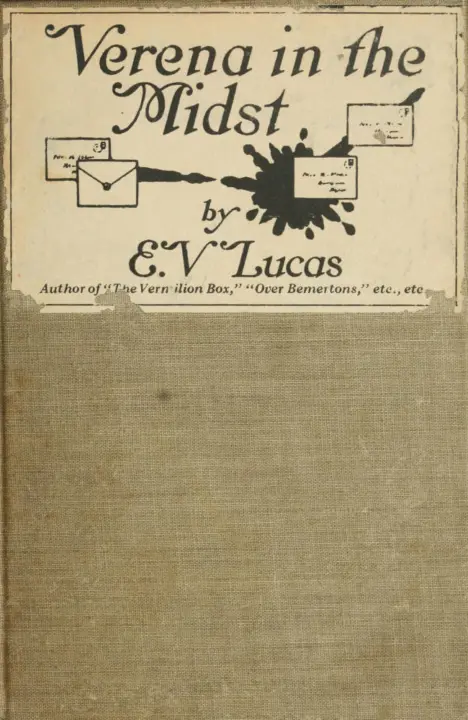
E. V. (Edward Verrall) Lucas
BEHIND THE BOOK
This eBook is for the use of anyone anywhere in the United States and most other parts of the world at no cost and with almost no restrictions whatsoever. You may copy it, give it away or re-use it under the terms of the Project Gutenberg License included with this eBook or online at www.gutenberg.org. If you are not located in the United States, you will have to check the laws of the country where you are located before using this eBook. Read the source licence.
The original source file, including credits and licence, is retained by this library. Request an original-format copy at no charge. Please include the book title and Project Gutenberg identifier #76344.
KEEP YOUR CURIOSITY GOING
Coulson Kernahan

Maurice Baring
Frances Wright
Cécile Tormay

Frederic Jesup Stimson

W. H. P. (William Henry Pope) Jarvis