
Switch off
Oliver Optic
THE CLASSIC COLLECTION · 1867
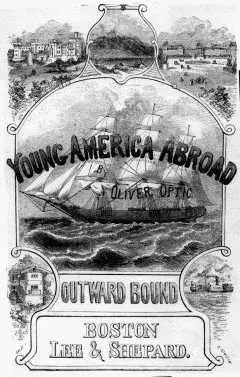
"Outward Bound; Or, Young America Afloat: A Story of Travel and Adventure" by William T. Adams (Oliver Optic) is a novel written in the late 19th century. This engaging adventure takes readers on a journey with the juvenile crew of the Academy Ship "Young America" as they prepare for life at sea, focusing on themes of discipline, education, and the mischief of youth. The story introduces several key characters, including Robert Shuffles, the impulsive instigator, and Harry Martyn, who works to uphold discipline among his fellow classmates. The opening of the narrative introduces readers to Robert Shuffles and Isaac Monroe, two boarding students from Brockway Academy engaging in a petty theft of peaches from a local garden. This act of rebellion sets up a backdrop where discipline is a pressing issue at the academy, leading to the suggestion of reformatory education aboard a ship. Mr. Lowington, the academy's principal, reflects on his own troubled youth while preparing to turn the ship into an institution for moral and educational development. With the main boys gathered on board, anticipation builds for their eventual adventures, academic pursuits, and the lessons—both harsh and humorous—they will learn while sailing the open seas.
Introduction adapted from the source catalogue; source summaries may be automatically generated.
Free to read · English · 79,888 words · No account needed
MAKE TIME FOR A GOOD BOOK
On by default. Untick to stop anonymous reading totals. Each page counts after 10 seconds in view. How this works.
Anonymous counting is on unless you have switched it off.
On board the Young America, ten fathoms were allowed for "stray line;" this length of line being permitted to run out before the measuring commenced, in order to get the chip clear of thee eddies in the wake of the ship. The ten fathoms were indicated by a white rag, drawn through the line; and when the officer paying out comes to this mark, he orders the quartermaster to turn the glass, and the operation actually begins. At every fifty-one feet (or forty-seven and six tenths, making the allowances) there is a mark--a bit of leather, or two or more knots. The instant the sands have all run through the glass, the quartermaster says, "Up," and the officer notes the mark to which the line has run out. Half and quarter knots are indicated on the line.
"Now, quartermaster, mind your eye. When the officer of the deck says, 'Turn,' you repeat the word after him, to show that you are alive," continued Peaks.
"Ready!" said Gordon.
"Ready!" replied Smith.
The lieutenant threw the chip into the water, and when the stray line had run off, he gave the word to turn the glass.
"Turn!" repeated Smith.
Gordon eased off the log-line, so that nothing should prevent it from
running easily.
"Up!" shouted Smith; and Gordon stopped the line.
"Very well," added Peaks. "What's the mark?"
"Ten and a quarter," replied the officer.
"That sounds more like it. I knew this ship was going more than seven knots. You see, young gentlemen, you can't catch flies and tend the log-line at the same time. Now, you may try it over again."
The experiment was repeated, with the same result. Other officers and seamen were called to the quarter-deck, and the training in heaving the log continued, until a reasonable degree of proficiency was attained.
"Land ho!" cried the lookout on the top-gallant forecastle, at about eleven o'clock in the forenoon.
"Where away?" called the officer of the deck.
"Dead ahead, sir."
"What is that land, Mr. Lowington?" asked Paul Kendall.
"Don't you know?"
"I'm sure I don't."
"Then you should study your map more. Look at the compass, and tell me
how she heads."
"South-east, sir," replied Paul, after looking into the binnacle.
"Now, what land lies south-east of Brockway Harbor?" asked the
principal.
"Cape Cod, I think."
"You are right; then that must be Cape Cod."
"Is it, really?"
"Certainly it is," laughed Mr. Lowington. "Have you no faith in your
map?"
"I didn't think we could be anywhere near Cape Cod. I thought it was farther off," added Paul, who seemed to be amazed to think they had actually crossed Massachusetts Bay.
Your reading position is saved on this browser. Take it to another device with a library code. Reading pages adapt to text, rather than matching a printed edition.
BEHIND THE BOOK
This eBook is for the use of anyone anywhere in the United States and most other parts of the world at no cost and with almost no restrictions whatsoever. You may copy it, give it away or re-use it under the terms of the Project Gutenberg License included with this eBook or online at www.gutenberg.org. If you are not located in the United States, you will have to check the laws of the country where you are located before using this eBook. Read the source licence.
The original source file, including credits and licence, is retained by this library. Request an original-format copy at no charge. Please include the book title and Project Gutenberg identifier #15920.
KEEP YOUR CURIOSITY GOING
Coulson Kernahan

Maurice Baring
Frances Wright
Cécile Tormay

Frederic Jesup Stimson

W. H. P. (William Henry Pope) Jarvis
