
Switch off
Oliver Optic
THE CLASSIC COLLECTION · 1867
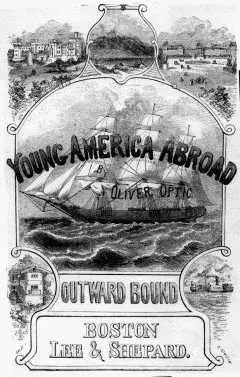
"Outward Bound; Or, Young America Afloat: A Story of Travel and Adventure" by William T. Adams (Oliver Optic) is a novel written in the late 19th century. This engaging adventure takes readers on a journey with the juvenile crew of the Academy Ship "Young America" as they prepare for life at sea, focusing on themes of discipline, education, and the mischief of youth. The story introduces several key characters, including Robert Shuffles, the impulsive instigator, and Harry Martyn, who works to uphold discipline among his fellow classmates. The opening of the narrative introduces readers to Robert Shuffles and Isaac Monroe, two boarding students from Brockway Academy engaging in a petty theft of peaches from a local garden. This act of rebellion sets up a backdrop where discipline is a pressing issue at the academy, leading to the suggestion of reformatory education aboard a ship. Mr. Lowington, the academy's principal, reflects on his own troubled youth while preparing to turn the ship into an institution for moral and educational development. With the main boys gathered on board, anticipation builds for their eventual adventures, academic pursuits, and the lessons—both harsh and humorous—they will learn while sailing the open seas.
Introduction adapted from the source catalogue; source summaries may be automatically generated.
Free to read · English · 79,888 words · No account needed
MAKE TIME FOR A GOOD BOOK
On by default. Untick to stop anonymous reading totals. Each page counts after 10 seconds in view. How this works.
Anonymous counting is on unless you have switched it off.
"I don't see it," interposed Monroe, shaking his head; and he was the young gentleman who had assisted the aspirant for the captaincy to rob Mr. Lowington's favorite peach tree.
"What have you got to say about it, Ike Monroe? Do you expect us to go
for you?"
"I didn't say so."
"That's what you meant."
"I've just as much right to the place as you have, Bob Shuffles."
"Do you think you could make the fellows stand round as I can? But hold on; fellows, don't let us fight about it. We are just the best six fellows on board, and if we have a mind to do so, we can have this thing all our own way," continued Shuffles.
"I don't see how," said Philip Sanborn.
"Don't you know how the politicians manage these things?"
"I don't."
"I'll tell you, then."
"But the principal said we must go according to merit, and elect the fellows who were the best fitted for the offices," interposed Howe.
"Exactly so; that's just what we are going to do. I'm going to be captain; can you tell me of any better fellow for the place?" demanded Shuffles, who, putting aside the jesting manner in which he had commenced the discussion, now assumed an earnest and impudent tone.
"Didn't you hear what Lowington said when he wound up his speech?" asked
Wilton.
"What?"
"About vetoing our choice if it was not a proper one."
"What of it?" asked Shuffles, innocently.
"Don't you think he would veto you?"
"Me! Not he! Lowington knows that I'm smart; I was too smart for him once, and he knows it. He won't veto me. We have been the best of friends lately."
"I don't believe he'll have a chance to veto you," said Wilton.
"What do you mean?"
"I don't believe you will be elected."
"I know I shall, if we manage it right. Let us look at it," continued Shuffles, as he took a pencil from his pocket. "Got a piece of paper?"
Monroe gave him a piece of paper, and the wire-puller began to make his
calculations.
"Eighty-seven votes," said he, writing the number on the paper. "Necessary to a choice, forty-four. Here are six votes to start with."
"For whom?" asked Monroe.
"For me, for captain, first, and for each of the others for whatever place he wants; say for Wilton for first lieutenant; Howe for second, Sanborn for third, Monroe for fourth, and Adler for first master. What do you say to that, fellows?"
Your reading position is saved on this browser. Take it to another device with a library code. Reading pages adapt to text, rather than matching a printed edition.
BEHIND THE BOOK
This eBook is for the use of anyone anywhere in the United States and most other parts of the world at no cost and with almost no restrictions whatsoever. You may copy it, give it away or re-use it under the terms of the Project Gutenberg License included with this eBook or online at www.gutenberg.org. If you are not located in the United States, you will have to check the laws of the country where you are located before using this eBook. Read the source licence.
The original source file, including credits and licence, is retained by this library. Request an original-format copy at no charge. Please include the book title and Project Gutenberg identifier #15920.
KEEP YOUR CURIOSITY GOING
Coulson Kernahan

Maurice Baring
Frances Wright
Cécile Tormay

Frederic Jesup Stimson

W. H. P. (William Henry Pope) Jarvis
