
Switch off
Oliver Optic
THE CLASSIC COLLECTION · 1867
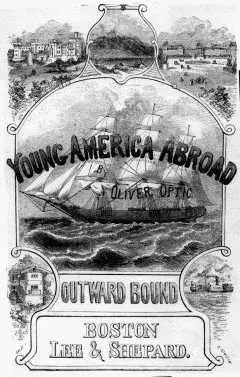
"Outward Bound; Or, Young America Afloat: A Story of Travel and Adventure" by William T. Adams (Oliver Optic) is a novel written in the late 19th century. This engaging adventure takes readers on a journey with the juvenile crew of the Academy Ship "Young America" as they prepare for life at sea, focusing on themes of discipline, education, and the mischief of youth. The story introduces several key characters, including Robert Shuffles, the impulsive instigator, and Harry Martyn, who works to uphold discipline among his fellow classmates. The opening of the narrative introduces readers to Robert Shuffles and Isaac Monroe, two boarding students from Brockway Academy engaging in a petty theft of peaches from a local garden. This act of rebellion sets up a backdrop where discipline is a pressing issue at the academy, leading to the suggestion of reformatory education aboard a ship. Mr. Lowington, the academy's principal, reflects on his own troubled youth while preparing to turn the ship into an institution for moral and educational development. With the main boys gathered on board, anticipation builds for their eventual adventures, academic pursuits, and the lessons—both harsh and humorous—they will learn while sailing the open seas.
Introduction adapted from the source catalogue; source summaries may be automatically generated.
Free to read · English · 79,888 words · No account needed
MAKE TIME FOR A GOOD BOOK
On by default. Untick to stop anonymous reading totals. Each page counts after 10 seconds in view. How this works.
Anonymous counting is on unless you have switched it off.
Pelham raised the slide, and the contents of the papers were read by
both.
Peas,........19
Beans,........22
The results given in by the two receivers were the same, and by the terms of the bond, it was an election.
"Shut the slide," said Shuffles.
"Who opened that binnacle?" demanded the first master, walking aft from his station on the forecastle.
"I did, sir," replied Shuffles, unwilling to permit the fourth
lieutenant to answer the question. "We were looking at some figures I
had made."
The master, finding that the fourth lieutenant was one of the party gathered around the binnacle, said no more, and returned to his place.
"Are you satisfied, Pelham?" asked Shuffles, in the softest of tones.
"I don't understand it," answered the disappointed candidate.
"Don't you? Well, you will remember that neither of us was to raise any question about the fairness of the ballot."
"I don't say a word about its fairness; I only said I did not understand it," answered Pelham, in surly tones.
"I don't understand it any better than you do; but the point just now is, whether you acknowledge me as captain, or not."
"Of course I do. When I pledge myself to do a thing, I always do it, I
hail you as captain."
"All right," added Shuffles. "Then nothing more need be said. You have kept your bond like a gentleman and I now appoint you my first officer, as I promised to do."
"Thank you," replied Pelham, in a sneering tone.
"What's the matter, my dear fellow? Are you not satisfied?" demanded
Shuffles.
"Entirely satisfied with the result;" but he talked like one who was
anything but satisfied.
"It was a fair thing--wasn't it?"
"I suppose it was; I don't know."
"You speak as though you were not satisfied, Pelham."
"I am not disposed to grumble. I only say that I don't understand it."
"What don't you understand?" asked Shuffles, sharply. "The election was conducted on a plan furnished by yourself; the receivers were of your own choice; the results agree; and I can't see, for the life of me, that there is any chance to find fault."
"I don't find fault. The result perplexes me, because I can't see
through it."
"What do you mean by that?"
"I don't see where your twenty-two votes came from."
"And I don't see where your nineteen came from," retorted the successful
candidate.
"The whole number of votes was forty-one," added Pelham, who was quite sure there was something wrong.
"The long and short of it is, that there are more fellows on board that 'know beans,' than you thought there were," laughed Shuffles.
Your reading position is saved on this browser. Take it to another device with a library code. Reading pages adapt to text, rather than matching a printed edition.
BEHIND THE BOOK
This eBook is for the use of anyone anywhere in the United States and most other parts of the world at no cost and with almost no restrictions whatsoever. You may copy it, give it away or re-use it under the terms of the Project Gutenberg License included with this eBook or online at www.gutenberg.org. If you are not located in the United States, you will have to check the laws of the country where you are located before using this eBook. Read the source licence.
The original source file, including credits and licence, is retained by this library. Request an original-format copy at no charge. Please include the book title and Project Gutenberg identifier #15920.
KEEP YOUR CURIOSITY GOING
Coulson Kernahan

Maurice Baring
Frances Wright
Cécile Tormay

Frederic Jesup Stimson

W. H. P. (William Henry Pope) Jarvis
