
Switch off
Oliver Optic
THE CLASSIC COLLECTION · 1867
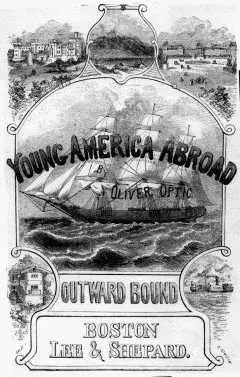
"Outward Bound; Or, Young America Afloat: A Story of Travel and Adventure" by William T. Adams (Oliver Optic) is a novel written in the late 19th century. This engaging adventure takes readers on a journey with the juvenile crew of the Academy Ship "Young America" as they prepare for life at sea, focusing on themes of discipline, education, and the mischief of youth. The story introduces several key characters, including Robert Shuffles, the impulsive instigator, and Harry Martyn, who works to uphold discipline among his fellow classmates. The opening of the narrative introduces readers to Robert Shuffles and Isaac Monroe, two boarding students from Brockway Academy engaging in a petty theft of peaches from a local garden. This act of rebellion sets up a backdrop where discipline is a pressing issue at the academy, leading to the suggestion of reformatory education aboard a ship. Mr. Lowington, the academy's principal, reflects on his own troubled youth while preparing to turn the ship into an institution for moral and educational development. With the main boys gathered on board, anticipation builds for their eventual adventures, academic pursuits, and the lessons—both harsh and humorous—they will learn while sailing the open seas.
Introduction adapted from the source catalogue; source summaries may be automatically generated.
Free to read · English · 79,888 words · No account needed
MAKE TIME FOR A GOOD BOOK
On by default. Untick to stop anonymous reading totals. Each page counts after 10 seconds in view. How this works.
Anonymous counting is on unless you have switched it off.
"The time is out, whether they have or not," replied Grossbeck.
"All we have to do now is to count the votes," added Shuffles, impatiently, for he was afraid his little trick would be exposed before the result of the ballot was obtained.
"Well, let us have it counted at once," said Pelham, who, having no doubt of the result, had no thought of offering any objection to the fairness of the election.
"We can't count the votes here," suggested McKeon. "Some one would see us, and want to know what we were doing."
"I can't leave the deck; I'm on duty," replied Shuffles.
"Let the receivers count it themselves."
"We ought to see them do it."
"That is not necessary. They don't know how many votes they have."
"I'm sure I don't," said Grossbeck.
"Neither do I," added McKeon.
"I'll tell you how we can manage it, without exciting the attention of
any one."
"I will agree to anything that is fair," replied Shuffles.
"Grossbeck shall go forward, and McKeon aft as far as the mainmast, so that each cannot know what the other is about. They can count the votes separately without being seen."
"I don't see how we can," said McKeon.
"Can you tell a pea from a bean by the feeling?"
"Of course we can."
"Where did you put the votes, Grossbeck?" asked Pelham.
"In my trousers' pocket."
"So did I," added McKeon.
"Both of you have on your pea-jackets now, and there is a pocket on each side of them. Take out all the peas first, and put them in the right-hand pocket of your pea-jacket; then all the beans, and put them in the left-hand pocket; then count each."
"Some fellow may see us counting them," said Grossbeck.
"You must take care of that," answered Pelham.
"If they do, it will not make much difference. Some of the fellows were careless, and threw their beans on the deck."
"Did they?" laughed Pelham? "I suppose they had no use for them."
"The second lieutenant saw them, and wanted to know what they meant,"
added Shuffles.
"Whew!" exclaimed Pelham.
"I made it all right, though I was obliged to invent a new game to throw
him off the track."
"Good!" said Pelham. "But we must go on with the counting. When you have found the number of peas and of beans, you will write the result on a piece of paper, each of you. McKeon, you will hand your paper to Shuffles, and, Grossbeck, you will hand yours to me. That's fair--isn't it?"
"Certainly," replied Shuffles.
Your reading position is saved on this browser. Take it to another device with a library code. Reading pages adapt to text, rather than matching a printed edition.
BEHIND THE BOOK
This eBook is for the use of anyone anywhere in the United States and most other parts of the world at no cost and with almost no restrictions whatsoever. You may copy it, give it away or re-use it under the terms of the Project Gutenberg License included with this eBook or online at www.gutenberg.org. If you are not located in the United States, you will have to check the laws of the country where you are located before using this eBook. Read the source licence.
The original source file, including credits and licence, is retained by this library. Request an original-format copy at no charge. Please include the book title and Project Gutenberg identifier #15920.
KEEP YOUR CURIOSITY GOING
Coulson Kernahan

Maurice Baring
Frances Wright
Cécile Tormay

Frederic Jesup Stimson

W. H. P. (William Henry Pope) Jarvis
