
Switch off
Oliver Optic
THE CLASSIC COLLECTION · 1867
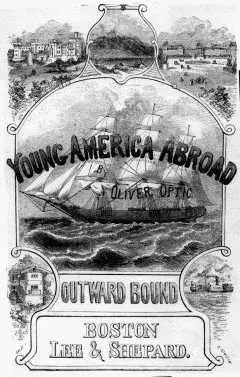
"Outward Bound; Or, Young America Afloat: A Story of Travel and Adventure" by William T. Adams (Oliver Optic) is a novel written in the late 19th century. This engaging adventure takes readers on a journey with the juvenile crew of the Academy Ship "Young America" as they prepare for life at sea, focusing on themes of discipline, education, and the mischief of youth. The story introduces several key characters, including Robert Shuffles, the impulsive instigator, and Harry Martyn, who works to uphold discipline among his fellow classmates. The opening of the narrative introduces readers to Robert Shuffles and Isaac Monroe, two boarding students from Brockway Academy engaging in a petty theft of peaches from a local garden. This act of rebellion sets up a backdrop where discipline is a pressing issue at the academy, leading to the suggestion of reformatory education aboard a ship. Mr. Lowington, the academy's principal, reflects on his own troubled youth while preparing to turn the ship into an institution for moral and educational development. With the main boys gathered on board, anticipation builds for their eventual adventures, academic pursuits, and the lessons—both harsh and humorous—they will learn while sailing the open seas.
Introduction adapted from the source catalogue; source summaries may be automatically generated.
Free to read · English · 79,888 words · No account needed
MAKE TIME FOR A GOOD BOOK
On by default. Untick to stop anonymous reading totals. Each page counts after 10 seconds in view. How this works.
Anonymous counting is on unless you have switched it off.
"I am sorry Shuffles is not an officer now, for he was one of the best we had for such service," added the captain.
"Shuffles is out of the question," replied Mr. Lowington.
"Mr. Haven, then, in the gig."
"The sea is very heavy, and the boats must be handled with skill and
prudence."
"The crews have been practised in heavy seas, though in nothing like
this."
The barge and the gig--called so by courtesy--were the two largest boats belonging to the ship, and pulled eight oars each. They were light and strong, and had been built with especial reference to the use for which they were intended. They were life-boats, and before the ship sailed, they had been rigged with life-lines and floats. If they were upset in a heavy sea, the crews could save themselves by clinging to the rope, buoyed up by the floats.
The Young America stood up towards the wreck, intending to pass under her stern as near as it was prudent to lay, the head of the dismasted ship being to the north-west.
"Boatswain, pipe all hands to muster," said the captain, prompted by Mr. Lowington, as the ship approached the wreck.
"All hands on deck, ahoy!" shouted the boatswain, piping the call.
The first lieutenant took the trumpet from the officer of the deck, and the crew, all of whom were on deck when the call was sounded, sprang to their muster stations.
"All hands, take in courses," said the executive officer; and those who were stationed at the tacks and sheets, clew-garnets and buntlines, prepared to do their duty when the boatswain piped the call.
"Man the fore and main clew-garnets and buntlines!" shouted the first lieutenant. "Stand by tacks and sheets!"
The fore and main sail, being the lowest square sails, are called the courses. There is no corresponding sail on the mizzenmast. The ropes by which the lower corners of these sails are hauled up for furling are the clew-garnets--the same that are designated clewlines on the topsails.
The tacks and sheets are the ropes by which the courses are hauled down, and kept in place, the tack being on the windward side, and the sheet on the leeward.
"All ready, sir," reported the lieutenants forward.
"Haul taut! Let go tacks and sheets! Haul up!"
These orders being promptly obeyed, the courses were hauled up, and the ship was under topsails and top-gallant sails, jib, flying-jib, and spanker.
"Ship, ahoy!" shouted the first lieutenant through his trumpet, as the Young America rolled slowly along under the stern of the wreck.
Your reading position is saved on this browser. Take it to another device with a library code. Reading pages adapt to text, rather than matching a printed edition.
BEHIND THE BOOK
This eBook is for the use of anyone anywhere in the United States and most other parts of the world at no cost and with almost no restrictions whatsoever. You may copy it, give it away or re-use it under the terms of the Project Gutenberg License included with this eBook or online at www.gutenberg.org. If you are not located in the United States, you will have to check the laws of the country where you are located before using this eBook. Read the source licence.
The original source file, including credits and licence, is retained by this library. Request an original-format copy at no charge. Please include the book title and Project Gutenberg identifier #15920.
KEEP YOUR CURIOSITY GOING
Coulson Kernahan

Maurice Baring
Frances Wright
Cécile Tormay

Frederic Jesup Stimson

W. H. P. (William Henry Pope) Jarvis
