
Last letters from the living dead man
David Patterson (Spirit) Hatch
THE CLASSIC COLLECTION · 1901
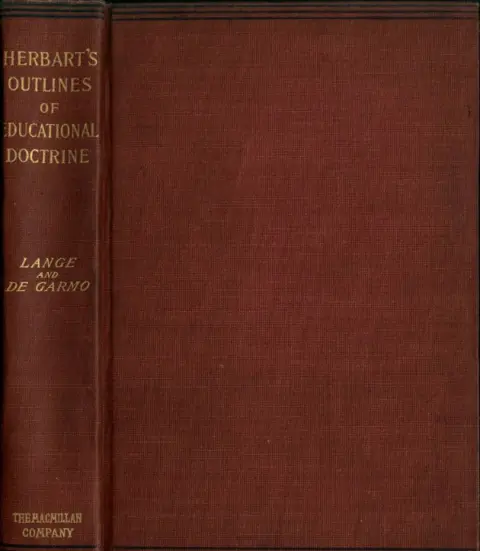
"Outlines of Educational Doctrine" by Johann Friedrich Herbart is a scientific publication written in the early 20th century. This work serves as a comprehensive examination of educational philosophy and its practical applications, focusing on the integration of ethics and psychology in pedagogy. Herbart aims to elucidate the principles guiding effective teaching and character formation, emphasizing the importance of fostering moral and intellectual growth in students. At the start of the manuscript, Herbart establishes the foundational concept of "plasticity" in pupils, positing that the ability to be molded is inherent to their educability. He discusses the relationship between ethics and psychology as the bases for pedagogical theory, arguing that educators must balance individual will and external influences in fostering moral character. Through initial explorations of virtue as the ultimate educational goal and the psychological processes underlying learning, Herbart lays the groundwork for systematic instruction aimed at cultivating a complete and socially responsible individual.
Introduction adapted from the source catalogue; source summaries may be automatically generated.
Free to read · English · 79,274 words · No account needed
MAKE TIME FOR A GOOD BOOK
On by default. Untick to stop anonymous reading totals. Each page counts after 10 seconds in view. How this works.
Anonymous counting is on unless you have switched it off.
The term educative instruction frequently occurs. It means, primarily, instruction that has, in the broad sense, an ethical bearing, or an influence upon character. It is based on the idea that, not school discipline alone, but also school instruction in the common branches should be of service to the child in moral and especially in social growth. The studies help to reveal to him his place and function in the world, they form his disposition toward men and things, they give him insight into ethical relations. Instruction that contains this element of moral training is therefore called educative instruction (Erziehender Unterricht).
101. The realia--natural history, geography, history--possess this one unquestionable advantage, viz., easy association with experience and intercourse. Partially, at least, the pupil’s spontaneous ideas (71) may go out toward them. Properly used, collections of plants, picture-books, maps, will contribute their share. In history, the fondness of youth for stories is utilized. The fact that these stories are partly taken from old books written in foreign languages, and that these languages were once actually spoken, has often to be mentioned in passing, before the study of these languages themselves is taken up, nay, even after they have been begun.
It is useless to undertake a demonstration of the utility of the realia. The young do not act for the sake of the more remote ends. Pupils work when they feel they can do something; and this consciousness of power to do must be created.
The remark that it is useless to undertake to demonstrate to the young the ultimate utility of natural science studies leads naturally to a distinction between interest in the studies as ultimate ends and as immediate ends. It is suggested in this paragraph that pupils are interested in showing their capacity to accomplish results. It is very evident that one of the teacher’s chief anxieties must be to awaken an interest in the studies as ends, not perhaps in their final utility in life, but as fields in which useful work can be done even in the immediate present. The chief category by which to measure the pupil’s interest in the various activities of the schoolroom is the quality of work that he can be taught to accomplish. One need not go far to learn that children like those studies best in which they can do the best work. This is true in several respects. They are interested in the artistic perfection of what they can accomplish, as in drawing, painting, writing, the arrangement of arithmetical problems, so that the page presents a neat appearance, and so that all the processes are plainly revealed to the eye. They are interested in reading when they can call the words with facility, with neatness, without stumbling, mispronouncing or miscalling--when the tones of the voice are agreeable. The quality of the work, however, which appeals perhaps most powerfully to the children, is that of intellectual comprehension. In the reading class it is a constant delight to discover the finer shades of meaning, to express them with the voice, to detect in others any deviation from the true thought. Reading in English is particularly susceptible to this kind of treatment. For the English language being largely devoid of inflections does not show through the form of the words the finer distinctions of thought, but the mind must perceive these from a text largely devoid of grammatical inflections. It is quite possible, therefore, to read in such a manner as to miss all but the most salient points of the matter presented. There is in reading an intensive and an extensive magnitude. Our older method of teaching reading was to devote the time to a few extracts from literary masterpieces, which were exhausted by minute study. The more recent tendency in elementary education is to neglect this side of reading and to devote the time to the cursory reading, not of extracts, but of whole masterpieces of literature. The danger of such a proceeding is that the finer qualities of reading will be neglected for the sake of quantitative mastery of a large amount of reading matter. A middle course between the two would doubtless bring better results. It would, on the one hand, secure an interest that attaches to masterpieces as wholes, and, on the other, the literary appreciation that comes from minute analysis both in thought and expression of the finer distinctions of thought. In mathematical studies, the æsthetic interest of form, or the active interest of actual performance of problems, is not the sole or even the chief interest that should be appealed to. But the pupil should feel that he is making a progressive mastery of the principles of number. It is a pleasure to apply a rule, to solve a problem neatly; but it is a still greater pleasure to comprehend thoroughly the meaning of the rule, to grasp and to feel its universality, so that although it is not worth while, as Herbart suggests, to urge the ultimate function of mathematics in the life of the world, it is quite worth while to set up those immediate ends of interest such as appear in the activity of solving problems, in the æsthetic appearance of the work upon paper or board or slate, and in the comprehension of mathematical principles. These ends are near at hand; they can be made to appeal to the pupil through the quality of the work that the teacher demands of him. The same is true in the natural sciences. Even though the ultimate function of biology is an idea too remote or too complex for the child to grasp with enthusiasm, the immediate mastery of a principle in physics, or the discovery of a law of plant life, or of a fact in chemistry, may be an end in which the pupil’s most intense interest can be excited.
Your reading position is saved on this browser. Take it to another device with a library code. Reading pages adapt to text, rather than matching a printed edition.
BEHIND THE BOOK
This eBook is for the use of anyone anywhere in the United States and most other parts of the world at no cost and with almost no restrictions whatsoever. You may copy it, give it away or re-use it under the terms of the Project Gutenberg License included with this eBook or online at www.gutenberg.org. If you are not located in the United States, you will have to check the laws of the country where you are located before using this eBook. Read the source licence.
The original source file, including credits and licence, is retained by this library. Request an original-format copy at no charge. Please include the book title and Project Gutenberg identifier #44905.
KEEP YOUR CURIOSITY GOING
David Patterson (Spirit) Hatch
Coulson Kernahan

Ralph Waldo Emerson
Frances Wright

Edwin Abbott Abbott

Joseph Droz