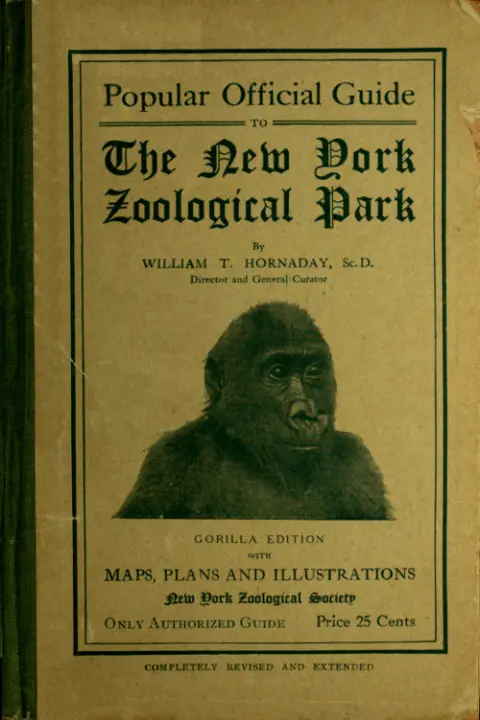
Popular Official Guide to the New York Zoological Park (September 1915) Thirteenth Edition
William T. (William Temple) Hornaday
THE CLASSIC COLLECTION · 1911
"Our Vanishing Wild Life: Its Extermination and Preservation" by William T. Hornaday is a scientific publication written in the early 20th century. The book focuses on the alarming decline of wildlife in North America, highlighting the species that have disappeared or are on the verge of extinction due to human activity. The author, a prominent conservationist and director of the New York Zoological Park, aims to raise awareness about the urgent need for wildlife protection and reform. The opening portion of the text sets a reflective tone as it emphasizes the historical abundance of wildlife now lost due to relentless hunting and habitat destruction. Hornaday discusses various species, using poignant examples such as the passenger pigeon, which once numbered in the millions yet became extinct through overhunting. He leverages historical anecdotes, legislative failures, and vivid imagery to illustrate the crisis facing wildlife. This introductory segment calls for immediate action from the public and lawmakers to protect the remaining wildlife, framing the preservation of nature as a moral obligation owed to future generations.
Introduction adapted from the source catalogue; source summaries may be automatically generated.
Free to read · English · 176,577 words · No account needed
MAKE TIME FOR A GOOD BOOK
On by default. Untick to stop anonymous reading totals. Each page counts after 10 seconds in view. How this works.
Anonymous counting is on unless you have switched it off.
Now, the twenty-one states issuing no licenses, or not reporting, produced in 1911 fully as many gunners per capita as did the other twenty-seven states. Computed fairly on existing averages they must have turned out a total of 1,155,966 gunners, making for all the United States =2,642,194= armed men and boys warring upon the remnant of game in 1911. We are not counting the large number of lawless hunters who never take out licenses. Now, is Mr. Beard's picture a truthful presentation, or not?
New York with only deer, ruffed grouse, shore-birds, ducks and a very few woodcock to shoot annually puts into the field 150,222 armed men. In 1909 they killed about 9,000 deer!
New Jersey, spending $30,000 in 1912 in efforts to restock her covers with game, and with a population of 2,537,167, sent out in 1911 a total army of 61,920 well-armed gunners. How can any of her game survive?
New Hampshire, with only 430,572 population, has 33,542 licensed hunters,--equal to thirty-three regiments of full strength!
Vermont, with 355,956 people, sends out annually an army of 31,762 men who hunt according to law; and in 1910 they killed 3,649 deer.
Utah, with only 373,351 population, had 27,800 men in the field after her very small remnant of game! How can any wild thing of Utah escape?
Montana, population 376,053, had in 1911 an army of 59,291 well-armed men, warring chiefly upon the big game, and swiftly exterminating it.
How long can any of the big game stand before the army of two and one-half million well-armed men, eager and keen to kill, and out to get an equivalent for their annual expenditure in guns, ammunition and other expenses?
In addition to the hunters themselves, they are assisted by thousands of expert guides, thousands of horses, thousands of dogs, hundreds of automobiles and hundreds of thousands of tents. Each big-game hunter has an experienced guide who knows the haunts and habits of the game, the best feeding grounds, the best trails, and everything else that will aid the hunter in taking the game at a disadvantage and destroying it. The big-game rifles are of the highest power, the longest range, the greatest accuracy and the best repeating mechanism that modern inventive genius can produce. It is said that in Wyoming the Maxim silencer is now being used. England has produced a weapon of a new type, called "the scatter rifle," which is intended for use on ducks. The best binoculars are used in searching out the game, and horses carry the hunters and guides as near as possible to the game. For bears, baits are freely used, and in the pursuit of pumas, dogs are employed to the limit of the available supply.
Your reading position is saved on this browser. Take it to another device with a library code. Reading pages adapt to text, rather than matching a printed edition.
William T. (William Temple) Hornaday
William T. (William Temple) Hornaday
William T. (William Temple) Hornaday & W. J. (William Jacob) Holland
William T. (William Temple) Hornaday
BEHIND THE BOOK
This eBook is for the use of anyone anywhere in the United States and most other parts of the world at no cost and with almost no restrictions whatsoever. You may copy it, give it away or re-use it under the terms of the Project Gutenberg License included with this eBook or online at www.gutenberg.org. If you are not located in the United States, you will have to check the laws of the country where you are located before using this eBook. Read the source licence.
The original source file, including credits and licence, is retained by this library. Request an original-format copy at no charge. Please include the book title and Project Gutenberg identifier #13249.
KEEP YOUR CURIOSITY GOING
Cécile Tormay

Moritz Busch
John L. Ransom
Frances Wright
Cécile Tormay

Mabel Potter Daggett