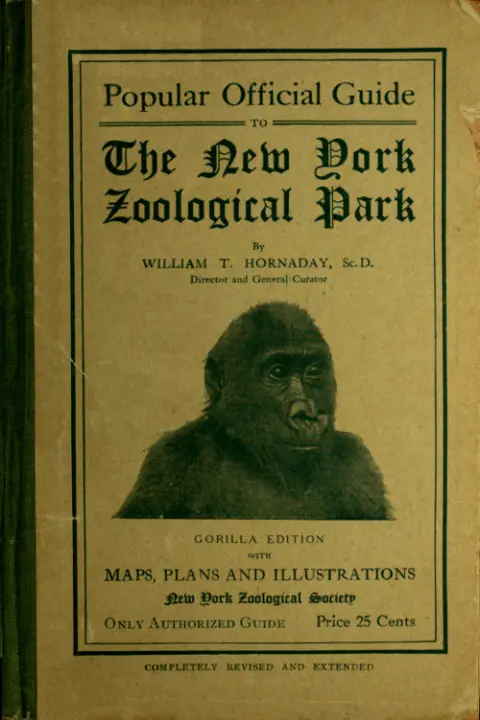
Popular Official Guide to the New York Zoological Park (September 1915) Thirteenth Edition
William T. (William Temple) Hornaday
THE CLASSIC COLLECTION · 1911
"Our Vanishing Wild Life: Its Extermination and Preservation" by William T. Hornaday is a scientific publication written in the early 20th century. The book focuses on the alarming decline of wildlife in North America, highlighting the species that have disappeared or are on the verge of extinction due to human activity. The author, a prominent conservationist and director of the New York Zoological Park, aims to raise awareness about the urgent need for wildlife protection and reform. The opening portion of the text sets a reflective tone as it emphasizes the historical abundance of wildlife now lost due to relentless hunting and habitat destruction. Hornaday discusses various species, using poignant examples such as the passenger pigeon, which once numbered in the millions yet became extinct through overhunting. He leverages historical anecdotes, legislative failures, and vivid imagery to illustrate the crisis facing wildlife. This introductory segment calls for immediate action from the public and lawmakers to protect the remaining wildlife, framing the preservation of nature as a moral obligation owed to future generations.
Introduction adapted from the source catalogue; source summaries may be automatically generated.
Free to read · English · 176,577 words · No account needed
MAKE TIME FOR A GOOD BOOK
On by default. Untick to stop anonymous reading totals. Each page counts after 10 seconds in view. How this works.
Anonymous counting is on unless you have switched it off.
Swan, white heron, bronze ibis. California valley quail are getting very scarce, and unless adequate protection is afforded them shortly, they will be found hereafter only in remote districts. Ducks also are decreasing rapidly.--(H.W. Keller, Los Angeles.)
Sage grouse and Columbian sharp-tailed grouse are so nearly extinct that it may practically be said that they are extinct. Among species likely to be exterminated in the near future are the wood-duck and band-tailed pigeon.--(W.P. Taylor, Berkeley.)
Sage grouse and sharp-tailed grouse; nearly all the shore birds.
All the shore birds; quail, purple martin.
Wood duck, upland plover, least tern, Wilson tern, roseate tern, black skimmer, oystercatcher, and numerous other littoral species. Pileated woodpeckers, bald eagles and all the ducks are much more rare than formerly. Swan are about gone, geese scarce. The list of ducks, geese and shore-birds, as well as of terns and gulls that are nearing extinction is appalling.--(C.J. Pennock, Wilmington.)
Wood-duck, woodcock, turtle dove and bob-white.--(A.R. Spaid,
Wilmington.)
Limpkin, ivory-billed woodpecker, wild turkey (?).
Ruffed grouse, wild turkey.
Harlequin duck, mountain plover, dusky grouse, Columbian sharp-tailed grouse, sage grouse. Elk, goats and grizzly bears are becoming very scarce. Of the smaller animals I have not seen a fisher for years, and marten are hardly to be found. The same is true of other species.--(Dr. Charles S. Moody, Sand Point.)
Pinnated grouse, except where rigidly protected. In Vermillion County, by long and persistent protection Harvey J. Sconce has bred back upon his farm about 400 of these birds.
Pileated woodpecker, woodcock, ruffed grouse, pigeon hawk, duck hawk.--(Amos W. Butler, Indianapolis.)
In northern and northwestern Indiana, a perpetual close season and rigid protection have enabled the almost-extinct pinnated grouse to breed up to a total number now estimated by Game Commissioner Miles and his wardens at 10,000 birds. This is a gratifying illustration of what can be done in bringing back an almost-vanished species. The good example of Indiana should be followed by every state that still possesses a remnant of prairie-chickens, or other grouse.
Pinnated grouse, wood-duck. Notwithstanding an invasion of Jasper County, Iowa, in the winter of 1911-12 by hundreds of pinnated grouse, such as had not been known in 20 years, this gives no ground to hope that the future of the species is worth a moment's purchase. The winter migration came from the Dakotas, and was believed to be due to the extra severe winter, and the scarcity of food. Commenting on this unprecedented occurrence, J.L. Sloanaker in the "Wilson Bulletin" No. 78, says:
Your reading position is saved on this browser. Take it to another device with a library code. Reading pages adapt to text, rather than matching a printed edition.
William T. (William Temple) Hornaday
William T. (William Temple) Hornaday
William T. (William Temple) Hornaday & W. J. (William Jacob) Holland
William T. (William Temple) Hornaday
BEHIND THE BOOK
This eBook is for the use of anyone anywhere in the United States and most other parts of the world at no cost and with almost no restrictions whatsoever. You may copy it, give it away or re-use it under the terms of the Project Gutenberg License included with this eBook or online at www.gutenberg.org. If you are not located in the United States, you will have to check the laws of the country where you are located before using this eBook. Read the source licence.
The original source file, including credits and licence, is retained by this library. Request an original-format copy at no charge. Please include the book title and Project Gutenberg identifier #13249.
KEEP YOUR CURIOSITY GOING
Cécile Tormay

Moritz Busch
John L. Ransom
Frances Wright
Cécile Tormay

Mabel Potter Daggett