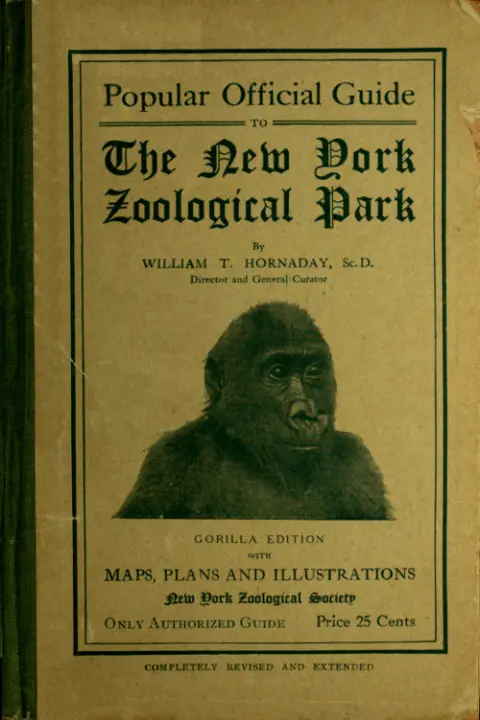
Popular Official Guide to the New York Zoological Park (September 1915) Thirteenth Edition
William T. (William Temple) Hornaday
THE CLASSIC COLLECTION · 1911
"Our Vanishing Wild Life: Its Extermination and Preservation" by William T. Hornaday is a scientific publication written in the early 20th century. The book focuses on the alarming decline of wildlife in North America, highlighting the species that have disappeared or are on the verge of extinction due to human activity. The author, a prominent conservationist and director of the New York Zoological Park, aims to raise awareness about the urgent need for wildlife protection and reform. The opening portion of the text sets a reflective tone as it emphasizes the historical abundance of wildlife now lost due to relentless hunting and habitat destruction. Hornaday discusses various species, using poignant examples such as the passenger pigeon, which once numbered in the millions yet became extinct through overhunting. He leverages historical anecdotes, legislative failures, and vivid imagery to illustrate the crisis facing wildlife. This introductory segment calls for immediate action from the public and lawmakers to protect the remaining wildlife, framing the preservation of nature as a moral obligation owed to future generations.
Introduction adapted from the source catalogue; source summaries may be automatically generated.
Free to read · English · 176,577 words · No account needed
MAKE TIME FOR A GOOD BOOK
On by default. Untick to stop anonymous reading totals. Each page counts after 10 seconds in view. How this works.
Anonymous counting is on unless you have switched it off.
Pigeon, wild turkey, pinnated grouse, northern pileated woodpecker, parrakeet; white-tailed deer, bison, elk, black bear, puma, gray wolf, beaver, otter, puma, lynx.
Records for birds insufficient. Mammals: bison, elk, antelope, mule
deer, puma, black bear.
The only species known to have been wholly exterminated during recent times is the California condor and the bison, both of which were rare stragglers into Oregon; but a number of species are now close to extinction.
Heath hen, pigeon, parrakeet, Labrador duck; bison, elk, moose, puma, gray wolf, Canada lynx, wolverine, beaver.--(Witmer Stone, Dr. C.B. Penrose and Arthur Chapman.)
Heath hen, passenger pigeon, wild turkey, least tern, eastern willet, Eskimo curlew, marbled godwit, long-billed curlew.--(Harry S. Hathaway); puma, black bear, gray wolf, beaver, otter, wolverine.
Ivory-billed woodpecker, Carolina parrakeet; bison, elk, puma, gray
wolf.--(James H. Rice, Jr.)
Whooping crane, trumpeter swan, pigeon, long-billed curlew; bison, elk, mule deer, mountain sheep.
Records insufficient.
Wild turkey, passenger pigeon, ivory-billed woodpecker, flamingo, roseate spoonbill, American egret, whooping crane, wood-duck; bison, elk, mountain sheep, antelope, "a small, dark deer that lived 40 years ago." (Capt. M.B. Davis.)
Records insufficient.
Records insufficient.
Very few species have become totally extinct, but a number are on the verge, and will be named in the next state schedule.
Pigeon, parrakeet; bison, elk, beaver, puma, gray wolf.
Whooping crane, passenger pigeon, American egret, wild turkey, Carolina parrakeet; bison, moose, elk, woodland caribou, puma, wolverine.
Whooping crane, trumpeter swan, wood-duck; mountain goat.
Passenger pigeon, whooping crane; bison.
A. Bryan Williams reports: "Do not know of any birds having become
extinct."
Pigeon; bison, antelope, gray wolf.
Pigeon.
Labrador duck, Eskimo curlew, passenger pigeon.
Wild turkey, pigeon, Eskimo curlew.
(Reported by E.T. Carbonell): Eskimo curlew, horned grebe, ring-billed gull, Caspian tern, passenger pigeon, Wilson's petrel, wood-duck, Barrow's golden-eye, whistling swan, American eider, white-fronted goose, purple sandpiper, Canada grouse, long-eared owl, screech owl, black-throated bunting, pine warbler, red-necked grebe, purple martin and catbird; beaver, black fox, silver gray fox, marten and black bear.
Pigeon.
Pigeon; bison.
The second question submitted in my inquiry produced results even more startling than the first. None of the persons reporting can be regarded as alarmists, but some of the lists of species approaching extinction are appallingly long. To their observations I add other notes and observations of interest at this time.
Your reading position is saved on this browser. Take it to another device with a library code. Reading pages adapt to text, rather than matching a printed edition.
William T. (William Temple) Hornaday
William T. (William Temple) Hornaday
William T. (William Temple) Hornaday & W. J. (William Jacob) Holland
William T. (William Temple) Hornaday
BEHIND THE BOOK
This eBook is for the use of anyone anywhere in the United States and most other parts of the world at no cost and with almost no restrictions whatsoever. You may copy it, give it away or re-use it under the terms of the Project Gutenberg License included with this eBook or online at www.gutenberg.org. If you are not located in the United States, you will have to check the laws of the country where you are located before using this eBook. Read the source licence.
The original source file, including credits and licence, is retained by this library. Request an original-format copy at no charge. Please include the book title and Project Gutenberg identifier #13249.
KEEP YOUR CURIOSITY GOING
Cécile Tormay

Moritz Busch
John L. Ransom
Frances Wright
Cécile Tormay

Mabel Potter Daggett