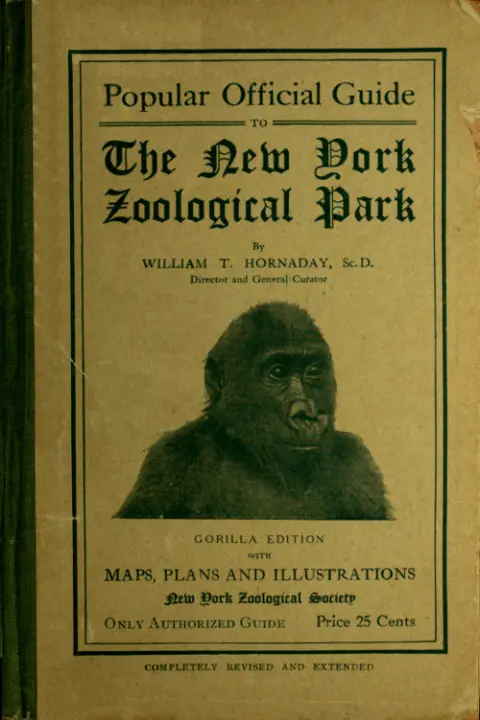
Popular Official Guide to the New York Zoological Park (September 1915) Thirteenth Edition
William T. (William Temple) Hornaday
THE CLASSIC COLLECTION · 1911
"Our Vanishing Wild Life: Its Extermination and Preservation" by William T. Hornaday is a scientific publication written in the early 20th century. The book focuses on the alarming decline of wildlife in North America, highlighting the species that have disappeared or are on the verge of extinction due to human activity. The author, a prominent conservationist and director of the New York Zoological Park, aims to raise awareness about the urgent need for wildlife protection and reform. The opening portion of the text sets a reflective tone as it emphasizes the historical abundance of wildlife now lost due to relentless hunting and habitat destruction. Hornaday discusses various species, using poignant examples such as the passenger pigeon, which once numbered in the millions yet became extinct through overhunting. He leverages historical anecdotes, legislative failures, and vivid imagery to illustrate the crisis facing wildlife. This introductory segment calls for immediate action from the public and lawmakers to protect the remaining wildlife, framing the preservation of nature as a moral obligation owed to future generations.
Introduction adapted from the source catalogue; source summaries may be automatically generated.
Free to read · English · 176,577 words · No account needed
MAKE TIME FOR A GOOD BOOK
On by default. Untick to stop anonymous reading totals. Each page counts after 10 seconds in view. How this works.
Anonymous counting is on unless you have switched it off.
These reservations are of immense value to bird life, and their creation represents the highest possible wisdom in utilizing otherwise valueless portions of the national domain. Dr. Palmer's alphabetical list of them is as follows, numbered in the order of their creation:
Belle Fourche, S. Dak. 34
Bering Sea, Alaska 44
Bogoslof, Alaska 51
Breton Island, La. 2
Bumping Lake, Wash. 39
Carlsbad, N. Mex. 31
Chase Lake, N. Dak. 20
Clealum, Wash. 38
Clear Lake, Cal. 52
Cold Springs, Oreg. 33
Conconully, Wash. 40
Copalis Rock, Wash. 13
Culebra, P. R. 48
Deer Flat, Idaho 29
East Park, Cal. 28
East Timhalier, La. 14
Farailon, Cal. 49
Flattery Rocks, Wash. 11
Forrester Island, Alaska 53
Green Bay, Wis. 56
Hawaiian Is., Hawaii 26
Hazy Islands, Alaska 54
Huron Islands, Mich. 4
Indian Key, Fla. 7
Island Bay, Fla. 24
Kachess, Wash. 37
Kecchelus, Wash. 36
Key West, Fla. 17
Klamath Lake, Oreg. 18
Loch-Katrine, Wyo. 25
Malheur Lake, Oreg. 19
Matlacha Pass, Fla. 23
Minidoka, Idaho 43
Mosquito Inlet, Fla. 15
Niobrara, Nebr. 55
Palma Sola, Fla. 22
Passage Key, Fla. 6
Pathfinder, Wyo. 41
Pelican Island, Fla. 1
Pine Island, Fla. 21
Pribilof, Alaska 50
Quillayute N'dles, Alaska 12
Rio Grande, N. Mex. 32
St. Lazaria, Alaska 46
Salt River, Ariz. 27
Shell Keys, La. 9
Shoshone, Wyo. 42
Siskiwit, Mich. 5
Strawberry Valley, Utah 35
Stump Lake, N. Dak. 3
Tern Islands, La. 8
Three Arch Rocks, Oreg. 10
Tortugas Keys, Fla. 16
Tuxedni, Alaska 45
Willow Creek, Mont. 30
Yukon Delta, Alaska 47
In addition to the above, the following governmental reservations have been established for the protection of wild life: Yes Bay, Alaska, of 35,200 acres; Afognak Island, Alaska, 800 sq. miles; Midway Islands Naval Reservation, H.T.; Farallon Island, Point Reyes and Ano Nuevo Island, California; Destruction Island, Washington, and Hawaiian Islands Reservation (Laysan).
PENNSYLVANIA.--The proposition that every state, territory and province in North America and everywhere else, should establish a series of state forest and game preserves, is fairly incontestable. As a business proposition it is to-day no more a debatable question, or open to argument, than is the water supply or sewer system of a city. The only perfect way to conserve a water supply for a great human population is by acquiring title to water sheds, and either protecting the forests upon them, or planting forests in case none exist.
Your reading position is saved on this browser. Take it to another device with a library code. Reading pages adapt to text, rather than matching a printed edition.
William T. (William Temple) Hornaday
William T. (William Temple) Hornaday
William T. (William Temple) Hornaday & W. J. (William Jacob) Holland
William T. (William Temple) Hornaday
BEHIND THE BOOK
This eBook is for the use of anyone anywhere in the United States and most other parts of the world at no cost and with almost no restrictions whatsoever. You may copy it, give it away or re-use it under the terms of the Project Gutenberg License included with this eBook or online at www.gutenberg.org. If you are not located in the United States, you will have to check the laws of the country where you are located before using this eBook. Read the source licence.
The original source file, including credits and licence, is retained by this library. Request an original-format copy at no charge. Please include the book title and Project Gutenberg identifier #13249.
KEEP YOUR CURIOSITY GOING
Cécile Tormay

Moritz Busch
John L. Ransom
Frances Wright
Cécile Tormay

Mabel Potter Daggett