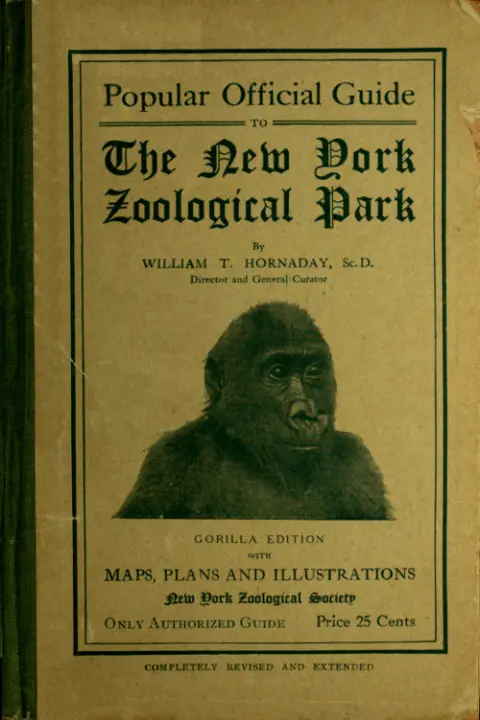
Popular Official Guide to the New York Zoological Park (September 1915) Thirteenth Edition
William T. (William Temple) Hornaday
THE CLASSIC COLLECTION · 1911
"Our Vanishing Wild Life: Its Extermination and Preservation" by William T. Hornaday is a scientific publication written in the early 20th century. The book focuses on the alarming decline of wildlife in North America, highlighting the species that have disappeared or are on the verge of extinction due to human activity. The author, a prominent conservationist and director of the New York Zoological Park, aims to raise awareness about the urgent need for wildlife protection and reform. The opening portion of the text sets a reflective tone as it emphasizes the historical abundance of wildlife now lost due to relentless hunting and habitat destruction. Hornaday discusses various species, using poignant examples such as the passenger pigeon, which once numbered in the millions yet became extinct through overhunting. He leverages historical anecdotes, legislative failures, and vivid imagery to illustrate the crisis facing wildlife. This introductory segment calls for immediate action from the public and lawmakers to protect the remaining wildlife, framing the preservation of nature as a moral obligation owed to future generations.
Introduction adapted from the source catalogue; source summaries may be automatically generated.
Free to read · English · 176,577 words · No account needed
MAKE TIME FOR A GOOD BOOK
On by default. Untick to stop anonymous reading totals. Each page counts after 10 seconds in view. How this works.
Anonymous counting is on unless you have switched it off.
The millions of the insect world are upon us. Their cost to us has been summed up by Mr. Marlatt in the table that appears below.
Official Report in the Yearbook of the Department of Agriculture,
1904.
Cereals $2,000,000,000 10 $200,000,000 Hay 530,000,000 10 53,000,000 Cotton 600,000,000 10 60,000,000 Tobacco 53,000,000 10 5,300,000 Truck Crops 265,000,000 20 53,000,000 Sugars 50,000,000 10 5,000,000 Fruits 135,000,000 20 27,000,000 Farm Forests 110,000,000 10 11,000,000 Miscellaneous Crops 58,000,000 10 5,800,000
Total $3,801,000,000 $420,100,000
Animal Products 1,750,000,000 10 175,000,000 Natural Forests and 100,000,000 Forest Products Products in Storage 100,000,000
The millions of the insect world are upon us. The birds fight them for us, and when the birds are numerous and have nestlings to feed, the number of insects they consume is enormous. They require absolutely nothing at our hands save the privilege of being let alone while they work for us! In fighting the insects, our only allies in nature are the songbirds, woodpeckers, shore-birds, swallows and martins, certain hawks, moles, shrews, bats, and a few other living creatures. All these wage war at their own expense. The farmers might just as well lose $8,250,000 through a short apple crop as to pay out that sum in labor and materials in spraying operations. And yet, fools that we are, we go on slaughtering our friends, and allowing others to slaughter them, under the same brand of fatuous folly that leads the people of Italy to build anew on the smoking sides of Vesuvius, after a dozen generations have been swept away by fire and ashes.
In the next chapter we will consider the work of our friends, The Birds.
Your reading position is saved on this browser. Take it to another device with a library code. Reading pages adapt to text, rather than matching a printed edition.
William T. (William Temple) Hornaday
William T. (William Temple) Hornaday
William T. (William Temple) Hornaday & W. J. (William Jacob) Holland
William T. (William Temple) Hornaday
BEHIND THE BOOK
This eBook is for the use of anyone anywhere in the United States and most other parts of the world at no cost and with almost no restrictions whatsoever. You may copy it, give it away or re-use it under the terms of the Project Gutenberg License included with this eBook or online at www.gutenberg.org. If you are not located in the United States, you will have to check the laws of the country where you are located before using this eBook. Read the source licence.
The original source file, including credits and licence, is retained by this library. Request an original-format copy at no charge. Please include the book title and Project Gutenberg identifier #13249.
KEEP YOUR CURIOSITY GOING
Cécile Tormay

Moritz Busch
John L. Ransom
Frances Wright
Cécile Tormay

Mabel Potter Daggett