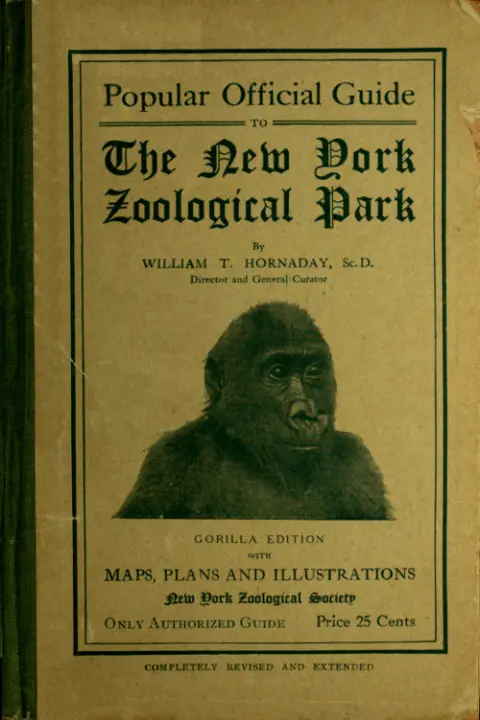
Popular Official Guide to the New York Zoological Park (September 1915) Thirteenth Edition
William T. (William Temple) Hornaday
THE CLASSIC COLLECTION · 1911
"Our Vanishing Wild Life: Its Extermination and Preservation" by William T. Hornaday is a scientific publication written in the early 20th century. The book focuses on the alarming decline of wildlife in North America, highlighting the species that have disappeared or are on the verge of extinction due to human activity. The author, a prominent conservationist and director of the New York Zoological Park, aims to raise awareness about the urgent need for wildlife protection and reform. The opening portion of the text sets a reflective tone as it emphasizes the historical abundance of wildlife now lost due to relentless hunting and habitat destruction. Hornaday discusses various species, using poignant examples such as the passenger pigeon, which once numbered in the millions yet became extinct through overhunting. He leverages historical anecdotes, legislative failures, and vivid imagery to illustrate the crisis facing wildlife. This introductory segment calls for immediate action from the public and lawmakers to protect the remaining wildlife, framing the preservation of nature as a moral obligation owed to future generations.
Introduction adapted from the source catalogue; source summaries may be automatically generated.
Free to read · English · 176,577 words · No account needed
MAKE TIME FOR A GOOD BOOK
On by default. Untick to stop anonymous reading totals. Each page counts after 10 seconds in view. How this works.
Anonymous counting is on unless you have switched it off.
Now that the best remaining game districts of Africa are rapidly coming under British control, it is a satisfaction to observe that the governing bodies and executive officers are alive to the necessity of preserving the big game from actual extinction. Excepting German East Africa, from Uganda to Cape Colony the game preserves form an almost continuous chain. It is quite impossible to enumerate all of them; but the two in British East Africa are of enormous size, and are well stocked with game. South Africa contains a great many smaller preserves and a few specimen herds of big game, but that is about all. Except in a few localities the hunting of big game in that region is done forever.
The Western Districts Game and Trout Protective Association of South Africa recently, (1911), has made careful counts and estimates of the number of individual game animals remaining in Cape Colony, with the following result:
From information kindly placed at the disposal of the Association by the Government, it was found that the following varieties of big game are still found in the Province. The numbers, however, are only approximate:
Blesbok: About 400 in Steynsburg, and 35 in Queen's Town divisions.
Bontebok: About 30 in Bredasdorp and 45 in Swellendam divisions.
Buffalo: About 340 in Uitenhage, 120 in Alexandria, and 75 in Bathurst
divisions.
Elephants: About 130 in Alexandria, 160 in Uitenhage, 40 in Bathurst, and 20 in Knysna divisions.
Gemsbok: About 2,450 in Namaqualand, 4,500 in Vryburg, 4,000 in Gordonia, and 670 in the Kenhardt, Mafeking and Barkly West divisions.
Koodoo: About 10,000, found chiefly in the divisions of Albany, Barkly West, Fort Beaufort, Hay, Herbert, Jansenville, Kuruman, Ladismith, Mafeking, Mossel Bay, Oudtshoorn, Riversdale, Steytlerville, Uitenhage, Victoria East and Vryburg.
Oribi: About 120, in the divisions of Albany and Alexandria.
Rietbok: About 170, in the Komgha division.
Zebra: About 560, most of which are to be found in the divisions of Cradock, George and Oudtshoorn. A few are to be found in the divisions of Uniondale and Uitenhage.
Springbok: Being migratory, it is difficult to estimate their number. In some years they are compelled by drought to invade the Province in large numbers. They are then seen as far south as Calvinia and Fraserburg. Large numbers are, however, fenced in on private estates in various parts of the Province.
Klipspringers: About 11,200, in the following divisions, viz.: Namaqualand, 6,559; Kuruman, 2,100; Steytlerville, 1,530; Oudtshoorn, 275; Hay, 250; Ladismith, 220; Graaff-Reinet, 119; Kenhardt, 66; and Cradock, 56.
Hartebeest: About 9,700, principally in the divisions of Vryburg, Gordonia, Kuruman, Mafeking, Kimberley, Hay and Beaufort West.
Wildebeest: About 3,450 in Vryburg, 80 each in Gordonia and Kuruman, 65 in Mafeking, 20 in Queen's Town, and a few in the Bredasdorp divisions.
Eland: About 12 in the Graaff-Reinet division, privately bred.
Your reading position is saved on this browser. Take it to another device with a library code. Reading pages adapt to text, rather than matching a printed edition.
William T. (William Temple) Hornaday
William T. (William Temple) Hornaday
William T. (William Temple) Hornaday & W. J. (William Jacob) Holland
William T. (William Temple) Hornaday
BEHIND THE BOOK
This eBook is for the use of anyone anywhere in the United States and most other parts of the world at no cost and with almost no restrictions whatsoever. You may copy it, give it away or re-use it under the terms of the Project Gutenberg License included with this eBook or online at www.gutenberg.org. If you are not located in the United States, you will have to check the laws of the country where you are located before using this eBook. Read the source licence.
The original source file, including credits and licence, is retained by this library. Request an original-format copy at no charge. Please include the book title and Project Gutenberg identifier #13249.
KEEP YOUR CURIOSITY GOING
Cécile Tormay

Moritz Busch
John L. Ransom
Frances Wright
Cécile Tormay

Mabel Potter Daggett