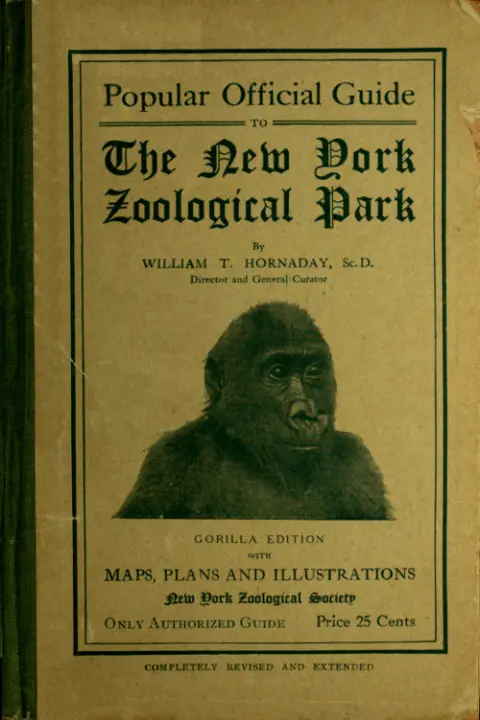
Popular Official Guide to the New York Zoological Park (September 1915) Thirteenth Edition
William T. (William Temple) Hornaday
THE CLASSIC COLLECTION · 1911
"Our Vanishing Wild Life: Its Extermination and Preservation" by William T. Hornaday is a scientific publication written in the early 20th century. The book focuses on the alarming decline of wildlife in North America, highlighting the species that have disappeared or are on the verge of extinction due to human activity. The author, a prominent conservationist and director of the New York Zoological Park, aims to raise awareness about the urgent need for wildlife protection and reform. The opening portion of the text sets a reflective tone as it emphasizes the historical abundance of wildlife now lost due to relentless hunting and habitat destruction. Hornaday discusses various species, using poignant examples such as the passenger pigeon, which once numbered in the millions yet became extinct through overhunting. He leverages historical anecdotes, legislative failures, and vivid imagery to illustrate the crisis facing wildlife. This introductory segment calls for immediate action from the public and lawmakers to protect the remaining wildlife, framing the preservation of nature as a moral obligation owed to future generations.
Introduction adapted from the source catalogue; source summaries may be automatically generated.
Free to read · English · 176,577 words · No account needed
MAKE TIME FOR A GOOD BOOK
On by default. Untick to stop anonymous reading totals. Each page counts after 10 seconds in view. How this works.
Anonymous counting is on unless you have switched it off.
By 1912, those deer had increased to 400, and the portion of this story that no one will believe is this: they spread all through the suburbs and hinterland farms of Avoca, and the people not only failed to assassinate all of them and eat them, but they actually killed only a few, protected the rest, and made pets of many! Queer people, those men and boys of Avoca. Nearly everywhere else in the world that I know, that history would have been ended differently. Here in the East, 90 per cent of our people are like the Avocans, but the other 10 per cent think only of slaying and eating, sans mercy, sans decency, sans law. Now the State of Iowa has taken hold, to capture some of those deer, and set them free in other portions of the state.
Elsewhere I shall note the quick and thorough success with which the white-tailed deer has been brought back in Vermont, Massachusetts, Connecticut, and southern New York.
No state having waste lands covered with brush or timber need be without the ubiquitous white-tailed deer. Give them a semblance of a fair show, and they will live and breed with surprising fecundity and persistence. If you start a park herd with ten does, soon you will have more deer than you will know how to dispose of, unless you market them under a Bayne law, duly tagged by the state. In close confinement this species fares rather poorly. In large preserves it does well, but during the rutting season the bucks are to be dreaded; and those that develop aggressive traits should be shot and marketed. This is the only way in which the deer parks of England are kept safe for unarmed people.
Dr. T.S. Palmer has taken much pains to ascertain the number of deer killed in the eastern United States. His records, as published in May, 1910, are as follows:
STATE 1908 1909 1910
Maine 15,000 15,879 15,000
New Hampshire (a) (a) (a)
Vermont 2,700 4,736 3,649
New York 6,000 9,000 9,000
New Jersey (a) 120
Pennsylvania 500 500 800
Michigan 9,076 6,641 13,347
Wisconsin 11,000 6,000 6,000
Minnesota 6,000 6,000 3,147
West Virginia 107 51 49
Maryland 16 13 6
Virginia 207 210 224
North Carolina (a) (a) (a)
South Carolina 1,000 (a) (a)
Georgia (a) 367 369
Florida 2,209 2,021 1,526
Alabama 152 148 132
Mississippi 411 458 500
Louisiana 5,500 5,470 5,000
Massachusetts 1,281
------ ------ ------
Total 59,878 57,494 60,150
(a) No statistics available.
At this date deer hunting is not permitted at any time in Indiana, Illinois, Iowa, Nebraska and Kansas,--where there are no wild deer; nor in Rhode Island, Connecticut, Delaware, Tennessee or Kentucky. The long close seasons in Massachusetts, Connecticut and southern New York have caused a great migration of deer into those once-depopulated regions,--in fact, right down to tide-water.
Your reading position is saved on this browser. Take it to another device with a library code. Reading pages adapt to text, rather than matching a printed edition.
William T. (William Temple) Hornaday
William T. (William Temple) Hornaday
William T. (William Temple) Hornaday & W. J. (William Jacob) Holland
William T. (William Temple) Hornaday
BEHIND THE BOOK
This eBook is for the use of anyone anywhere in the United States and most other parts of the world at no cost and with almost no restrictions whatsoever. You may copy it, give it away or re-use it under the terms of the Project Gutenberg License included with this eBook or online at www.gutenberg.org. If you are not located in the United States, you will have to check the laws of the country where you are located before using this eBook. Read the source licence.
The original source file, including credits and licence, is retained by this library. Request an original-format copy at no charge. Please include the book title and Project Gutenberg identifier #13249.
KEEP YOUR CURIOSITY GOING
Cécile Tormay

Moritz Busch
John L. Ransom
Frances Wright
Cécile Tormay

Mabel Potter Daggett