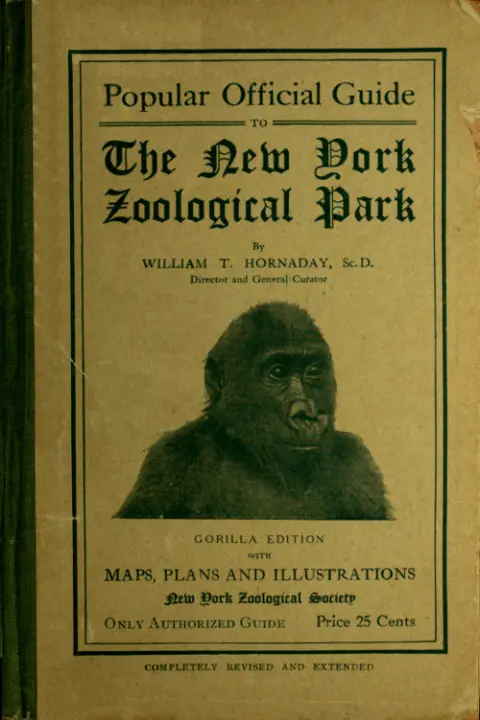
Popular Official Guide to the New York Zoological Park (September 1915) Thirteenth Edition
William T. (William Temple) Hornaday
THE CLASSIC COLLECTION · 1911
"Our Vanishing Wild Life: Its Extermination and Preservation" by William T. Hornaday is a scientific publication written in the early 20th century. The book focuses on the alarming decline of wildlife in North America, highlighting the species that have disappeared or are on the verge of extinction due to human activity. The author, a prominent conservationist and director of the New York Zoological Park, aims to raise awareness about the urgent need for wildlife protection and reform. The opening portion of the text sets a reflective tone as it emphasizes the historical abundance of wildlife now lost due to relentless hunting and habitat destruction. Hornaday discusses various species, using poignant examples such as the passenger pigeon, which once numbered in the millions yet became extinct through overhunting. He leverages historical anecdotes, legislative failures, and vivid imagery to illustrate the crisis facing wildlife. This introductory segment calls for immediate action from the public and lawmakers to protect the remaining wildlife, framing the preservation of nature as a moral obligation owed to future generations.
Introduction adapted from the source catalogue; source summaries may be automatically generated.
Free to read · English · 176,577 words · No account needed
MAKE TIME FOR A GOOD BOOK
On by default. Untick to stop anonymous reading totals. Each page counts after 10 seconds in view. How this works.
Anonymous counting is on unless you have switched it off.
I am tempted to try to map out roughly what are to-day the unopened and undestroyed wild haunts of big game in North America. In doing this, however, I warn the reader not to be deceived into thinking that because game still exists in those regions, those areas therefore constitute a permanent preserve and safe breeding-ground for large mammals. That is very, very far from being the case. The further "opening up" of the wilderness areas, as I shall call them for convenience, can and surely will quickly wipe out their big game; for throughout nine-tenths of those areas it holds to life by very slender threads.
To-day the unopened and undestroyed wilderness areas of North America, wherein large mammals still live in a normal wild state, are in general as follows:
THE ARCTIC BARREN GROUNDS, or Arctic Prairies, north of the limit of trees, embracing the Barren Grounds of northern Canada, the great arctic archipelago, Ellesmere, Melville and Grant Lands and Greenland. This region is the home of the musk-ox and three species of arctic caribou.
THE ALASKA-YUKON REGION, inhabited by the moose, white mountain sheep, mountain goat, four species of caribou, and half a dozen species of Alaska brown, grizzly and black bears.
NORTHERN ONTARIO, QUEBEC, LABRADOR AND NEWFOUNDLAND, inhabited by moose, woodland caribou, white-tailed deer and black bear.
BRITISH COLUMBIA, inhabited by a magnificent big-game fauna embracing the moose, elk, caribou of two species, white sheep, black sheep, big-horn sheep, mule deer, white-tailed deer, mountain goat, grizzly, black and inland white bears.
THE SIERRA MADRE OF MEXICO, containing jaguar, puma, grizzly and black bears, mule deer, white-tailed deer, antelope, mountain sheep and peccaries.
I have necessarily omitted all those regions of the United States and Canada that still contain a remnant of big game, but have been literally "shot to pieces" by gunners.
In the United States and southern Canada there are about fifteen localities which contain a supply of big game sufficient that a conscientious sportsman might therein hunt and kill one head per year with a clear conscience. All others should be closed for five years! Here is the list of availables; and regarding it there will be about as many opinions as there are big-game sportsmen:
HUNTING GROUNDS IN AND NEAR THE UNITED STATES AND SOUTHERN CANADA WHEREIN IT IS RIGHT TO HUNT BIG GAME
THE MAINE WOODS: Well stocked with white-tailed deer.
NEW BRUNSWICK: Well stocked with moose; a few caribou, deer and black
bear.
WHITE MOUNTAINS OF NEW HAMPSHIRE AND VERMONT: For deer.
THE ADIRONDACKS, NEW YORK: Well stocked with white-tailed deer, only.
PENNSYLVANIA MOUNTAINS: Contain many deer and black bears, and soon will
contain more.
NORTHERN MINNESOTA: Deer and moose.
Your reading position is saved on this browser. Take it to another device with a library code. Reading pages adapt to text, rather than matching a printed edition.
William T. (William Temple) Hornaday
William T. (William Temple) Hornaday
William T. (William Temple) Hornaday & W. J. (William Jacob) Holland
William T. (William Temple) Hornaday
BEHIND THE BOOK
This eBook is for the use of anyone anywhere in the United States and most other parts of the world at no cost and with almost no restrictions whatsoever. You may copy it, give it away or re-use it under the terms of the Project Gutenberg License included with this eBook or online at www.gutenberg.org. If you are not located in the United States, you will have to check the laws of the country where you are located before using this eBook. Read the source licence.
The original source file, including credits and licence, is retained by this library. Request an original-format copy at no charge. Please include the book title and Project Gutenberg identifier #13249.
KEEP YOUR CURIOSITY GOING
Cécile Tormay

Moritz Busch
John L. Ransom
Frances Wright
Cécile Tormay

Mabel Potter Daggett