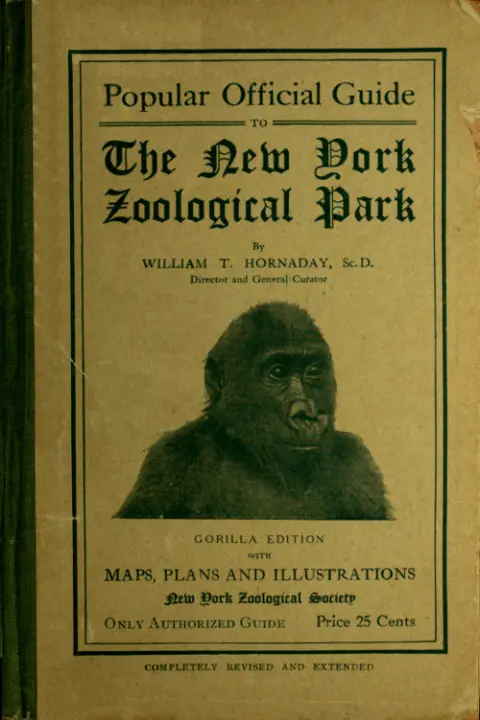
Popular Official Guide to the New York Zoological Park (September 1915) Thirteenth Edition
William T. (William Temple) Hornaday
THE CLASSIC COLLECTION · 1911
"Our Vanishing Wild Life: Its Extermination and Preservation" by William T. Hornaday is a scientific publication written in the early 20th century. The book focuses on the alarming decline of wildlife in North America, highlighting the species that have disappeared or are on the verge of extinction due to human activity. The author, a prominent conservationist and director of the New York Zoological Park, aims to raise awareness about the urgent need for wildlife protection and reform. The opening portion of the text sets a reflective tone as it emphasizes the historical abundance of wildlife now lost due to relentless hunting and habitat destruction. Hornaday discusses various species, using poignant examples such as the passenger pigeon, which once numbered in the millions yet became extinct through overhunting. He leverages historical anecdotes, legislative failures, and vivid imagery to illustrate the crisis facing wildlife. This introductory segment calls for immediate action from the public and lawmakers to protect the remaining wildlife, framing the preservation of nature as a moral obligation owed to future generations.
Introduction adapted from the source catalogue; source summaries may be automatically generated.
Free to read · English · 176,577 words · No account needed
MAKE TIME FOR A GOOD BOOK
On by default. Untick to stop anonymous reading totals. Each page counts after 10 seconds in view. How this works.
Anonymous counting is on unless you have switched it off.
Sold by Hale & Sons Sold by Dalton & Young Aigrettes 1,020 ounces Aigrettes 5,879 ounces Paradise 2,209 skins Heron 1,608 " Hummingbirds 10,040 " Paradise 2,850 skins Bustard 28,000 quills Condors 1,500 " Eagles 1,900 "
Sold by Figgis & Co. Sold by Lewis & Peat Aigrettes 1,501 ounces Aigrettes 1,680 ounces Herons 140 " Herons 400 " Paradise 318 skins Birds of Paradise 700 skins
If I am correctly informed, the London feather trade admits that it requires six egrets to yield one "ounce" of aigrette plumes. This being the case, the 21,528 ounces sold as above stand for 129,168 egrets killed for nine months' supply of egret plumes, for London alone.
The total number of bird corpses auctioned during these three sales is
as follows:
Aigrettes, 21,528 ounces = 129,168 Egrets.
Herons, 2,683 " = 13,598 Herons.
20,698 Birds of Paradise.
41,090 Hummingbirds.
9,464 Eagles, Condors, etc.
9,472 Other Birds.
-------
Total number of birds 223,490
It is to be remembered that the sales listed above cover the transactions of four firms only, and do not in any manner take into account the direct importations from Paris, Berlin and Amsterdam of manufacturers and other dealers. The defenders of the feather trade are at great pains to assure the world that in the monthly, bi-monthly and quarterly sales, feathers often appear in the market twice in the same year; and this statement is made for them in order to be absolutely fair. Recent examinations of the plume catalogues for an entire year, marked with the price paid for each item, reveals very few which are blank, indicating no sale! The subtractions of the duplicated items would alter the result only very slightly.
The full extent of England's annual consumption of the plumage of wild birds slaughtered especially for the trade never has been determined. I doubt whether it is possible to ascertain it. The information that we have is so fragmentary that in all probability it reflects only a small portion of the whole truth, but for all that, it is sufficient to prove the case of the Defenders of the Birds vs. the London Chamber of Commerce.
Pounds Value Venezuela 8,398 $191,058 Brazil 787 5,999 Japan 2,284 3,830 China 6,329 16,308 Tripoli 345 900 Egypt 21,047 89,486 Java, Sumatra, and Borneo 15,703 186,504 Cape of Good Hope 709,406[E] 9,747,146 British India 18,359 22,137 Hong-Kong 310 3,090 British West Indies 30 97 Other British Colonies 10,438 21,938
[Footnote E: Chiefly Ostrich feathers.]
The above does not take into account the feathers from game birds received in England from France, Germany, Austria-Hungary, Belgium and the Netherlands.
As a final side-light on the quantity of egret and heron plumes offered and sold in London during the twelve months ending in April, 1912, we offer the following exhibit:
Offered Sold Venezuelan, long and medium 11,617 ounces 7,072 ounces Venezuelan, mixed Heron 4,043 " 2,539 " Brazilian 3,335 " 1,810 " Chinese 641 " 576 "
19,636 ounces 11,997 ounces
Your reading position is saved on this browser. Take it to another device with a library code. Reading pages adapt to text, rather than matching a printed edition.
William T. (William Temple) Hornaday
William T. (William Temple) Hornaday
William T. (William Temple) Hornaday & W. J. (William Jacob) Holland
William T. (William Temple) Hornaday
BEHIND THE BOOK
This eBook is for the use of anyone anywhere in the United States and most other parts of the world at no cost and with almost no restrictions whatsoever. You may copy it, give it away or re-use it under the terms of the Project Gutenberg License included with this eBook or online at www.gutenberg.org. If you are not located in the United States, you will have to check the laws of the country where you are located before using this eBook. Read the source licence.
The original source file, including credits and licence, is retained by this library. Request an original-format copy at no charge. Please include the book title and Project Gutenberg identifier #13249.
KEEP YOUR CURIOSITY GOING
Cécile Tormay

Moritz Busch
John L. Ransom
Frances Wright
Cécile Tormay

Mabel Potter Daggett