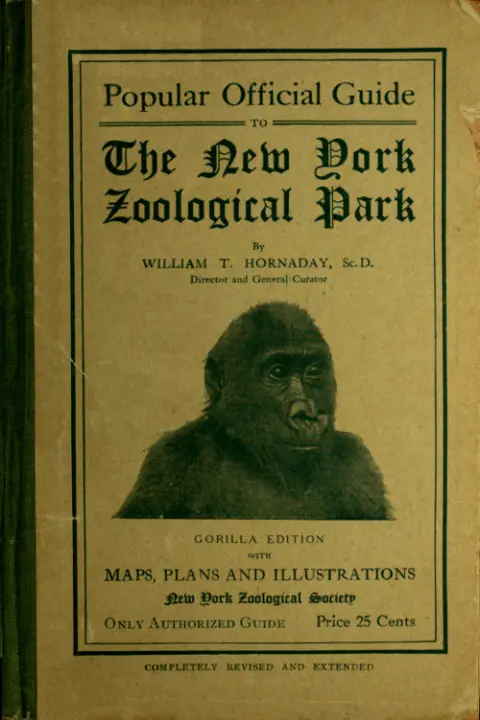
Popular Official Guide to the New York Zoological Park (September 1915) Thirteenth Edition
William T. (William Temple) Hornaday
THE CLASSIC COLLECTION · 1911
"Our Vanishing Wild Life: Its Extermination and Preservation" by William T. Hornaday is a scientific publication written in the early 20th century. The book focuses on the alarming decline of wildlife in North America, highlighting the species that have disappeared or are on the verge of extinction due to human activity. The author, a prominent conservationist and director of the New York Zoological Park, aims to raise awareness about the urgent need for wildlife protection and reform. The opening portion of the text sets a reflective tone as it emphasizes the historical abundance of wildlife now lost due to relentless hunting and habitat destruction. Hornaday discusses various species, using poignant examples such as the passenger pigeon, which once numbered in the millions yet became extinct through overhunting. He leverages historical anecdotes, legislative failures, and vivid imagery to illustrate the crisis facing wildlife. This introductory segment calls for immediate action from the public and lawmakers to protect the remaining wildlife, framing the preservation of nature as a moral obligation owed to future generations.
Introduction adapted from the source catalogue; source summaries may be automatically generated.
Free to read · English · 176,577 words · No account needed
MAKE TIME FOR A GOOD BOOK
On by default. Untick to stop anonymous reading totals. Each page counts after 10 seconds in view. How this works.
Anonymous counting is on unless you have switched it off.
Green Sandpiper, Brown Creeper,
Dotterel, Nuthatch,
Magpie, Black-Cap Warbler,
Corn Bunting, Black-Headed Warbler,
Migratory Quail, Fantail Warbler,
Green Woodpecker, Missel Thrush,
Spotted Woodpecker, Ring Ouzel,
Wood Lark, Rock Sparrow, and
Gray Wagtail.
"Here, too [at Florence] we saw often, bunches and baskets of small birds, chiefly redbreasts, hawked through the streets.... Every Sunday that we went into the country we met numbers of Italians out shooting, and their bags seemed to consist wholly of small birds.
"At Genoa, San Remo, Monte Carlo and Nice, between December 13 and 29, I did not visit the central markets, if such exist, but saw frequently bunches of small birds hanging outside stores.... A gentleman who spent the fall on an automobile trip through the west of FRANCE from Brittany to the Pyrenees, tells me he noticed these bunches of small birds on sale in every town he visited.
"That killing song-birds for food," continues Dr. Bishop, "is not confined to the poor Italians I learned on October 27, when one of the most prominent and wealthy Italian ornithologists--a delightful man--told me he had shot 180 skylarks and pipits the day before, and that his family liked them far better than other game. Our prejudice against selling game does not exist in Europe, and this same ornithologist told me he often shot 200 ducks in a day at his shooting-box, sending to the market what he could not use himself. On November 1, 1910, he shot 82 ducks, and on November 8, 103, chiefly widgeon and teal."
An "ornithologist" indeed! A "sportsman" also, is he not? He belongs with his brother "ornithologists" of the roccolos, who net their "game" with the aid of blind birds! Brave men, gallant "sportsmen," are these men of Italy,--and western France also if the tale is true!
If the people of Europe can stand the wholesale, systematic slaughter of their song and insectivorous birds, we can! If they are too mean-spirited to rise up, make a row about it, and stop it, then let them pay the price; but, by the Eternal, Antonio shall not come to this country with the song-bird tastes of the roccolo and indulge them here!
The above facts have been cited, not at all for the benefit of Europe, but for our own good. The American People are now confronted by the Italian and Austrian and Hungarian laborer and saloon-keeper and mechanic, and all Americans should have an exact measure of the sentiments of southern Europe toward our wild life generally, especially the birds that we do not shoot at all, and therefore are easy to kill.
Your reading position is saved on this browser. Take it to another device with a library code. Reading pages adapt to text, rather than matching a printed edition.
William T. (William Temple) Hornaday
William T. (William Temple) Hornaday
William T. (William Temple) Hornaday & W. J. (William Jacob) Holland
William T. (William Temple) Hornaday
BEHIND THE BOOK
This eBook is for the use of anyone anywhere in the United States and most other parts of the world at no cost and with almost no restrictions whatsoever. You may copy it, give it away or re-use it under the terms of the Project Gutenberg License included with this eBook or online at www.gutenberg.org. If you are not located in the United States, you will have to check the laws of the country where you are located before using this eBook. Read the source licence.
The original source file, including credits and licence, is retained by this library. Request an original-format copy at no charge. Please include the book title and Project Gutenberg identifier #13249.
KEEP YOUR CURIOSITY GOING
Cécile Tormay

Moritz Busch
John L. Ransom
Frances Wright
Cécile Tormay

Mabel Potter Daggett