
Last letters from the living dead man
David Patterson (Spirit) Hatch
THE CLASSIC COLLECTION · 1852
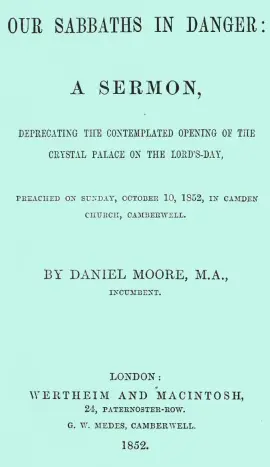
"Our Sabbaths in Danger" by Daniel Moore is a sermon written in the early 19th century that addresses the moral and spiritual implications of opening the Crystal Palace on the Lord's Day. This theological work discusses the sanctity of the Sabbath, its historical origins, and the consequences of its desecration, reflecting a period of intense religious sentiment characteristic of the Victorian era. The sermon aims to emphasize that the Sabbath was established for humanity's benefit, rather than merely as a ritual obligation. In the sermon, Moore passionately argues against the planned opening of the Crystal Palace on Sundays, viewing it not only as a potential desecration of the Sabbath but also as a threat to the moral fabric of society. He explores biblical principles that underscore the Sabbath's importance, urging believers to resist the cultural shift towards secularization that compromises their religious values. Moore warns of the detrimental effects this change would have on the community's spiritual life and affirms that the sanctity of the Sabbath must be preserved to ensure both personal devotion and societal morality. Through historical context and theological reasoning, he calls for a spirited defense of the Lord's Day against encroaching secular influences.
Introduction adapted from the source catalogue; source summaries may be automatically generated.
Free to read · English · 7,693 words · No account needed
MAKE TIME FOR A GOOD BOOK
On by default. Untick to stop anonymous reading totals. Each page counts after 10 seconds in view. How this works.
Anonymous counting is on unless you have switched it off.
iv. Once more, brethren, I ask you to look at the demoralizing influence of this contemplated impiety. It was the great Burke, I believe, who once put forth the false and mischievous sentiment, that “vice lost half its danger by losing all its grossness.” On a like principle, some appear to be contending now, that Sabbath immoralities will lose much of their evil, if we can only qualify their coarseness by the externals of cultivation and refinement. But sin is sin, hide it under what mask we will. Whilst, as to moral danger to the community, it is surely better that men should even see the dead men’s bones and all the uncleanness, than that their eyes should be ensnared by the beauty of the whited sepulchre. The Sabbath-breaker now is a marked man; he steals away to his low tavern indulgences; he there herds with his like; and, as a conscious offender against the laws of God and man, waits till, under the protection of nightfall, he may steal to his home again. But if the proposed arrangement be brought about, he will commit the same offence,—under authority, with Royal countenance, on the plea that he wishes to enlarge the powers which God hath given him; nay, it is much if he parrot not, at Infidel bidding, the audacious pretence that he would offer a tribute of admiration “to nature and to nature’s God.” Oh! brethren, when will the race be extinct who seek to betray the Son of man with a kiss?
But will not the project under consideration be a gain to public morals, in regard of the lower vices of sensuality and intoxication? I answer unhesitatingly, No. Unhappily, we are not without our precedent of these Sunday gardens now—gardens which, in their disposition and decorations, appeal, and in their degree successfully, to the very tastes which it is among the purposes of the new speculation to cultivate. And these pleasure-grounds are found to be the heart and centre of the most debasing vices. Returns have been put into my hands from one of these haunts of Sabbath festivity in a country town,—described as being, in themselves, most attractive and beautiful. Into these gardens 3,000 people have gone on a Sunday evening, consuming among them nearly 600 gallons of malt liquor alone;—a quantity which, if a reasonable deduction be made for the number of children, would suppose one quart to have been consumed by every grown-up person, whether male or female, upon the ground. Let us, for the honour of the female sex, make a still further deduction, and what a humiliating reflection is forced upon us as to the state of a large majority of the men! Brethren, these are painful details to have to bring into a pulpit. But when we have beaten the adversary from every other ground—the ground of right, of truth, of religious decency, of national piety and honour—it may be well to see if he has any standing-place on the ground which he thinks unassailably his own. And this argument, that he will draw men off from the brutal indulgences of their own locality, is one which the champions of desecration make much of. Whereas I know, on the authority of those through whose hands the negotiations pass, that premiums of almost incredible amount are being offered for the liberty of erecting places in the neighbourhood, where the same low appetites may be ministered to, which the Sabbath-breaker finds gratified now in his own low tavern at home. {25} And then judge for yourselves whether he will be much less disposed to gratify them. Think of the excitement of the journey, the sensuous fascinations of the scene, the stimulating influence of a large living mass, all bent on unrestrained enjoyment, and then consider whether any other change will be wrought, in the habits of those whom it is sought to reclaim, than that they will do under some decorated and emblazoned booth, what they now do in an alehouse, and waste far more than they do already of those precious earnings which should go to buy their children bread. And where the carcase is, there will the eagles be. The cunning pickpocket will be there. The man of dissolute pleasures will be there. The shame of womanhood will be there;—all coming from far to keep each the Sabbath of their vocation—to worship at this great metropolis of immorality and sin.
Your reading position is saved on this browser. Take it to another device with a library code. Reading pages adapt to text, rather than matching a printed edition.
BEHIND THE BOOK
This eBook is for the use of anyone anywhere in the United States and most other parts of the world at no cost and with almost no restrictions whatsoever. You may copy it, give it away or re-use it under the terms of the Project Gutenberg License included with this eBook or online at www.gutenberg.org. If you are not located in the United States, you will have to check the laws of the country where you are located before using this eBook. Read the source licence.
The original source file, including credits and licence, is retained by this library. Request an original-format copy at no charge. Please include the book title and Project Gutenberg identifier #62221.
KEEP YOUR CURIOSITY GOING
David Patterson (Spirit) Hatch

David Patterson (Spirit) Hatch

David Patterson (Spirit) Hatch
Cécile Tormay

Moritz Busch
John L. Ransom