
Last letters from the living dead man
David Patterson (Spirit) Hatch
THE CLASSIC COLLECTION · 1852
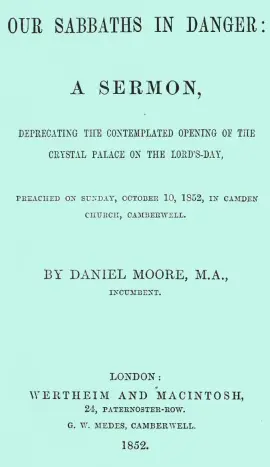
"Our Sabbaths in Danger" by Daniel Moore is a sermon written in the early 19th century that addresses the moral and spiritual implications of opening the Crystal Palace on the Lord's Day. This theological work discusses the sanctity of the Sabbath, its historical origins, and the consequences of its desecration, reflecting a period of intense religious sentiment characteristic of the Victorian era. The sermon aims to emphasize that the Sabbath was established for humanity's benefit, rather than merely as a ritual obligation. In the sermon, Moore passionately argues against the planned opening of the Crystal Palace on Sundays, viewing it not only as a potential desecration of the Sabbath but also as a threat to the moral fabric of society. He explores biblical principles that underscore the Sabbath's importance, urging believers to resist the cultural shift towards secularization that compromises their religious values. Moore warns of the detrimental effects this change would have on the community's spiritual life and affirms that the sanctity of the Sabbath must be preserved to ensure both personal devotion and societal morality. Through historical context and theological reasoning, he calls for a spirited defense of the Lord's Day against encroaching secular influences.
Introduction adapted from the source catalogue; source summaries may be automatically generated.
Free to read · English · 7,693 words · No account needed
MAKE TIME FOR A GOOD BOOK
On by default. Untick to stop anonymous reading totals. Each page counts after 10 seconds in view. How this works.
Anonymous counting is on unless you have switched it off.
Again, in contending for the universal obligation to separate a seventh portion of our time to the service of God, we cannot overlook the plain intimations contained in the earliest records of all nations, that, either with religious sanctions or without them, men have observed this weekly division of time. Chaldeans, Egyptians, Greeks, and Romans, all seem to have known of it;—and the question is how, except as the relic of some universal tradition, those nations should have thought of such a measurement of time at all? For other divisions of time we can find reasons,—obvious, necessary, and natural. The daily rotation of the earth on its axis; the completed cycle of lunar phases; the sun imparting to the revolving worlds the blessings of cold and heat, summer and winter, seed-time and harvest, are phenomena quite adequate to explain why we should break up our life into days, and months, and years; but for WEEKS we have no such reason, nor, indeed, any reason to give, except that it is one of the original appointments and laws of God. It is an arbitrary period, the recurrence of which neither nature nor reason seems, in any way, to have marked out for us, but which, on the all-commanding authority of revelation, men have been taught to set apart to sacred remembrances. The Sabbath was MADE for man.
III. Thus, as far as our limits would permit, I think it has been shown that, irrespective of dispensations, or Churches, or particular covenants, God did appoint it as an ordinance for the whole human family, that every recurring seventh day of their life should be separated to religious uses. He first “blessed” the day, that is, pledged himself to be propitious to the service which, in spirit and in truth, men should offer Him on that day; and then “hallowed” it, or, as the word is, “set it apart,” intimating that anything opposed or foreign to such religious service, was to be strictly forbidden. If this ground have been made good, I shall be less careful to adduce all that could be said in favour of the next question which might be raised; namely, on the supposition that God has made this claim upon all men of a seventh portion of their time, is that seventh which has been set apart by the Christian Church the right seventh; in other words, have we sufficient reason for believing that the change of day, from the last day of the week to the first, is agreeable to the will of God? Now the only reasons, it would seem, which could justify such change, must be found either in an express revelation, or in the ascertained practice of those, who having for three years had the Lord of the Sabbath to guide them, must have known on what day He designed it should thenceforth be kept. A change of the actual day, it has been conjectured, from some expressions in the history, was made by Moses, at the time of the Exodus, transferring the holy day to that which first saw Israel’s redemption from bonds,—what should hinder that, with sufficient authority, a change should not be made, again transferring our Sabbath to the day which, in the resurrection of the Son of God, saw the redemption of the spiritual Israel from the grave? Besides, an avowed end of the Jewish Sabbath was as a protest against false religions. The pious Israelite was distinguished from the idolaters among whom he dwelt, by his close observance of the sacred day:—why may not our Lord have ordained a change in the Sabbath of the Christian, as a protest against the continuing obstinacy of the Jew? Of course, these are no more than conjectures, and though sustained by names of great weight, they leave the fact to be judged of only as we should judge of all other facts; namely, by a reasonable and sufficient amount of historic evidence. And this we are thought to have, even in the scattered notices found in the sacred narrative itself,—in the frequent allusions to religious meetings on the first day of the week, in the choice of this day by our Lord for two successive manifestations to his disciples, in the selection of it for the first miraculous effusion of the Holy Spirit, in the special mention of it by Paul as that on which he preached the Word and administered the sacraments, in the directions given to the Churches of Galatia and Corinth to lay by their alms that they might make an offering of them to God on the first day of the week,—all passages proving, as clearly as anything can, that, among the New Testament Christians, a character of separation and sacredness was attached to the first day, which was not accorded to any other.
Your reading position is saved on this browser. Take it to another device with a library code. Reading pages adapt to text, rather than matching a printed edition.
BEHIND THE BOOK
This eBook is for the use of anyone anywhere in the United States and most other parts of the world at no cost and with almost no restrictions whatsoever. You may copy it, give it away or re-use it under the terms of the Project Gutenberg License included with this eBook or online at www.gutenberg.org. If you are not located in the United States, you will have to check the laws of the country where you are located before using this eBook. Read the source licence.
The original source file, including credits and licence, is retained by this library. Request an original-format copy at no charge. Please include the book title and Project Gutenberg identifier #62221.
KEEP YOUR CURIOSITY GOING
David Patterson (Spirit) Hatch

David Patterson (Spirit) Hatch

David Patterson (Spirit) Hatch
Cécile Tormay

Moritz Busch
John L. Ransom