
Last letters from the living dead man
David Patterson (Spirit) Hatch
THE CLASSIC COLLECTION · 1852
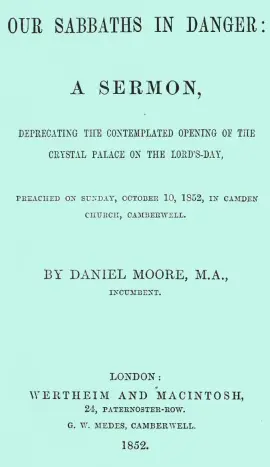
"Our Sabbaths in Danger" by Daniel Moore is a sermon written in the early 19th century that addresses the moral and spiritual implications of opening the Crystal Palace on the Lord's Day. This theological work discusses the sanctity of the Sabbath, its historical origins, and the consequences of its desecration, reflecting a period of intense religious sentiment characteristic of the Victorian era. The sermon aims to emphasize that the Sabbath was established for humanity's benefit, rather than merely as a ritual obligation. In the sermon, Moore passionately argues against the planned opening of the Crystal Palace on Sundays, viewing it not only as a potential desecration of the Sabbath but also as a threat to the moral fabric of society. He explores biblical principles that underscore the Sabbath's importance, urging believers to resist the cultural shift towards secularization that compromises their religious values. Moore warns of the detrimental effects this change would have on the community's spiritual life and affirms that the sanctity of the Sabbath must be preserved to ensure both personal devotion and societal morality. Through historical context and theological reasoning, he calls for a spirited defense of the Lord's Day against encroaching secular influences.
Introduction adapted from the source catalogue; source summaries may be automatically generated.
Free to read · English · 7,693 words · No account needed
MAKE TIME FOR A GOOD BOOK
On by default. Untick to stop anonymous reading totals. Each page counts after 10 seconds in view. How this works.
Anonymous counting is on unless you have switched it off.
Brethren, you are aware of the reasons which induce me, at the hazard of going over much of familiar argument, formally to review the grounds on which we hold that a PROPER MORAL SANCTITY does attach to the CHRISTIAN SABBATH:—that the institution itself has an origin, an object, a typical significance and value, which are independent of all economies, and will endure to all time; and, therefore, that any nation which shall presume to tamper with its unalterable sacredness, is drawing down upon itself those awful maledictions which, by an undesigned coincidence, have been so often recited in our ears this morning as the just retribution of POLLUTED SABBATHS. {5}
I. In trying to arrive at correct notions upon what may be due to the sacred day, and how far it may be lawful that churches and places of amusement should share its hours between them, our first thoughts are naturally directed to the Old Testament accounts of the Sabbath institution itself. Was its origin paradisaical, or patriarchal, or Levitical? And if it were either of these, were the reasons given for commencing it such as would pass away, when the dispensation under which it was given passed away? This question is important, because there is a current way of speaking of the Sabbath as if it were a mere festival of the Jewish Church, deriving its whole sanctity from the Levitical law, and only taken up by the Christian Church at second hand,—as among the useful things of the old economy which it would be as well to perpetuate, though not one of the binding things we were under any obligation to observe.
Now, to expose the absurdity of this notion, we have only to take the earliest Scripture notices of the institution which come to hand. In the second chapter of the book of Genesis, at the close of the account of the creation, we read,—And on the seventh day God ended his work which He had made; and He rested on the seventh day from all his work which He had made. And God blessed the seventh day and sanctified it: BECAUSE that in it He had rested from all his work which God created and made. If this passage stood alone, one conclusion only could be drawn from it; namely, that the institution of the Sabbath succeeded the creation immediately in order of time, and that it was sanctified for reasons which must be binding on all mankind alike. But other notices in the writings of Moses follow, which might seem to militate against this view, and even to favour the erroneous notion I have adverted to, of the Sabbath having only a temporary or dispensational sanctity. Thus, in the thirty-first chapter of Exodus, we read,—Wherefore the children of Israel shall keep the Sabbath throughout their generations for a perpetual covenant: it is a SIGN between me and the children of Israel for ever. Whilst, further, in the book of Deuteronomy, at the fifth chapter, we find Moses exhorting the people to the observance of the holy day, with this added reason: Remember that thou wast a servant in the land of Egypt, and that the Lord thy God brought thee out thence through a mighty hand and stretched-out arm; THEREFORE the Lord thy God commanded thee to keep the Sabbath-day. Now, whether we are able to give any satisfactory account of these additional reasons for the institution or not, the revealed fact will remain the same,—namely, that the Sabbath was not Levitical in its origin, and was not even first made known to the Jews, at the giving of the law. Nothing can be plainer than that the Sabbath was both known and observed before the Jewish Church had any existence. For, besides the incidental notices both before and after the deluge,—such as Noah sending out the dove again “after other seven days,”—we find the Jews actually keeping a Sabbath in the wilderness of Sin, before the covenant of Sinai had been entered into. Thus, at the giving of the manna, we have Moses saying unto the people, To-morrow is the rest of the holy Sabbath unto the Lord: on that day ye shall not find it in the field: for the Lord hath given you the Sabbath: therefore He giveth you on the sixth day the bread of two days:—language plainly implying that, at that time, the Sabbath was an established observance of the religious life. What shall we say, then, of those subsequent reasons for the institution which connect it with a peculiar national covenant? or with the deliverance of the Israelites from bondage? Why, not that they are meant to be reasons for the institution itself, but reasons for a particular time and form of its re-promulgation. The children of Israel, it is to be remembered, had been for several hundred years under captivity in Egypt. Many of their ordinances, it is likely they would have forgotten; and their Sabbaths, it is all but certain, their task-masters would not permit them to observe. On their Exodus, therefore, it became necessary that there should be a formal re-enactment of the holy day; not only by a repetition of those moral considerations, on account of which the Almighty had originally set it apart, but also with a recital of such other arguments as should make the sanctity of the day especially binding upon them as a nation; namely, that in their revived and perpetuated Sabbath, they were to keep up a grateful commemoration of their deliverance from Egypt, as well as behold a standing pledge or seal of the covenant into which God was then entering with his people. To infer that mankind had never observed a day of sanctified rest until the Sabbath was made a sign of the covenant with Moses, would be as unreasonable as the inference that the sun’s light had never been refracted in the rain-drops, until God set his “bow in the clouds,” to be a sign of his covenant with Noah. It pleased God to take an existing moral fact in the one case, as He had taken an existing physical fact in the other, to be a perpetual and visible memorial of his own gracious purposes. And, surely, to the Israelites, in all ages, it must have been a great encouragement to see the promise made unto their fathers guaranteed by a seal, which was honoured as the first token ever made to human kind, and hallowed by considerations which could never change, and never lose their force.
Your reading position is saved on this browser. Take it to another device with a library code. Reading pages adapt to text, rather than matching a printed edition.
BEHIND THE BOOK
This eBook is for the use of anyone anywhere in the United States and most other parts of the world at no cost and with almost no restrictions whatsoever. You may copy it, give it away or re-use it under the terms of the Project Gutenberg License included with this eBook or online at www.gutenberg.org. If you are not located in the United States, you will have to check the laws of the country where you are located before using this eBook. Read the source licence.
The original source file, including credits and licence, is retained by this library. Request an original-format copy at no charge. Please include the book title and Project Gutenberg identifier #62221.
KEEP YOUR CURIOSITY GOING
David Patterson (Spirit) Hatch

David Patterson (Spirit) Hatch

David Patterson (Spirit) Hatch
Cécile Tormay

Moritz Busch
John L. Ransom