THE CLASSIC COLLECTION✦Love Letters of Nathaniel Hawthorne, Volume 2 (of 2)CLASSIC FREE BOOKS
Love Letters of Nathaniel Hawthorne, Volume 2 (of 2)
Nathaniel Hawthorne
THE CLASSIC COLLECTION · 1863
"Our Old Home, Vol. 2" by Nathaniel Hawthorne is a travelogue written in the late 19th century. This reflective work encapsulates the author’s observations and experiences while exploring England, particularly focusing on historical sites, landscapes, and cultural insights during his visits to locales like Blenheim and the homes of famous figures such as Robert Burns. The narrative emphasizes not just the sights, but also the emotional and psychological impressions left on Hawthorne as he contemplates the deeper meanings behind these places. The opening of the volume sets the tone for a leisurely exploration through the countryside, as Hawthorne, accompanied by his party, sets out on an excursion to Blenheim, the residence of the Duke of Marlborough. They navigate through quaint villages, noting the architecture and pastoral beauty, before arriving at the sprawling estate, steeped in history. Hawthorne describes the lush landscapes and significant landmarks they encounter, such as Rosamond’s Well and the Triumphal Pillar, while also reflecting on the gifts of nature and man that adorn Blenheim Park. Interlaced with observations on the Duke's legacy, his musings reveal a contemplative traveler grappling with the weight of history, fame, and the passage of time—elements that resonate throughout the entire volume.
Introduction adapted from the source catalogue; source summaries may be automatically generated.
Free to read · English · 65,686 words · No account needed
MAKE TIME FOR A GOOD BOOK
On by default. Untick to stop anonymous reading totals. Each page counts after 10 seconds in view. How this works.
Anonymous counting is on unless you have switched it off.
To make an end of these first impressions, I fancied that not merely the Suffolk bar, but the bar of any inland county in New England, might show a set of thin-visaged men looking wretchedly worn, sallow, deeply wrinkled across the forehead, and grimly furrowed about the mouth, with whom these heavy-cheeked English lawyers, slow-paced and fat-witted as they must needs be, would stand very little chance in a professional contest. How that matter might turn out, I am unqualified to decide. But I state these results of my earliest glimpses at Englishmen, not for what they are worth, but because I ultimately gave them up as worth little or nothing. In course of time, I came to the conclusion that Englishmen of all ages are a rather good-looking people, dress in admirable taste from their own point of view, and, under a surface never silken to the touch, have a refinement of manners too thorough and genuine to be thought of as a separate endowment,--that is to say, if the individual himself be a man of station, and has had gentlemen for his father and grandfather. The sturdy Anglo-Saxon nature does not refine itself short of the third generation. The tradesmen, too, and all other classes, have their own proprieties.
The only value of my criticisms, therefore, lay in their exemplifying the proneness of a traveler to measure one people by the distinctive characteristics of another,--as English writers invariably measure us, and take upon themselves to be disgusted accordingly, instead of trying to find out some principle of beauty with which we may be in conformity.
In due time we were summoned to the table, and went thither in no solemn procession, but with a good deal of jostling, thrusting behind, and scrambling for places when we reached our destination. The legal gentlemen, I suspect, were responsible for this indecorous zeal, which I never afterwards remarked in a similar party. The dining-hall was of noble size, and, like the other rooms of the suite, was gorgeously painted and gilded and brilliantly illuminated. There was a splendid table-service, and a noble array of footmen, some of them in plain clothes, and others wearing the town-livery, richly decorated with gold-lace, and themselves excellent specimens of the blooming young manhood of Britain. When we were fairly seated, it was certainly an agreeable spectacle to look up and down the long vista of earnest faces, and behold them so resolute, so conscious that there was an important business in hand, and so determined to be equal to the occasion. Indeed, Englishman or not, I hardly know what can be prettier than a snow-white tablecloth, a huge heap of flowers as a central decoration, bright silver, rich china, crystal glasses, decanters of Sherry at due intervals, a French roll and an artistically folded napkin at each plate, all that airy portion of a banquet, in short, that comes before the first mouthful, the whole illuminated by a blaze of artificial light, without which a dinner of made-dishes looks spectral, and the simplest viands are the best. Printed bills-of-fare were distributed, representing an abundant feast, no part of which appeared on the table until called for in separate plates. I have entirely forgotten what it was, but deem it no great matter, inasmuch as there is a pervading commonplace and identicalness in the composition of extensive dinners, on account of the impossibility of supplying a hundred guests with anything particularly delicate or rare. It was suggested to me that certain juicy old gentlemen had a private understanding what to call for, and that it would be good policy in a stranger to follow in their footsteps through the feast. I did not care to do so, however, because, like Sancho Panza's dip out of Camacho's caldron, any sort of potluck at such a table would be sure to suit my purpose; so I chose a dish or two on my own judgment, and, getting through my labors betimes, had great pleasure in seeing the Englishmen toil onward to the end.
Your reading position is saved on this browser. Take it to another device with a library code. Reading pages adapt to text, rather than matching a printed edition.
Nathaniel Hawthorne
Nathaniel Hawthorne
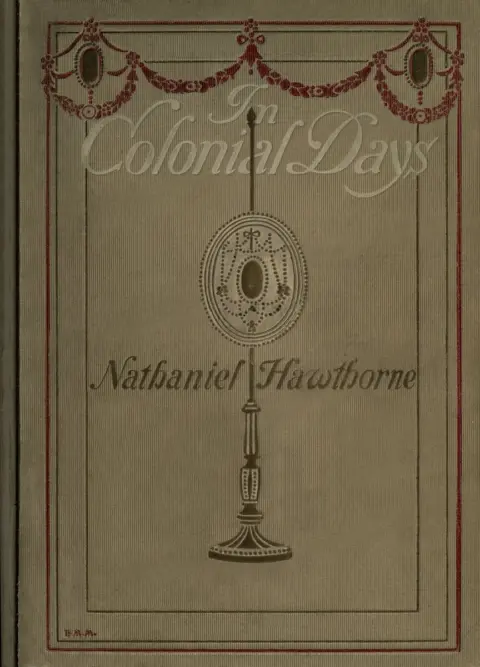
Nathaniel Hawthorne

Rebecca Harding Davis & Thomas De Quincey & Charles Dickens & Nathaniel Hawthorne & Edward Bulwer Lytton, Baron Lytton & Edgar Allan Poe & Harriet Elizabeth Prescott Spofford
BEHIND THE BOOK
This eBook is for the use of anyone anywhere in the United States and most other parts of the world at no cost and with almost no restrictions whatsoever. You may copy it, give it away or re-use it under the terms of the Project Gutenberg License included with this eBook or online at www.gutenberg.org. If you are not located in the United States, you will have to check the laws of the country where you are located before using this eBook. Read the source licence.
The original source file, including credits and licence, is retained by this library. Request an original-format copy at no charge. Please include the book title and Project Gutenberg identifier #37625.
KEEP YOUR CURIOSITY GOING
Wilfrid Scawen Blunt
Wilfrid Scawen Blunt

E. W. (Edgar Watson) Howe
Cécile Tormay

Moritz Busch
John L. Ransom