THE CLASSIC COLLECTION✦Love Letters of Nathaniel Hawthorne, Volume 2 (of 2)CLASSIC FREE BOOKS
Love Letters of Nathaniel Hawthorne, Volume 2 (of 2)
Nathaniel Hawthorne
THE CLASSIC COLLECTION · 1863
"Our Old Home: A Series of English Sketches" by Nathaniel Hawthorne is a collection of essays written in the mid-19th century that reflect on the author's experiences during his time as the American consul in Liverpool, England. The sketches convey Hawthorne's perceptions of English culture, scenery, and the contrasts between American and English national identities, revealing both admiration and critique of the English way of life. The opening of the text introduces the reader to Hawthorne's motivation for writing these sketches, capturing his feelings of nostalgia and ambivalence towards England as his "old home." He begins by expressing a personal dedication to a friend, Franklin Pierce, and explains the humble nature of these essays, which do not tackle grand political themes but rather focus on aesthetic observations of English life. Hawthorne shares vivid descriptions of his experiences at the consulate, depicting a chaotic environment filled with Americans seeking refuge or assistance, and illustrating his nuanced views on the English populace, ranging from admiration to a recognition of their perceived arrogance. Through these reflections, Hawthorne sets the tone for a series of explorations into the landscape and social fabric of England, revealing the complexities of identity and belonging for him as an American abroad.
Introduction adapted from the source catalogue; source summaries may be automatically generated.
Free to read · English · 115,855 words · No account needed
MAKE TIME FOR A GOOD BOOK
On by default. Untick to stop anonymous reading totals. Each page counts after 10 seconds in view. How this works.
Anonymous counting is on unless you have switched it off.
The article which I am writing has taken its own course, and occupied itself almost wholly with country churches; whereas I had purposed to attempt a description of some of the many old towns--Warwick, Coventry, Kenilworth, Stratford-on-Avon--which lie within an easy scope of Leamington. And still another church presents itself to my remembrance. It is that of Hatton, on which I stumbled in the course of a forenoon's ramble, and paused a little while to look at it for the sake of old Dr. Parr, who was once its vicar. Hatton, so far as I could discover, has no public-house, no shop, no contiguity of roofs (as in most English villages, however small), but is merely an ancient neighborhood of farm-houses, spacious, and standing wide apart, each within its own precincts, and offering a most comfortable aspect of orchards, harvest-fields, barns, stacks, and all manner of rural plenty. It seemed to be a community of old settlers, among whom everything had been going on prosperously since an epoch beyond the memory of man; and they kept a certain privacy among themselves, and dwelt on a cross-road, at the entrance of which was a barred gate, hospitably open, but still impressing me with a sense of scarcely warrantable intrusion. After all, in some shady nook of those gentle Warwickshire slopes there may have been a denser and more populous settlement, styled Hatton, which I never reached.
Emerging from the by-road, and entering upon one that crossed it at right angles and led to Warwick, I espied the church of Dr. Parr. Like the others which I have described, it had a low stone tower, square, and battlemented at its summit: for all these little churches seem to have been built on the same model, and nearly at the same measurement, and have even a greater family-likeness than the cathedrals. As I approached, the bell of the tower (a remarkably deep-toned bell, considering how small it was) flung its voice abroad, and told me that it was noon. The church stands among its graves, a little removed from the wayside, quite apart from any collection of houses, and with no signs of vicarage; it is a good deal shadowed by trees, and not wholly destitute of ivy. The body of the edifice, unfortunately (and it is an outrage which the English church-wardens are fond of perpetrating), has been newly covered with a yellowish plaster or wash, so as quite to destroy the aspect of antiquity, except upon the tower, which wears the dark gray hue of many centuries. The chancel-window is painted with a representation of Christ upon the Cross, and all the other windows are full of painted or stained glass, but none of it ancient, nor (if it be fair to judge from without of what ought to be seen within) possessing any of the tender glory that should be the inheritance of this branch of Art, revived from mediaeval times. I stepped over the graves, and peeped in at two or three of the windows, and saw the snug interior of the church glimmering through the many-colored panes, like a show of commonplace objects under the fantastic influence of a dream: for the floor was covered with modern pews, very like what we may see in a New England meeting-house, though, I think, a little more favorable than those would be to the quiet slumbers of the Hatton farmers and their families. Those who slept under Dr. Parr's preaching now prolong their nap, I suppose, in the churchyard round about, and can scarcely have drawn much spiritual benefit from any truths that he contrived to tell them in their lifetime. It struck me as a rare example (even where examples are numerous) of a man utterly misplaced, that this enormous scholar, great in the classic tongues, and inevitably converting his own simplest vernacular into a learned language, should have been set up in this homely pulpit, and ordained to preach salvation to a rustic audience, to whom it is difficult to imagine how he could ever have spoken one available word.
Your reading position is saved on this browser. Take it to another device with a library code. Reading pages adapt to text, rather than matching a printed edition.
Nathaniel Hawthorne
Nathaniel Hawthorne
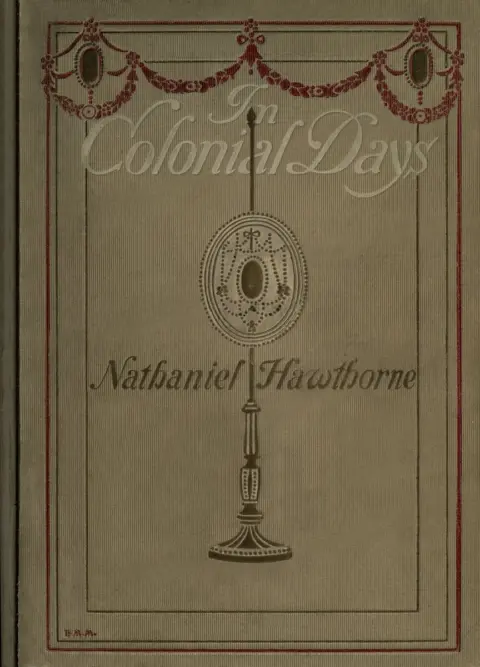
Nathaniel Hawthorne

Rebecca Harding Davis & Thomas De Quincey & Charles Dickens & Nathaniel Hawthorne & Edward Bulwer Lytton, Baron Lytton & Edgar Allan Poe & Harriet Elizabeth Prescott Spofford
BEHIND THE BOOK
This eBook is for the use of anyone anywhere in the United States and most other parts of the world at no cost and with almost no restrictions whatsoever. You may copy it, give it away or re-use it under the terms of the Project Gutenberg License included with this eBook or online at www.gutenberg.org. If you are not located in the United States, you will have to check the laws of the country where you are located before using this eBook. Read the source licence.
The original source file, including credits and licence, is retained by this library. Request an original-format copy at no charge. Please include the book title and Project Gutenberg identifier #8090.
KEEP YOUR CURIOSITY GOING
Wilfrid Scawen Blunt
Wilfrid Scawen Blunt

E. W. (Edgar Watson) Howe

David Patterson (Spirit) Hatch

David Patterson (Spirit) Hatch

David Patterson (Spirit) Hatch