THE CLASSIC COLLECTION✦Love Letters of Nathaniel Hawthorne, Volume 2 (of 2)CLASSIC FREE BOOKS
Love Letters of Nathaniel Hawthorne, Volume 2 (of 2)
Nathaniel Hawthorne
THE CLASSIC COLLECTION · 1863
"Our Old Home: A Series of English Sketches" by Nathaniel Hawthorne is a collection of essays written in the mid-19th century that reflect on the author's experiences during his time as the American consul in Liverpool, England. The sketches convey Hawthorne's perceptions of English culture, scenery, and the contrasts between American and English national identities, revealing both admiration and critique of the English way of life. The opening of the text introduces the reader to Hawthorne's motivation for writing these sketches, capturing his feelings of nostalgia and ambivalence towards England as his "old home." He begins by expressing a personal dedication to a friend, Franklin Pierce, and explains the humble nature of these essays, which do not tackle grand political themes but rather focus on aesthetic observations of English life. Hawthorne shares vivid descriptions of his experiences at the consulate, depicting a chaotic environment filled with Americans seeking refuge or assistance, and illustrating his nuanced views on the English populace, ranging from admiration to a recognition of their perceived arrogance. Through these reflections, Hawthorne sets the tone for a series of explorations into the landscape and social fabric of England, revealing the complexities of identity and belonging for him as an American abroad.
Introduction adapted from the source catalogue; source summaries may be automatically generated.
Free to read · English · 115,855 words · No account needed
MAKE TIME FOR A GOOD BOOK
On by default. Untick to stop anonymous reading totals. Each page counts after 10 seconds in view. How this works.
Anonymous counting is on unless you have switched it off.
I remember such a path, the access to which is from Lovers' Grove, a range of tall old oaks and elms on a high hill-top, whence there is a view of Warwick Castle, and a wide extent of landscape, beautiful, though bedimmed with English mist. This particular foot-path, however, is not a remarkably good specimen of its kind, since it leads into no hollows and seclusions, and soon terminates in a high-road. It connects Leamington by a short cut with the small neighboring village of Lillington, a place which impresses an American observer with its many points of contrast to the rural aspects of his own country. The village consists chiefly of one row of contiguous dwellings, separated only by party-walls, but ill-matched among themselves, being of different heights, and apparently of various ages, though all are of an antiquity which we should call venerable. Some of the windows are leaden-framed lattices, opening on hinges. These houses are mostly built of gray stone; but others, in the same range, are of brick, and one or two are in a very old fashion,-- Elizabethan, or still older,--having a ponderous framework of oak, painted black, and filled in with plastered stone or bricks. Judging by the patches of repair, the oak seems to be the more durable part of the structure. Some of the roofs are covered with earthen tiles; others (more decayed and poverty-stricken) with thatch, out of which sprouts a luxurious vegetation of grass, house-leeks, and yellow flowers. What especially strikes an American is the lack of that insulated space, the intervening gardens, grass-plots, orchards, broad-spreading shade-trees, which occur between our own village-houses. These English dwellings have no such separate surroundings; they all grow together, like the cells of a honeycomb.
Beyond the first row of houses, and hidden from it by a turn of the road, there was another row (or block, as we should call it) of small old cottages, stuck one against another, with their thatched roofs forming a single contiguity. These, I presume, were the habitations of the poorest order of rustic laborers; and the narrow precincts of each cottage, as well as the close neighborhood of the whole, gave the impression of a stifled, unhealthy atmosphere among the occupants. It seemed impossible that there should be a cleanly reserve, a proper self-respect among individuals, or a wholesome unfamiliarity between families where human life was crowded and massed into such intimate communities as these. Nevertheless, not to look beyond the outside, I never saw a prettier rural scene than was presented by this range of contiguous huts. For in front of the whole row was a luxuriant and well-trimmed hawthorn hedge, and belonging to each cottage was a little square of garden-ground, separated from its neighbors by a line of the same verdant fence. The gardens were chockfull, not of esculent vegetables, but of flowers, familiar ones, but very bright-colored, and shrubs of box, some of which were trimmed into artistic shapes; and I remember, before one door, a representation of Warwick Castle, made of oyster-shells. The cottagers evidently loved the little nests in which they dwelt, and did their best to make them beautiful, and succeeded more than tolerably well,--so kindly did nature help their humble efforts with its verdure, flowers, moss, lichens, and the green things that grew out of the thatch. Through some of the open doorways we saw plump children rolling about on the stone floors, and their mothers, by no means very pretty, but as happy-looking as mothers generally are; and while we gazed at these domestic matters, an old woman rushed wildly out of one of the gates, upholding a shovel, on which she clanged and clattered with a key. At first we fancied that she intended an onslaught against ourselves, but soon discovered that a more dangerous enemy was abroad; for the old lady's bees had swarmed, and the air was full of them, whizzing by our heads like bullets.
Your reading position is saved on this browser. Take it to another device with a library code. Reading pages adapt to text, rather than matching a printed edition.
Nathaniel Hawthorne
Nathaniel Hawthorne
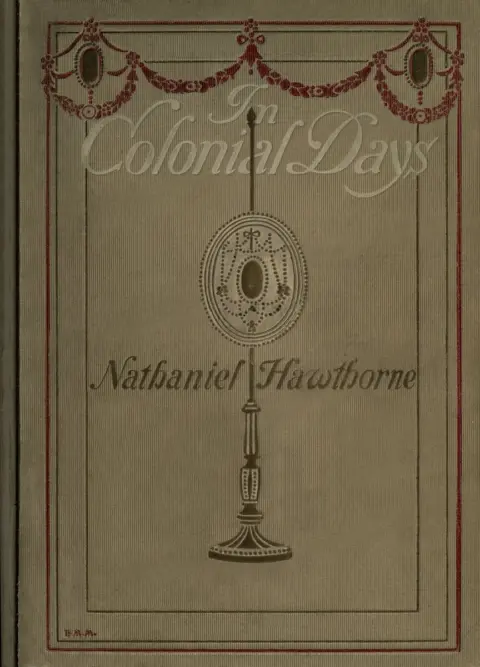
Nathaniel Hawthorne

Rebecca Harding Davis & Thomas De Quincey & Charles Dickens & Nathaniel Hawthorne & Edward Bulwer Lytton, Baron Lytton & Edgar Allan Poe & Harriet Elizabeth Prescott Spofford
BEHIND THE BOOK
This eBook is for the use of anyone anywhere in the United States and most other parts of the world at no cost and with almost no restrictions whatsoever. You may copy it, give it away or re-use it under the terms of the Project Gutenberg License included with this eBook or online at www.gutenberg.org. If you are not located in the United States, you will have to check the laws of the country where you are located before using this eBook. Read the source licence.
The original source file, including credits and licence, is retained by this library. Request an original-format copy at no charge. Please include the book title and Project Gutenberg identifier #8090.
KEEP YOUR CURIOSITY GOING
Wilfrid Scawen Blunt
Wilfrid Scawen Blunt

E. W. (Edgar Watson) Howe

David Patterson (Spirit) Hatch

David Patterson (Spirit) Hatch

David Patterson (Spirit) Hatch