THE CLASSIC COLLECTION✦Love Letters of Nathaniel Hawthorne, Volume 2 (of 2)CLASSIC FREE BOOKS
Love Letters of Nathaniel Hawthorne, Volume 2 (of 2)
Nathaniel Hawthorne
THE CLASSIC COLLECTION · 1863
"Our Old Home: A Series of English Sketches" by Nathaniel Hawthorne is a collection of essays written in the mid-19th century that reflect on the author's experiences during his time as the American consul in Liverpool, England. The sketches convey Hawthorne's perceptions of English culture, scenery, and the contrasts between American and English national identities, revealing both admiration and critique of the English way of life. The opening of the text introduces the reader to Hawthorne's motivation for writing these sketches, capturing his feelings of nostalgia and ambivalence towards England as his "old home." He begins by expressing a personal dedication to a friend, Franklin Pierce, and explains the humble nature of these essays, which do not tackle grand political themes but rather focus on aesthetic observations of English life. Hawthorne shares vivid descriptions of his experiences at the consulate, depicting a chaotic environment filled with Americans seeking refuge or assistance, and illustrating his nuanced views on the English populace, ranging from admiration to a recognition of their perceived arrogance. Through these reflections, Hawthorne sets the tone for a series of explorations into the landscape and social fabric of England, revealing the complexities of identity and belonging for him as an American abroad.
Introduction adapted from the source catalogue; source summaries may be automatically generated.
Free to read · English · 115,855 words · No account needed
MAKE TIME FOR A GOOD BOOK
On by default. Untick to stop anonymous reading totals. Each page counts after 10 seconds in view. How this works.
Anonymous counting is on unless you have switched it off.
At a given signal we all found our way into an immense room, called the Egyptian Hall, I know not why, except that the architecture was classic, and as different as possible from the ponderous style of Memphis and the Pyramids. A powerful band played inspiringly as we entered, and a brilliant profusion of light shone down on two long tables, extending the whole length of the hall, and a cross-table between them, occupying nearly its entire breadth. Glass gleamed and silver glistened on an acre or two of snowy damask, over which were set out all the accompaniments of a stately feast. We found our places without much difficulty, and the Lord Mayor's chaplain implored a blessing on the food,--a ceremony which the English never omit, at a great dinner or a small one, yet consider, I fear, not so much a religious rite as a sort of preliminary relish before the soup.
The soup, of course, on this occasion, was turtle, of which, in accordance with immemorial custom, each guest was allowed two platefuls, in spite of the otherwise immitigable law of table-decorum. Indeed, judging from the proceedings of the gentlemen near me, I surmised that there was no practical limit, except the appetite of the guests and the capacity of the soup-tureens. Not being fond of this civic dainty, I partook of it but once, and then only in accordance with the wise maxim, always to taste a fruit, a wine, or a celebrated dish, at its indigenous site; and the very fountain-head of turtle-soup, I suppose, is in the Lord Mayor's dinner-pot. It is one of those orthodox customs which people follow for half a century without knowing why, to drink a sip of rum-punch, in a very small tumbler, after the soup. It was excellently well-brewed, and it seemed to me almost worth while to sup the soup for the sake of sipping the punch. The rest of the dinner was catalogued in a bill-of-fare printed on delicate white paper within an arabesque border of green and gold. It looked very good, not only in the English and French names of the numerous dishes, but also in the positive reality of the dishes themselves, which were all set on the table to be carved and distributed by the guests. This ancient and honest method is attended with a good deal of trouble, and a lavish effusion of gravy, yet by no means bestowed or dispensed in vain, because you have thereby the absolute assurance of a banquet actually before your eyes, instead of a shadowy promise in the bill-of-fare, and such meagre fulfilment as a single guest can contrive to get upon his individual plate. I wonder that Englishmen, who are fond of looking at prize-oxen in the shape of butcher's-meat, do not generally better estimate the aesthetic gormandism of devouring the whole dinner with their eyesight, before proceeding to nibble the comparatively few morsels which, after all, the most heroic appetite and widest stomachic capacity of mere mortals can enable even an alderman really to eat. There fell to my lot three delectable things enough, which I take pains to remember, that the reader may not go away wholly unsatisfied from the Barmecide feast to which I have bidden him,-- a red mullet, a plate of mushrooms, exquisitely stewed, and part of a ptarmigan, a bird of the same family as the grouse, but feeding high up towards the summit of the Scotch mountains, whence it gets a wild delicacy of flavor very superior to that of the artificially nurtured English game-fowl. All the other dainties have vanished from my memory as completely as those of Prospero's banquet after Ariel had clapped his wings over it. The band played at intervals inspiriting us to new efforts, as did likewise the sparkling wines which the footmen supplied from an inexhaustible cellar, and which the guests quaffed with little apparent reference to the disagreeable fact that there comes a to-morrow morning after every feast. As long as that shall be the case, a prudent man can never have full enjoyment of his dinner.
Your reading position is saved on this browser. Take it to another device with a library code. Reading pages adapt to text, rather than matching a printed edition.
Nathaniel Hawthorne
Nathaniel Hawthorne
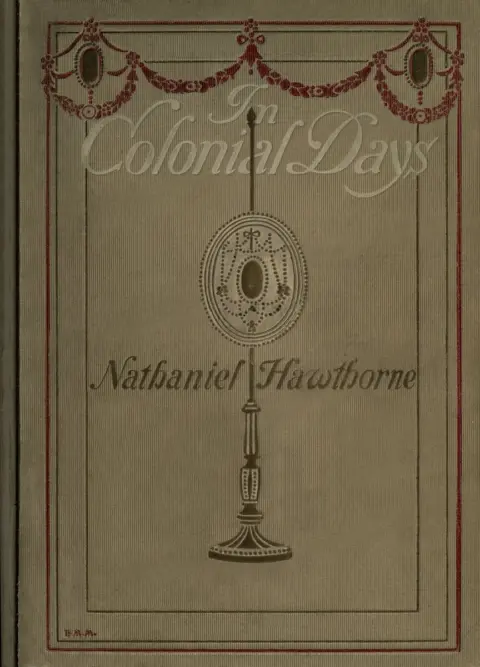
Nathaniel Hawthorne

Rebecca Harding Davis & Thomas De Quincey & Charles Dickens & Nathaniel Hawthorne & Edward Bulwer Lytton, Baron Lytton & Edgar Allan Poe & Harriet Elizabeth Prescott Spofford
BEHIND THE BOOK
This eBook is for the use of anyone anywhere in the United States and most other parts of the world at no cost and with almost no restrictions whatsoever. You may copy it, give it away or re-use it under the terms of the Project Gutenberg License included with this eBook or online at www.gutenberg.org. If you are not located in the United States, you will have to check the laws of the country where you are located before using this eBook. Read the source licence.
The original source file, including credits and licence, is retained by this library. Request an original-format copy at no charge. Please include the book title and Project Gutenberg identifier #8090.
KEEP YOUR CURIOSITY GOING
Wilfrid Scawen Blunt
Wilfrid Scawen Blunt

E. W. (Edgar Watson) Howe

David Patterson (Spirit) Hatch

David Patterson (Spirit) Hatch

David Patterson (Spirit) Hatch