THE CLASSIC COLLECTION✦Love Letters of Nathaniel Hawthorne, Volume 2 (of 2)CLASSIC FREE BOOKS
Love Letters of Nathaniel Hawthorne, Volume 2 (of 2)
Nathaniel Hawthorne
THE CLASSIC COLLECTION · 1863
"Our Old Home: A Series of English Sketches" by Nathaniel Hawthorne is a collection of essays written in the mid-19th century that reflect on the author's experiences during his time as the American consul in Liverpool, England. The sketches convey Hawthorne's perceptions of English culture, scenery, and the contrasts between American and English national identities, revealing both admiration and critique of the English way of life. The opening of the text introduces the reader to Hawthorne's motivation for writing these sketches, capturing his feelings of nostalgia and ambivalence towards England as his "old home." He begins by expressing a personal dedication to a friend, Franklin Pierce, and explains the humble nature of these essays, which do not tackle grand political themes but rather focus on aesthetic observations of English life. Hawthorne shares vivid descriptions of his experiences at the consulate, depicting a chaotic environment filled with Americans seeking refuge or assistance, and illustrating his nuanced views on the English populace, ranging from admiration to a recognition of their perceived arrogance. Through these reflections, Hawthorne sets the tone for a series of explorations into the landscape and social fabric of England, revealing the complexities of identity and belonging for him as an American abroad.
Introduction adapted from the source catalogue; source summaries may be automatically generated.
Free to read · English · 115,855 words · No account needed
MAKE TIME FOR A GOOD BOOK
On by default. Untick to stop anonymous reading totals. Each page counts after 10 seconds in view. How this works.
Anonymous counting is on unless you have switched it off.
On a Sunday afternoon, I passed through a side-entrance in the time-blackened wall of a place of worship, and found myself among a congregation assembled in one of the transepts and the immediately contiguous portion of the nave. It was a vast old edifice, spacious enough, within the extent covered by its pillared roof and overspread by its stone pavement, to accommodate the whole of church-going London, and with a far wider and loftier concave than any human power of lungs could fill with audible prayer. Oaken benches were arranged in the transept, on one of which I seated myself, and joined, as well as I knew how, in the sacred business that was going forward. But when it came to the sermon, the voice of the preacher was puny, and so were his thoughts, and both seemed impertinent at such a time and place, where he and all of us were bodily included within a sublime act of religion, which could be seen above and around us and felt beneath our feet. The structure itself was the worship of the devout men of long ago, miraculously preserved in stone without losing an atom of its fragrance and fervor; it was a kind of anthem-strain that they had sung and poured out of the organ in centuries gone by; and being so grand and sweet, the Divine benevolence had willed it to be prolonged for the behoof of auditors unborn. I therefore came to the conclusion, that, in my individual case, it would be better and more reverent to let my eyes wander about the edifice than to fasten them and my thoughts on the evidently uninspired mortal who was venturing--and felt it no venture at all--to speak here above his breath.
The interior of Westminster Abbey (for the reader recognized it, no doubt, the moment we entered) is built of rich brown stone; and the whole of it--the lofty roof, the tall, clustered pillars, and the pointed arches--appears to be in consummate repair. At all points where decay has laid its finger, the structure is clamped with iron or otherwise carefully protected; and being thus watched over,--whether as a place of ancient sanctity, a noble specimen of Gothic art, or an object of national interest and pride,--it may reasonably be expected to survive for as many ages as have passed over it already. It was sweet to feel its venerable quietude, its long-enduring peace, and yet to observe how kindly and even cheerfully it received the sunshine of to-day, which fell from the great windows into the fretted aisles and arches that laid aside somewhat of their aged gloom to welcome it. Sunshine always seems friendly to old abbeys, churches, and castles, kissing them, as it were, with a more affectionate, though still reverential familiarity, than it accords to edifices of later date. A square of golden light lay on the sombre pavement of the nave, afar off, falling through the grand western entrance, the folding leaves of which were wide open, and afforded glimpses of people passing to and fro in the outer world, while we sat dimly enveloped in the solemnity of antique devotion. In the south transept, separated from us by the full breadth of the minster, there were painted glass windows of which the uppermost appeared to be a great orb of many-colored radiance, being, indeed, a cluster of saints and angels whose glorified bodies formed the rays of an aureole emanating from a cross in the midst. These windows are modern, but combine softness with wonderful brilliancy of effect. Through the pillars and arches, I saw that the walls in that distant region of the edifice were almost wholly incrusted with marble, now grown yellow with time, no blank, unlettered slabs, but memorials of such men as their respective generations deemed wisest and bravest. Some of them were commemorated merely by inscriptions on mural tablets, others by sculptured bas-reliefs, others (once famous, but now forgotten generals or admirals, these) by ponderous tombs that aspired towards the roof of the aisle, or partly curtained the immense arch of a window. These mountains of marble were peopled with the sisterhood of Allegory, winged trumpeters, and classic figures in full-bottomed wigs; but it was strange to observe how the old Abbey melted all such absurdities into the breadth of its own grandeur, even magnifying itself by what would elsewhere have been ridiculous. Methinks it is the test of Gothic sublimity to overpower the ridiculous without deigning to hide it; and these grotesque monuments of the last century answer a similar purpose with the grinning faces which, the old architects scattered among their most solemn conceptions.
Your reading position is saved on this browser. Take it to another device with a library code. Reading pages adapt to text, rather than matching a printed edition.
Nathaniel Hawthorne
Nathaniel Hawthorne
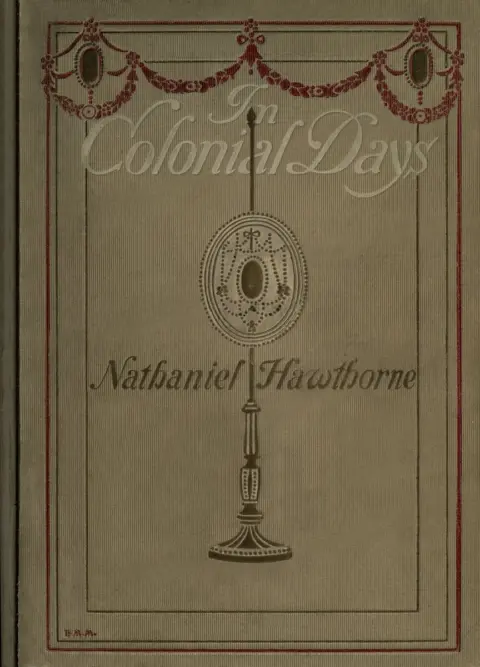
Nathaniel Hawthorne

Rebecca Harding Davis & Thomas De Quincey & Charles Dickens & Nathaniel Hawthorne & Edward Bulwer Lytton, Baron Lytton & Edgar Allan Poe & Harriet Elizabeth Prescott Spofford
BEHIND THE BOOK
This eBook is for the use of anyone anywhere in the United States and most other parts of the world at no cost and with almost no restrictions whatsoever. You may copy it, give it away or re-use it under the terms of the Project Gutenberg License included with this eBook or online at www.gutenberg.org. If you are not located in the United States, you will have to check the laws of the country where you are located before using this eBook. Read the source licence.
The original source file, including credits and licence, is retained by this library. Request an original-format copy at no charge. Please include the book title and Project Gutenberg identifier #8090.
KEEP YOUR CURIOSITY GOING
Wilfrid Scawen Blunt
Wilfrid Scawen Blunt

E. W. (Edgar Watson) Howe

David Patterson (Spirit) Hatch

David Patterson (Spirit) Hatch

David Patterson (Spirit) Hatch