THE CLASSIC COLLECTION✦Love Letters of Nathaniel Hawthorne, Volume 2 (of 2)CLASSIC FREE BOOKS
Love Letters of Nathaniel Hawthorne, Volume 2 (of 2)
Nathaniel Hawthorne
THE CLASSIC COLLECTION · 1863
"Our Old Home: A Series of English Sketches" by Nathaniel Hawthorne is a collection of essays written in the mid-19th century that reflect on the author's experiences during his time as the American consul in Liverpool, England. The sketches convey Hawthorne's perceptions of English culture, scenery, and the contrasts between American and English national identities, revealing both admiration and critique of the English way of life. The opening of the text introduces the reader to Hawthorne's motivation for writing these sketches, capturing his feelings of nostalgia and ambivalence towards England as his "old home." He begins by expressing a personal dedication to a friend, Franklin Pierce, and explains the humble nature of these essays, which do not tackle grand political themes but rather focus on aesthetic observations of English life. Hawthorne shares vivid descriptions of his experiences at the consulate, depicting a chaotic environment filled with Americans seeking refuge or assistance, and illustrating his nuanced views on the English populace, ranging from admiration to a recognition of their perceived arrogance. Through these reflections, Hawthorne sets the tone for a series of explorations into the landscape and social fabric of England, revealing the complexities of identity and belonging for him as an American abroad.
Introduction adapted from the source catalogue; source summaries may be automatically generated.
Free to read · English · 115,855 words · No account needed
MAKE TIME FOR A GOOD BOOK
On by default. Untick to stop anonymous reading totals. Each page counts after 10 seconds in view. How this works.
Anonymous counting is on unless you have switched it off.
An elderly maid, seeing us looking up at the west front, came to the door of an adjacent house, and called to inquire if we wished to go into the Cathedral; but as there would have been a dusky twilight beneath its roof, like the antiquity that has sheltered itself within, we declined for the present. So we merely walked round the exterior, and thought it more beautiful than that of York; though, on recollection, I hardly deem it so majestic and mighty as that. It is vain to attempt a description, or seek even to record the feeling which the edifice inspires. It does not impress the beholder as an inanimate object, but as something that has a vast, quiet, long-enduring life of its own,--a creation which man did not build, though in some way or other it is connected with him, and kindred to human nature. In short, I fall straightway to talking nonsense, when I try to express my inner sense of this and other cathedrals.
While we stood in the close, at the eastern end of the Minster, the clock chimed the quarters; and then Great Tom, who hangs in the Rood Tower, told us it was eight o'clock, in far the sweetest and mightiest accents that I ever heard from any bell,--slow, and solemn, and allowing the profound reverberations of each stroke to die away before the next one fell. It was still broad daylight in that upper region of the town, and would be so for some time longer; but the evening atmosphere was getting sharp and cool. We therefore descended the steep street,--our younger companion running before us, and gathering such headway that I fully expected him to break his head against some projecting wall.
In the morning we took a fly (an English term for an exceedingly sluggish vehicle), and drove up to the Minster by a road rather less steep and abrupt than the one we had previously climbed. We alighted before the west front, and sent our charioteer in quest of the verger; but, as he was not immediately to be found, a young girl let us into the nave. We found it very grand, it is needless to say, but not so grand, methought, as the vast nave of York Cathedral, especially beneath the great central tower of the latter. Unless a writer intends a professedly architectural description, there is but one set of phrases in which to talk of all the cathedrals in England and elsewhere. They are alike in their great features: an acre or two of stone flags for a pavement; rows of vast columns supporting a vaulted roof at a dusky height; great windows, sometimes richly bedimmed with ancient or modern stained glass; and an elaborately carved screen between the nave and chancel, breaking the vista that might else be of such glorious length, and which is further choked up by a massive organ.--in spite of which obstructions, you catch the broad, variegated glimmer of the painted east window, where a hundred saints wear their robes of transfiguration. Behind the screen are the carved oaken stalls of the Chapter and Prebendaries, the Bishop's throne, the pulpit, the altar, and whatever else may furnish out the Holy of Holies. Nor must we forget the range of chapels (once dedicated to Catholic saints, but which have now lost their individual consecration), nor the old monuments of kings, warriors, and prelates, in the side-aisles of the chancel. In close contiguity to the main body of the Cathedral is the Chapter-House, which, here at Lincoln, as at Salisbury, is supported by one central pillar rising from the floor, and putting forth branches like a tree, to hold up the roof. Adjacent to the Chapter-House are the cloisters, extending round a quadrangle, and paved with lettered tombstones, the more antique of which have had their inscriptions half obliterated by the feet of monks taking their noontide exercise in these sheltered walks, five hundred years ago. Some of these old burial-stones, although with ancient crosses engraved upon them, have been made to serve as memorials to dead people of very recent date.
Your reading position is saved on this browser. Take it to another device with a library code. Reading pages adapt to text, rather than matching a printed edition.
Nathaniel Hawthorne
Nathaniel Hawthorne
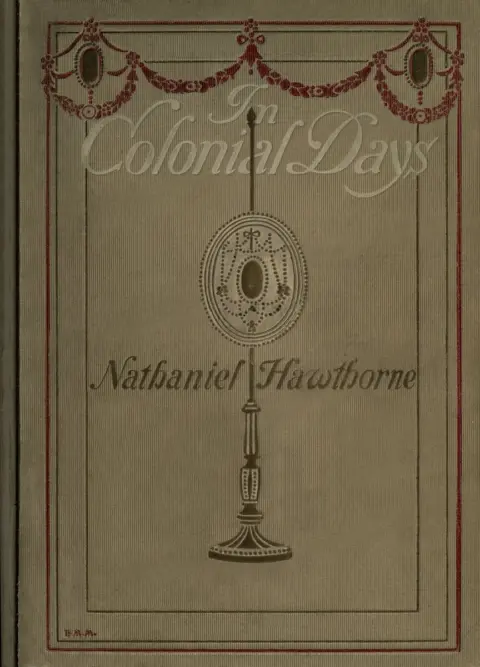
Nathaniel Hawthorne

Rebecca Harding Davis & Thomas De Quincey & Charles Dickens & Nathaniel Hawthorne & Edward Bulwer Lytton, Baron Lytton & Edgar Allan Poe & Harriet Elizabeth Prescott Spofford
BEHIND THE BOOK
This eBook is for the use of anyone anywhere in the United States and most other parts of the world at no cost and with almost no restrictions whatsoever. You may copy it, give it away or re-use it under the terms of the Project Gutenberg License included with this eBook or online at www.gutenberg.org. If you are not located in the United States, you will have to check the laws of the country where you are located before using this eBook. Read the source licence.
The original source file, including credits and licence, is retained by this library. Request an original-format copy at no charge. Please include the book title and Project Gutenberg identifier #8090.
KEEP YOUR CURIOSITY GOING
Wilfrid Scawen Blunt
Wilfrid Scawen Blunt

E. W. (Edgar Watson) Howe

David Patterson (Spirit) Hatch

David Patterson (Spirit) Hatch

David Patterson (Spirit) Hatch