THE CLASSIC COLLECTION✦War-Time Financial ProblemsCLASSIC FREE BOOKS
War-Time Financial Problems
Hartley Withers
THE CLASSIC COLLECTION · 1917
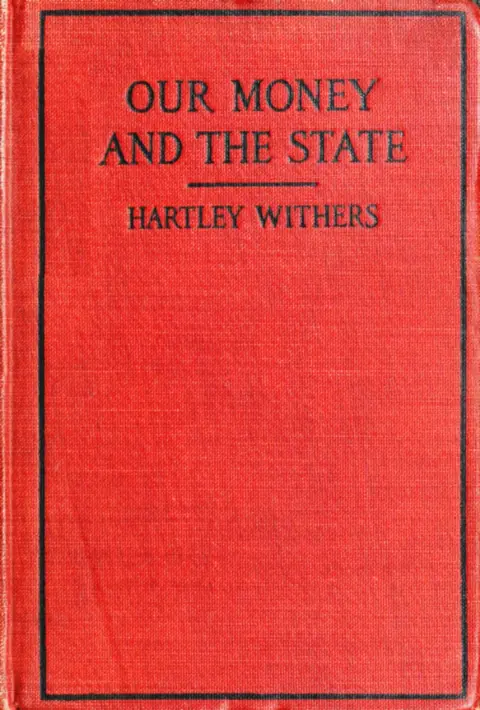
Our money and the state by Hartley Withers. Explore this classic work in a free online edition. Subjects include Finance; Taxation. Read the locally hosted text below, adjust the reading display, and continue where you left off.
Introduction adapted from the source catalogue; source summaries may be automatically generated.
Free to read · English · 32,093 words · No account needed
MAKE TIME FOR A GOOD BOOK
On by default. Untick to stop anonymous reading totals. Each page counts after 10 seconds in view. How this works.
Anonymous counting is on unless you have switched it off.
[10] Since this chapter was written I have been fortified by seeing its main contention endorsed by Professor Sprague, of Harvard, in an article in The Economic Journal for April 1917, which embodied an address given by him to the American Economic Association.
[11] Chisholm’s Analysis of the Public Accounts, p. 509.
[12] A New York banker’s circular, dated April 14th, 1917, says: “Posterity will chiefly benefit from the struggle for freedom and should pay its part.”
[13] Written in March 1917.
[14] Meaning of Money, pp. 64 et seq.
[15] These dates are chosen to fit those of the balance sheets of the other banks, which are only published half-yearly.
[16] Meaning of Money, loc. cit.
[17] A report of the Committee of Public Accounts quoted in the London Economist of August 26th, 1916, p. 357, shows that the British Admiralty and the War Office were buying against one another.
[18] Wealth of Nations, Book V, Chap. II, Part 2.
[19] Political Economy, Part VI, §§ 588 et seq.
[20] Book V, Chap. I, Part II, “Of the Expense of Justice.”
[21] Chisholm’s Analysis, p. 424.
[22] Ibid., p. 416.
[23] Seligman, The Income Tax, p. 132.
[24] About sixty cents.
[25] Seligman, The Income Tax, p. 103.
[26] The full text of the Fabian suggestion is as follows:
“What is suggested is that, so far as incomes not exceeding £2,500 a year are concerned, whether earned or unearned, it should be open to any person assessed to ask that all the taxable receipts of all the members of his family, living in the same household with him and sharing in its expenses, or maintained elsewhere wholly or partially at his expense, should be aggregated for assessment as a Family Income; and that Family Incomes so arrived at should, for income tax purposes, be divided by the number of members of the family (husband, wife, children, stepchildren, father and mother, or grandparents only) actually maintained therefrom. There could then be allowed from the combined Family Income, in respect of each person maintained therefrom, whatever Abatement each portion of such income would justify if it were that of one person only.”--How to Pay for the War, pp. 237-8.
In order to prevent the suggested abatements and allowances from exempting too many people altogether from income tax, these writers suggest that “nothing in them should be allowed to reduce the tax actually payable below the minimum of, say, a penny in the pound on the income prior to the deduction of any abatement or allowance.”
[27] “All persons being required to make returns of the whole of their income, from whatever source derived.”--Chisholm’s Analysis, p. 425.
[28] Wealth and Welfare, p. 371, 2.
[29] Seligman, The Income Tax, p. 165.
[30] British Budgets, by Sir B. Mallet, pp. 105 and 493.
[31] I have developed this platitude in a book called Poverty and
Waste, published in 1913.
Your reading position is saved on this browser. Take it to another device with a library code. Reading pages adapt to text, rather than matching a printed edition.
BEHIND THE BOOK
This eBook is for the use of anyone anywhere in the United States and most other parts of the world at no cost and with almost no restrictions whatsoever. You may copy it, give it away or re-use it under the terms of the Project Gutenberg License included with this eBook or online at www.gutenberg.org. If you are not located in the United States, you will have to check the laws of the country where you are located before using this eBook. Read the source licence.
The original source file, including credits and licence, is retained by this library. Request an original-format copy at no charge. Please include the book title and Project Gutenberg identifier #79609.
KEEP YOUR CURIOSITY GOING

Charles G. (Charles Griffith) Ross
Hannah Webster Foster

Emily Lawless
Edwin Hamlin Carr

Charles De Lano Hine
Andrew Ure