THE CLASSIC COLLECTION✦The Feasts of Autolycus: The Diary of a Greedy WomanCLASSIC FREE BOOKS
The Feasts of Autolycus: The Diary of a Greedy Woman
Elizabeth Robins Pennell
THE CLASSIC COLLECTION · 1910
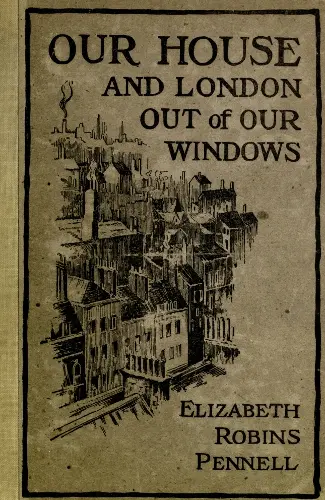
"Our House and London out of Our Windows" by Elizabeth Robins Pennell is a memoir written in the early 20th century. The book provides an intimate look into life from the perspective of the author and her partner, as they navigate the challenges of domestic life and the quirks of their hired help in London. The focus on amusing and sometimes poignant anecdotes paints a vivid picture of their home and surroundings, allowing readers to explore both the beauty and difficulties of their experiences. The beginning of the narrative recounts the serendipitous journey the author and her partner undertake in search of a home, leading them to a charming residence on the Thames. As they settle in, the author introduces her first servant, 'Enrietter', who initially seems perfect but quickly leads to a series of dramatic and comical incidents that showcase the complexities of hiring help in London. The author reflects on her expectations versus the reality of domestic life, setting the stage for the many adventures, misadventures, and vibrant characters that populate their world as they seek to create a sense of home amidst the chaos of urban living.
Introduction adapted from the source catalogue; source summaries may be automatically generated.
Free to read · English · 69,236 words · No account needed
MAKE TIME FOR A GOOD BOOK
On by default. Untick to stop anonymous reading totals. Each page counts after 10 seconds in view. How this works.
Anonymous counting is on unless you have switched it off.
He was a man of wonderful schemes, but originally they led to results as wonderful. When we first knew him he ruled in an office in Bond Street, he had partners, he had clerks, he had a porter in livery at the door. He embarked upon daring adventures and brought them off. He gave interesting commissions, and he paid for them too, as we learned to our profit. He had large ideas and a wide horizon; he shrank from the cheap and popular, from what the people like. He was not above taking the advice of others upon subjects of which he was broad-minded enough to understand and to acknowledge his own ignorance, for he spared himself no pains in his determination to secure the best. And he was full of go; that was why we liked him. I look back to evenings when he came to dinner to talk over some new scheme, and when he would sit on and talk on after his last train--his home was in the suburbs--had long gone and, as he told us afterwards, he would have to wait in one of the little restaurants near Fleet Street that are open all night for journalists until it was time to catch the earliest newspaper train. He would drop in at any odd hour to discuss his latest enterprise. We were always seeing him, and we were always delighted to see him, enthusiasm not being so common a virtue in the Briton that we can afford not to make the most of it when it happens. We found him, as a consequence, a stimulating companion. I cannot say exactly when the change came; why it came remains a mystery to us to this day. Probably it began long before we realized it. The first symptoms were a trick of borrowing: at the outset such trivial things as a daily paper to which he should have subscribed, or books which he should have bought for himself. Then it was a half crown here and a half crown there, because he had not time to go back to the office before rushing to the station, or because he had not a cab fare with him, or because of half a dozen other accidents as plausible. We might not have given a second thought to all this but for the rapidity with which the half crowns developed into five shillings, and the five into ten, and the ten into a sovereign on evenings when the cab, for which we had to take his word, had been waiting during the hours of his stay. We could not help our suspicions, the more so because that indefinable but rank odour of drugs, by which our Beggars too frequently announce themselves, grew stronger as the amount of which he was in need increased. And very soon he was confiding to us the details of a quarrel which deprived him of his partners and their capital. Then the Bond Street office was given up and his business was done in some vague rooms, the whereabouts of which he never disclosed; only too soon it seemed to be done entirely in the street. We would meet him at night slinking along the Strand, one of the miserable shadows of humanity whom the darkness lures out of the nameless holes and corners where they hide during the day. At last came a period when he kept away from our chambers altogether, sending his wife to us instead. Her visits were after dark, usually towards midnight. She called for all sorts of things,--a week's rent, medicine from the druggist in the Strand, Sunday's dinner, her 'bus fare home, once I remember for an umbrella. She was never without an excuse for the emergency that forced her to disturb us, and she was no less fine than he in keeping up the fiction that it was an emergency, and that business prospered though removed from Bond Street into the Unknown. I think it was after this loan of an umbrella that he again came himself, nominally to return it and incidentally to borrow something else. I had not seen him for several months. It might have been years judging from his appearance, and I wished, as I still wish, I had not seen him then. In the Bond Street days he had the air of a man who lived well, and he was correct in dress, "well groomed" as they say. And now? His face was as colourless and emaciated as the faces from which I shrink in the "hunger line" on the Embankment; he wore a brown tweed suit, torn and mended and torn again, with a horrible patch of another colour on one knee that drew my eyes irresistibly to it; his straw hat was as burned and battered as days of tramping in the sun and nights of sleeping in the rain could make it. He was the least embarrassed of the two. In fact, he was not embarrassed at all, but sat in the chair where so often he had faced me in irreproachable frock coat and spotless trousers, and explained as in the old days his wonderful schemes, expressing again the hope that we would second him and, with him, again achieve success. He might have been a prince promising his patronage. And all the while I did not know which way to look, so terrible was his face pinched and drawn with hunger, so eloquent that staring patch on his knee. That was several years ago, and it was the last visit either he or his wife ever made us. I cannot imagine that anything was left to them except greater misery, deeper degradation, and--the merciful end, which I hope came swiftly.
Your reading position is saved on this browser. Take it to another device with a library code. Reading pages adapt to text, rather than matching a printed edition.
Elizabeth Robins Pennell
Joseph Pennell & Elizabeth Robins Pennell
Elizabeth Robins Pennell & Joseph Pennell
Joseph Pennell & Elizabeth Robins Pennell
BEHIND THE BOOK
This eBook is for the use of anyone anywhere in the United States and most other parts of the world at no cost and with almost no restrictions whatsoever. You may copy it, give it away or re-use it under the terms of the Project Gutenberg License included with this eBook or online at www.gutenberg.org. If you are not located in the United States, you will have to check the laws of the country where you are located before using this eBook. Read the source licence.
The original source file, including credits and licence, is retained by this library. Request an original-format copy at no charge. Please include the book title and Project Gutenberg identifier #38749.
KEEP YOUR CURIOSITY GOING
Wilfrid Scawen Blunt
Wilfrid Scawen Blunt

E. W. (Edgar Watson) Howe
Francis Greenleaf Allinson & Anne C. E. (Anne Crosby Emery) Allinson
Cyrenus Cole

John Martineau