
Some Artists at the Fair
Francis Davis Millet & W. Hamilton (William Hamilton) Gibson & Will H. (Will Hicok) Low & John Ames Mitchell & Francis Hopkinson Smith
THE CLASSIC COLLECTION · 1895
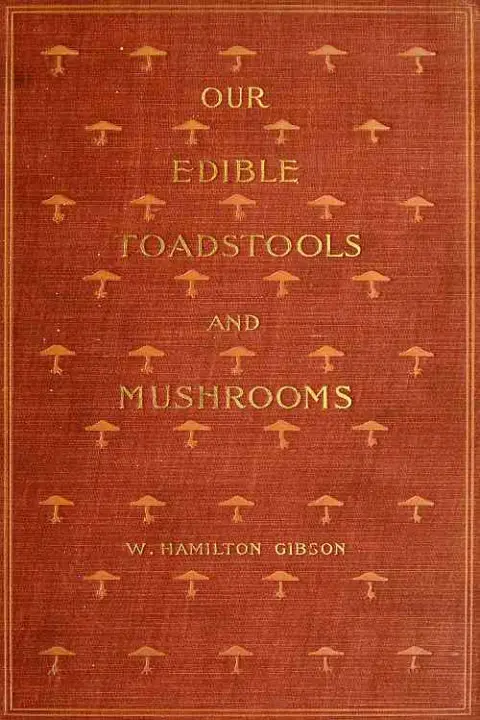
"Our Edible Toadstools and Mushrooms and How to Distinguish Them" by W. Hamilton Gibson is a practical guide on identifying edible fungi, likely written in the late 19th century. This publication focuses on educating the general public about thirty native food mushroom varieties and provides easy-to-follow rules for distinguishing these from their potentially poisonous counterparts. The book aims to promote the safe appreciation and gathering of mushrooms, addressing both the joy of foraging and the importance of caution. The opening of this work presents a thoughtful introduction to the author’s motivation for creating a user-friendly guide to mushrooms, responding to concerns about the widespread popularity and risks of mushroom consumption. Gibson discusses the challenges of conveying scientific knowledge on fungi to the general audience and highlights the specific dangers associated with poisonous species, particularly the Amanita genus. He emphasizes the need for practical knowledge in mushroom identification to prevent fatalities, while also underscoring the bountiful resources available in nature that could alleviate hunger if gathered mindfully. The author aims to empower readers with the skills to safely enjoy the culinary delights offered by certain mushrooms, while remaining vigilant against the dangers of misidentifying toxic varieties.
Introduction adapted from the source catalogue; source summaries may be automatically generated.
Free to read · English · 48,918 words · No account needed
MAKE TIME FOR A GOOD BOOK
On by default. Untick to stop anonymous reading totals. Each page counts after 10 seconds in view. How this works.
Anonymous counting is on unless you have switched it off.
=Season:= July-September.
[Sidenote: =Mild white-milk species=]
One other species of Lactarius, L. volemum, may properly find a place in this work as being easily recognized. In general shape it resembles L. deliciosus. The top is of a rich sienna golden hue; the gills are crowded. The milk is white as it first falls from the fracture, becoming dull dark-reddish, and having a mild, pleasant taste; gills white, at length yellowish or buff-colored. This species is esculent.
[Sidenote: =Peppery white-milk species=]
Other species are accounted edible, even one--the peppery Lactarius, L. piperatus--a pure-white variety, whose copious exudations of white milk will almost blister the lips, an acrid property which is claimed by Curtis, Smith, and others to be dispelled in cooking, by which treatment it becomes delicious and wholesome.
This species may reach a diameter of seven inches, its shape at first rounded, convex, then flat, concave, and finally funnel-shaped, as in many of the species. But its decidedly ardent tang in the raw state, as reminiscent from my own experience, warns me not to dwell too enthusiastically upon its merits in my limited selection of desirable esculent species.
Cantharellus cibarius
Bearing somewhat the shape of the Lactarius, but having its own distinguishing features, is the Chantarelle (Plate 19).
[Sidenote: =Fluted gills=]
The "Agarics," as already described on page 79, are distinguished by the feature of the gills, or thin laminated curtains--the hymenium--upon which the spores are produced, and from which they are shed beneath the mushroom. These gills vary in thickness and number in the various species, and in one genus are so short, thick, swollen, and branched as to give rather the effect of turgid veins than gills, as shown in the accompanying sectional drawing. We occasionally come upon one of these mushrooms in our walks, usually in the woods. When it first appears the cap is rounded, and the rim folded inward towards the stem; but in mature specimens it assumes the flat or, later, the cup-shaped form shown in Plate 19.
=Cantharellus cibarius=
=Pileus:= At first convex, later flat; three to five inches in diameter, with central hollow, and finally almost funnel form. Color, bright to deep yellow above and below.
=Gills:= Shallow and fluted, resembling swollen veins, branched, more or less interconnected and tapering off down the stem; color same as pileus.
=Stem:= Solid, generally (often slightly) tapering towards base; paler than pileus or gills.
=Spores:= Very pale yellow ochre in color; elliptical.
=Taste:= Peppery and pungent in the raw state; mild
and sweet after cooking.
=Odor:= Suggesting ripe apricots or plums.
Your reading position is saved on this browser. Take it to another device with a library code. Reading pages adapt to text, rather than matching a printed edition.
Francis Davis Millet & W. Hamilton (William Hamilton) Gibson & Will H. (Will Hicok) Low & John Ames Mitchell & Francis Hopkinson Smith
W. Hamilton (William Hamilton) Gibson
W. Hamilton (William Hamilton) Gibson
BEHIND THE BOOK
This eBook is for the use of anyone anywhere in the United States and most other parts of the world at no cost and with almost no restrictions whatsoever. You may copy it, give it away or re-use it under the terms of the Project Gutenberg License included with this eBook or online at www.gutenberg.org. If you are not located in the United States, you will have to check the laws of the country where you are located before using this eBook. Read the source licence.
The original source file, including credits and licence, is retained by this library. Request an original-format copy at no charge. Please include the book title and Project Gutenberg identifier #46514.
KEEP YOUR CURIOSITY GOING

Charles G. (Charles Griffith) Ross
Hannah Webster Foster

Emily Lawless
Edwin Hamlin Carr

Charles De Lano Hine
Andrew Ure