
Some Artists at the Fair
Francis Davis Millet & W. Hamilton (William Hamilton) Gibson & Will H. (Will Hicok) Low & John Ames Mitchell & Francis Hopkinson Smith
THE CLASSIC COLLECTION · 1895
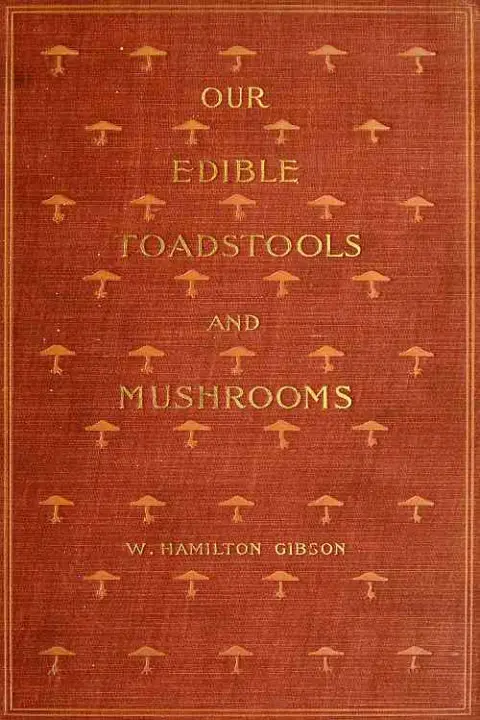
"Our Edible Toadstools and Mushrooms and How to Distinguish Them" by W. Hamilton Gibson is a practical guide on identifying edible fungi, likely written in the late 19th century. This publication focuses on educating the general public about thirty native food mushroom varieties and provides easy-to-follow rules for distinguishing these from their potentially poisonous counterparts. The book aims to promote the safe appreciation and gathering of mushrooms, addressing both the joy of foraging and the importance of caution. The opening of this work presents a thoughtful introduction to the author’s motivation for creating a user-friendly guide to mushrooms, responding to concerns about the widespread popularity and risks of mushroom consumption. Gibson discusses the challenges of conveying scientific knowledge on fungi to the general audience and highlights the specific dangers associated with poisonous species, particularly the Amanita genus. He emphasizes the need for practical knowledge in mushroom identification to prevent fatalities, while also underscoring the bountiful resources available in nature that could alleviate hunger if gathered mindfully. The author aims to empower readers with the skills to safely enjoy the culinary delights offered by certain mushrooms, while remaining vigilant against the dangers of misidentifying toxic varieties.
Introduction adapted from the source catalogue; source summaries may be automatically generated.
Free to read · English · 48,918 words · No account needed
MAKE TIME FOR A GOOD BOOK
On by default. Untick to stop anonymous reading totals. Each page counts after 10 seconds in view. How this works.
Anonymous counting is on unless you have switched it off.
Mrs. B., 1/180, 1/90, 1/90, or 5/180, or 1/36 gr.
Mr. F., 1/180, 1/90, 1/90, 1/90, or 7/180 gr.
Mrs. R., 1/180, 1/90, 1/90, 1/90, or 7/180 gr.
Thos. R., 1/180, 1/90, 1/90, 1/90, 1/90, or 9/180, or
1/20 gr.
Mrs. F., 1/180, 1/90, 1/90, 1/90, 1/90, or 9/180, or
1/20 gr.
In accordance with the above formulæ the drug was administered. I visited the patients at intervals of six or eight hours, and at each visitation they received an injection in the doses above mentioned. From this we see that in all Mrs. B. received gr. 1/36 of atropine; Mr. F. received gr. 7/180 of atropine; Mrs. R. received gr. 7/180 of atropine; Thos R. (fatal) received gr. 1/20 of atropine; Mrs. F. (fatal) received gr. 1/20 of atropine.
The alkaloid failing to save the two that died I think can be attributed to one of two causes, or probably both:
1. That the use of atropine was begun too late and not
used heroically enough.
2. That so much of the poison was taken up by the
system in these cases that it became too virulent
to counteract.
From the history of the cases I know they ate by far the largest quantity. My opinion leans towards the first probable cause I have mentioned.
Another fact worth stating here is that the pupils
never became affected by the administration of these
doses.
Hoping this will make the matter satisfactory, I remain
Yours truly, J. E. SHADLE.
The interval between the ingestion and the symptoms is, therefore, a most important aid in the diagnosis of a case of mushroom poisoning; and in the event of an Amanita, heretofore absolutely fatal, it is presumably under the control of medical science, now that the deadly toxic principle has at last found its enemy in the neutralizing properties of the equally deadly atropine.
It would seem, moreover, from the severe personal experience of Mr. Julius A. Palmer, that the poison of the Amanita is quite capable of mischief without being taken into the digestive organs. So volatile is this dangerous alkaloid that it may produce violent effects upon the system either through its odor alone, or by simple contact with the skin and consequent absorption.
Mr. Palmer, in his before-mentioned article in the Moniteur Scientifique, Paris, relates the following experiences:
[Sidenote: =Poisons by contact and odor=]
"Once while perspiring from a long walk I undertook to bring in a large bunch of the Amanita for an artist. Seated in a close car, holding them in my warm hand, although protected by a paper wrapper, a fearful nausea overcame me. The toadstool was not at first suspected, yet I had all the symptoms of a sea-sick person, and was only relieved by a wide distance between myself and the exciting cause.
Your reading position is saved on this browser. Take it to another device with a library code. Reading pages adapt to text, rather than matching a printed edition.
Francis Davis Millet & W. Hamilton (William Hamilton) Gibson & Will H. (Will Hicok) Low & John Ames Mitchell & Francis Hopkinson Smith
W. Hamilton (William Hamilton) Gibson
W. Hamilton (William Hamilton) Gibson
BEHIND THE BOOK
This eBook is for the use of anyone anywhere in the United States and most other parts of the world at no cost and with almost no restrictions whatsoever. You may copy it, give it away or re-use it under the terms of the Project Gutenberg License included with this eBook or online at www.gutenberg.org. If you are not located in the United States, you will have to check the laws of the country where you are located before using this eBook. Read the source licence.
The original source file, including credits and licence, is retained by this library. Request an original-format copy at no charge. Please include the book title and Project Gutenberg identifier #46514.
KEEP YOUR CURIOSITY GOING

Charles G. (Charles Griffith) Ross
Hannah Webster Foster

Emily Lawless
Edwin Hamlin Carr

Charles De Lano Hine
Andrew Ure