
Some Artists at the Fair
Francis Davis Millet & W. Hamilton (William Hamilton) Gibson & Will H. (Will Hicok) Low & John Ames Mitchell & Francis Hopkinson Smith
THE CLASSIC COLLECTION · 1895
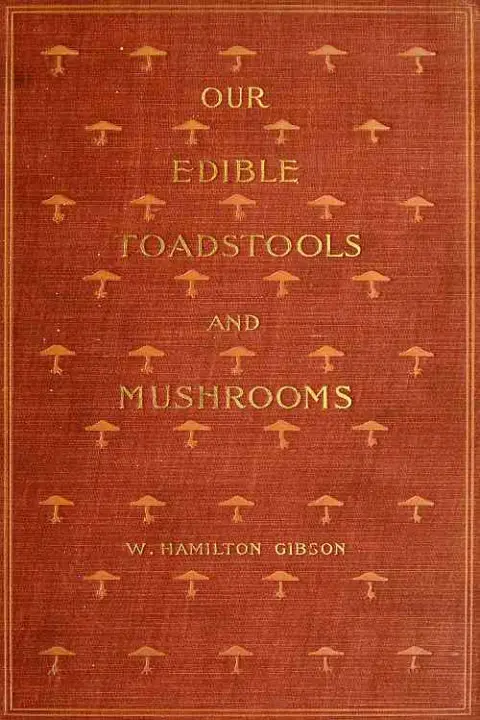
"Our Edible Toadstools and Mushrooms and How to Distinguish Them" by W. Hamilton Gibson is a practical guide on identifying edible fungi, likely written in the late 19th century. This publication focuses on educating the general public about thirty native food mushroom varieties and provides easy-to-follow rules for distinguishing these from their potentially poisonous counterparts. The book aims to promote the safe appreciation and gathering of mushrooms, addressing both the joy of foraging and the importance of caution. The opening of this work presents a thoughtful introduction to the author’s motivation for creating a user-friendly guide to mushrooms, responding to concerns about the widespread popularity and risks of mushroom consumption. Gibson discusses the challenges of conveying scientific knowledge on fungi to the general audience and highlights the specific dangers associated with poisonous species, particularly the Amanita genus. He emphasizes the need for practical knowledge in mushroom identification to prevent fatalities, while also underscoring the bountiful resources available in nature that could alleviate hunger if gathered mindfully. The author aims to empower readers with the skills to safely enjoy the culinary delights offered by certain mushrooms, while remaining vigilant against the dangers of misidentifying toxic varieties.
Introduction adapted from the source catalogue; source summaries may be automatically generated.
Free to read · English · 48,918 words · No account needed
MAKE TIME FOR A GOOD BOOK
On by default. Untick to stop anonymous reading totals. Each page counts after 10 seconds in view. How this works.
Anonymous counting is on unless you have switched it off.
[Sidenote: =Worthless popular tests=]
The change of color in fracture (9) has long been a ban to the fungus as food. But this would exclude several very delicious species, which turn bluish, greenish, and red when broken--viz., Boletus subtomentosus (Plate 22), Boletus strobilaceus (Plate 23), and Lactarius (Plate 18).
The "toadstools" with "sticky tops" thus discriminated against (10) include a number of esculent species, Boleti and Russulæ, and others, as do also the varieties with side-stems (11)--viz., Agaricus ulmarius (Plate 15), Fistulina hepatica (Plate 25), Agaricus ostreatus (Plate 14), etc.
[Sidenote: =Worthless popular tests=]
The clustered fungi (12) have long been included in the black-list without reason, as witness the following esteemed esculent species: The Shaggy-mane (Plate 16), Coprinus atramentarius (Plate 17), Oyster mushroom (Plate 14), Elm mushroom (Plate 15), Puff-balls (Plate 34), and Champignon (Plate 8).
To exclude all fungi which grow in dark, damp places (13) is a singular inconsistency, as in some localities this would eliminate the very one species of "mushroom" admittedly eatable by popular favor. In many countries these are regularly cultivated for market in dark, damp, subterranean caverns or in cellars. Indeed, the "dark, damp place" would appear to be the ideal habitat of this the "only mushroom!"
Equally absurd is the discrimination against those growing on wood (14), which again deprives us of the delicious Hydnum (Plate 27), the Beefsteak (Plate 25), Oyster mushroom (Plate 14), Elm mushroom (Plate 15), and many others, including Puff-balls (Plate 34). If we exclude those growing upon or near manure (15), we shall be obliged to omit the Coprinus group (Plates 16 and 17), and often the "reel mushroom" as well.
Among the bright-colored species (16), it is true, are many dangerous individuals, as, for instance, the deadly Fly Amanita of Plate 4, and the emetic Russula (Plate 13), but on this fiat we should have to reject the other brilliant esculent Russulæ (Plates 11 and 12), the brilliant yellow Chantarelle (Plate 19), the Lactarius (Plate 18), and various other equally palatable and wholesome species.
[Sidenote: =Worthless popular tests=]
The objection against milky mushrooms (17) would serve to exclude the poisonous species of Lactarius, but would thus include at least two of the delicious species of the group, L. deliciosus, with orange milk (Plate 18), and L. piperatus, another species with white milk not figured in this volume.
The group of Russulæ, most of which are esculent, is notable for their gills of even length (18), though not all the species are thus characterized. This discrimination, however, especially applies to the Shaggy-mane (Plate 16), which is conspicuously even-gilled, and is a decided delicacy.
This species, together with its congener, the edible Coprinus atramentarius (Plate 17), are notorious for their melting into black fluid (19), which is thus of no significance as a test, although the mushrooms are not supposed to be eaten in this stage of deliquescence.
Your reading position is saved on this browser. Take it to another device with a library code. Reading pages adapt to text, rather than matching a printed edition.
Francis Davis Millet & W. Hamilton (William Hamilton) Gibson & Will H. (Will Hicok) Low & John Ames Mitchell & Francis Hopkinson Smith
W. Hamilton (William Hamilton) Gibson
W. Hamilton (William Hamilton) Gibson
BEHIND THE BOOK
This eBook is for the use of anyone anywhere in the United States and most other parts of the world at no cost and with almost no restrictions whatsoever. You may copy it, give it away or re-use it under the terms of the Project Gutenberg License included with this eBook or online at www.gutenberg.org. If you are not located in the United States, you will have to check the laws of the country where you are located before using this eBook. Read the source licence.
The original source file, including credits and licence, is retained by this library. Request an original-format copy at no charge. Please include the book title and Project Gutenberg identifier #46514.
KEEP YOUR CURIOSITY GOING

Charles G. (Charles Griffith) Ross
Hannah Webster Foster

Emily Lawless
Edwin Hamlin Carr

Charles De Lano Hine
Andrew Ure