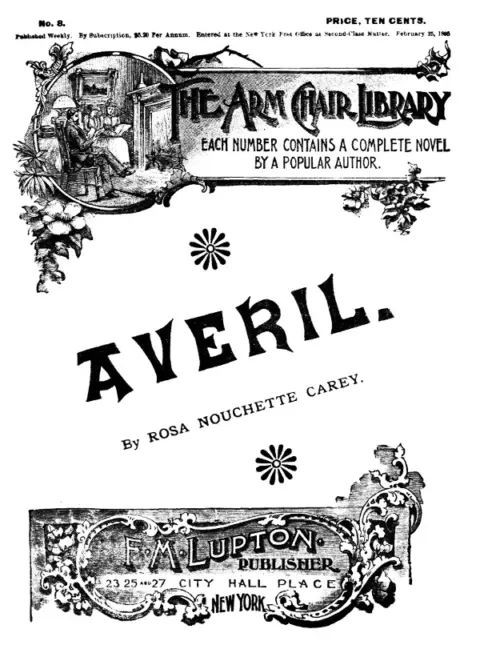
Averil
Rosa Nouchette Carey
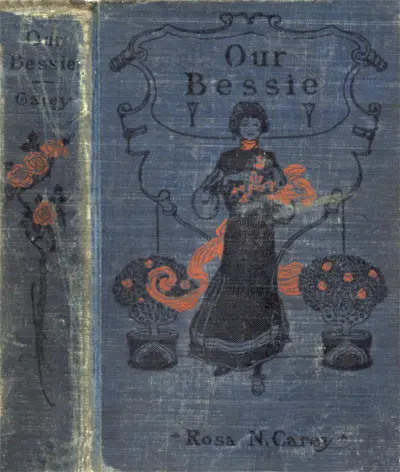
THE CLASSIC COLLECTION · 1891
"Our Bessie" by Rosa Nouchette Carey is a novel written in the late 19th century. The story revolves around Bessie Lambert, a cheerful and optimistic young woman who encounters a series of adventures, particularly highlighted by her meeting with Edna Sefton during a snowbound train journey. The narrative explores themes of family dynamics, social class differences, and the personal growth of Bessie as she navigates her relationships. At the start of the book, Bessie finds herself stranded in a snowdrift while traveling home. She is optimistic about her situation, viewing it as an adventure rather than an inconvenience. Her demeanor contrasts sharply with that of Edna Sefton, a fellow traveler who is distressed and frightened. After a warm exchange, the two girls bond over their backgrounds, revealing Bessie's modest upbringing and Edna's wealth. As the train is eventually freed from the snow, Bessie's kindheartedness and willingness to help Edna set the stage for their evolving friendship, illustrating the beginning of Bessie's journey into a world of social interactions that differ from her own.
Introduction adapted from the source catalogue; source summaries may be automatically generated.
Free to read · English · 75,345 words · No account needed
MAKE TIME FOR A GOOD BOOK
On by default. Untick to stop anonymous reading totals. Each page counts after 10 seconds in view. How this works.
Anonymous counting is on unless you have switched it off.
"He does not favor us much with his company, as you will soon see for yourself, Miss Lambert. My stepson is not a society man," observed Mrs. Sefton.
"So much the better," was on Bessie's lips, but she prudently refrained from speaking the words. She was beginning to wonder, however, if Mrs. Sefton or Edna could mention his name without adding something disparaging. Edna especially was forever indulging in some light sarcasm at her brother's expense.
They sat in the cool drawing-room a little while after luncheon, until the Athertons arrived with their rackets; and then they all went down to the tennis lawn.
The Atherton's were nice-looking girls, and Bessie was rather taken with them, but she was somewhat surprised when they opened their lips. She was walking across the grass with Florence, the tallest and prettiest of the sisters, and, indeed, she was rather a sweet-looking girl.
"Is it not a lovely day?" observed Bessie.
"Awfully jolly," replied Miss Florence, in a sharp, clipping voice; and the next minute Bessie heard her call one of her sisters a duffer for missing the ball.
"What would mother say?" thought Bessie. She was not much used to the typical girl of the period; after all, she was an old-fashioned little person.
The Athertons were really nice girls, although they talked slang like their brothers, and conformed to all the foolish fashions of the day, disguising their honest, womanly hearts under blunt, flippant manners.
"What a pity," said Bessie to herself, when she came to know them better. They were good-natured, clever girls, very fond of each other, and devoted to their mother and brothers. Reggie's examination--exam., Florence called it--for Sandhurst; Harold's new coach, and Bertie's score at cricket, were the theme of their conversation. "I am afraid Harold won't pass," observed Sabina sadly. "His last coach was such a muff, but the man he has got now seems a good old sort. Harold can get on with him comfortably."
"Well, what do you think of the girls?" asked Edna, when she and Bessie were left alone at the close of the afternoon.
"I think they are very nice, Florence especially, but it is such a pity that they talk slang; it seems to spoil them, somehow."
"I agree with you that it is bad style, but, you see, they have learned
it from their brothers."
Bad style, that was all. Bessie's gentle-looking mouth closed firmly with the expression it always wore when politeness forbade her to air her true opinions, but in her own heart she was saying:
Your reading position is saved on this browser. Take it to another device with a library code. Reading pages adapt to text, rather than matching a printed edition.
Rosa Nouchette Carey
Rosa Nouchette Carey
Rosa Nouchette Carey
Rosa Nouchette Carey
BEHIND THE BOOK
This eBook is for the use of anyone anywhere in the United States and most other parts of the world at no cost and with almost no restrictions whatsoever. You may copy it, give it away or re-use it under the terms of the Project Gutenberg License included with this eBook or online at www.gutenberg.org. If you are not located in the United States, you will have to check the laws of the country where you are located before using this eBook. Read the source licence.
The original source file, including credits and licence, is retained by this library. Request an original-format copy at no charge. Please include the book title and Project Gutenberg identifier #28651.
KEEP YOUR CURIOSITY GOING
Coulson Kernahan

Maurice Baring
Frances Wright
Cécile Tormay

Frederic Jesup Stimson

W. H. P. (William Henry Pope) Jarvis