THE CLASSIC COLLECTION✦The gist of Burton’s Anatomy of melancholyCLASSIC FREE BOOKS
The gist of Burton’s Anatomy of melancholy
Charles Joseph Finger
THE CLASSIC COLLECTION · 1923
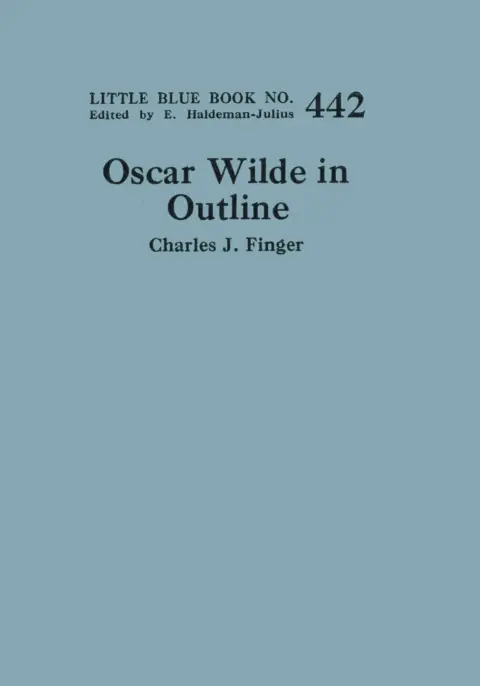
"Oscar Wilde in outline" by Charles Joseph Finger is a critical study written in the early 20th century. It surveys Wilde’s life and writings—poetry, fiction, criticism, and especially drama—through the lens of his temperament, aesthetics, and reputation. The focus is on how Wilde’s paradoxes, influences, and public scandals shaped both his art and its reception, with the case made that his lasting strength lies in his plays and essays.
The opening of this study argues that readers habitually confuse an artist’s work with the accidents of life, then places Wilde within that problem by briskly ranking his achievements across genres and noting how scandal has distorted judgment. Finger sketches Wilde’s “feminine” sensibility, heredity, love of display, and delight in contradiction, then defends the serious intent beneath his provocations—critiques of Puritan moralizing, American commercialism, and empty social ambition, and an insistence on self-culture and art’s independence from morality. He traces Wilde’s partisanship, especially his adoption of Baudelaire’s creed of “art for art’s sake,” and surveys the fiction: a sardonic take on Lord Arthur Savile’s tidy murder, and a mixed appraisal of The Picture of Dorian Gray—lavishly colored, French-influenced, and artificial yet memorable. Briefly, he treats the fairy tales as ornate fables for adults, before celebrating the plays’ glittering wit and stagecraft and noting the press’s hostility. The section then turns to Wilde as critic and essayist—sympathetic, stylish, influenced by Chuang Tzu—reading “Pen, Pencil and Poison” as a cool, psychological portrait rather than an ode to crime. Throughout, Finger quotes widely and compares deftly to argue that Wilde’s paradoxes mask a coherent plea for beauty, individuality, and the primacy of art.
Introduction adapted from the source catalogue; source summaries may be automatically generated.
Free to read · English · 18,365 words · No account needed
MAKE TIME FOR A GOOD BOOK
On by default. Untick to stop anonymous reading totals. Each page counts after 10 seconds in view. How this works.
Anonymous counting is on unless you have switched it off.
Lord Goring. So the newspapers are always telling us.
Vicomte de Nanjac. I read all your English newspapers. I find
them so amusing.
Lord Goring. Then, my dear Nanjac, you must certainly read
between the lines.
Vicomte de Nanjac. I should like to, but my professor objects. (To MABEL CHILTERN.) May I have the pleasure of escorting you to the music-room, Mademoiselle?
Mabel Chiltern (looking very disappointed). Delighted, Vicomte, quite delighted! (Turning to LORD GORING.) Aren’t you coming to the music-room?
Lord Goring. Not if there is any music going on, Miss Mabel.
Mabel Chiltern (severely). The music is in German. You would not understand it. (Goes out with the VICOMTE DE NANJAC. LORD CAVERSHAM comes up to his son.)
Lord Caversham. Well, sir! what are you doing here? Wasting your life as usual. You should be in bed, sir. You keep too late hours! I heard of you the other night at Lady Rufford’s dancing till four o’clock in the morning!
Lord Goring. Only a quarter to four, father.
Lord Caversham. Can’t make out how you stand London society. The thing has gone to the dogs, a lot of damned nobodies talking about nothing.
Lord Goring. I love talking about nothing, father. It is the only thing I know anything about.
Lord Caversham. You seem to me to be living entirely for pleasure.
Lord Goring. What else is there to live for, father? Nothing ages like happiness. --An Ideal Husband (Act I.)
I choose, deliberately, the less talked of portions of the plays I
quote. Here again:
Lady Hunstanton. We who are wives don’t belong to any one.
Lady Stutfield. Oh, I am so very, very glad to hear you say so.
Lady Hunstanton. But do you really think, dear Caroline, that legislation would improve matters in any way? I am told that, nowadays, all the married men live like bachelors, and all the bachelors like married men.
Mrs. Allonby. I certainly never know one from the other.
Lady Stutfield. Oh, I think one can always know at once whether a man has home claims upon his life or not. I have noticed a very, very sad expression in the eyes of so many married men.
Mrs. Allonby. Ah, all that I have noticed is that they are horribly tedious when they are good husbands, and abominably conceited when they are not.
Lady Hunstanton. Well, I suppose the type of husband has completely changed since my young days, but I’m bound to state that poor dear Hunstanton was the most delightful of creatures, and as good as gold.
Your reading position is saved on this browser. Take it to another device with a library code. Reading pages adapt to text, rather than matching a printed edition.
Charles Joseph Finger
Charles Joseph Finger
Charles Joseph Finger
Charles Joseph Finger
BEHIND THE BOOK
This eBook is for the use of anyone anywhere in the United States and most other parts of the world at no cost and with almost no restrictions whatsoever. You may copy it, give it away or re-use it under the terms of the Project Gutenberg License included with this eBook or online at www.gutenberg.org. If you are not located in the United States, you will have to check the laws of the country where you are located before using this eBook. Read the source licence.
The original source file, including credits and licence, is retained by this library. Request an original-format copy at no charge. Please include the book title and Project Gutenberg identifier #77494.
KEEP YOUR CURIOSITY GOING

Charles G. (Charles Griffith) Ross
Hannah Webster Foster

Emily Lawless
Edwin Hamlin Carr

Charles De Lano Hine
Andrew Ure