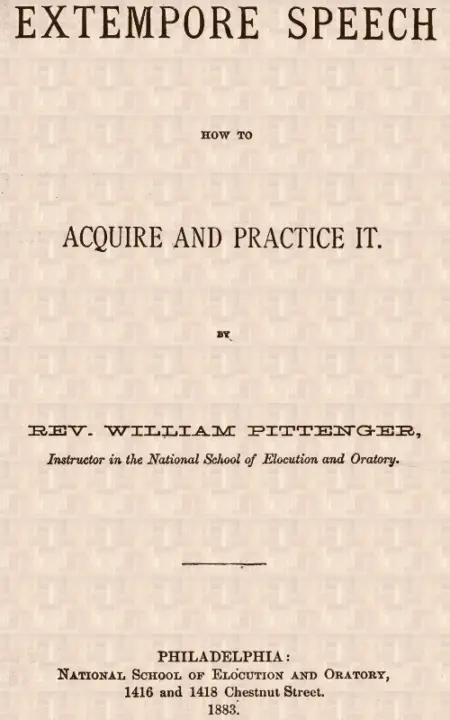
Extempore Speech: How to Acquire and Practice It
William Pittenger
THE CLASSIC COLLECTION · 1868
"Oratory Sacred and Secular; Or, The Extemporaneous Speaker" by William Pittenger is a comprehensive instructional guide on the art of public speaking, written in the late 19th century. The work focuses on the principles and techniques essential for effective extemporaneous speech, particularly in the context of preaching, while also emphasizing the importance of preparation and self-improvement. It includes profiles of eminent speakers throughout history, thus combining practical advice with inspirational examples. The opening of the book introduces the purpose of the text, which is to assist individuals, especially those in the ministry, in mastering the art of extemporaneous speaking. Pittenger reflects on his own experiences of struggling with public speaking and expresses his desire to provide a resource that could have eased that journey. He discusses the advantages and disadvantages of written versus spoken discourse, laying the foundation for the content that will follow, which emphasizes the necessity for intellectual competency, emotional engagement, and a profound understanding of one's subject matter in the pursuit of eloquence. The introduction also hints at the significance of personal growth through the process of public speaking, suggesting that effective oratory comes from a combination of thoughtful preparation and genuine emotion.
Introduction adapted from the source catalogue; source summaries may be automatically generated.
Free to read · English · 75,964 words · No account needed
MAKE TIME FOR A GOOD BOOK
On by default. Untick to stop anonymous reading totals. Each page counts after 10 seconds in view. How this works.
Anonymous counting is on unless you have switched it off.
But prayer is far more than the means of cultivating emotion. There is a direct influence that comes from God to man. The power of the Holy Spirit is no fable. A heavenly anointing is sent down—an unction that gives sweetness and power even to the most commonplace words. It is not bestowed unasked, for God desires that we should feel the need of His high gifts before they are granted. But when humbly implored, there is often breathed an influence from above, mighty to sustain the faithful minister in his task. What an encouraging but awful thought! God himself stands by us in the time of our weakness and gives us His strength. If the minister would always go to the pulpit with this assurance, he would not fear the mass of upturned faces, but calmly view them with a heart stayed on the Master whose work he has to do.
The Spirit’s presence will not in the least absolve us from the need of complete preparation. In nothing is it more true that God helps those who help themselves. All that we contend for is such an influence as will cause the words uttered to penetrate the souls of those for whom they were spoken, remove the fear of man from the preacher’s heart, and make him bold in speaking the truth. It may be that clearer knowledge will be given, and the most fitting selection of words suggested, but this can only be hoped for after all preparation is made. God does not duplicate his work, and that which he gives man faculties to discover, he will not afterward bring to him by an express revelation.
The second method of imparting unction and feeling to the coldness of thought, is by meditating on the great truths and promises of Christianity. This subject is well treated in Baxter’s “Saint’s Rest,” though not with reference to the wants of the orator. The power of long-continued and earnest meditation varies in different persons, but all can acquire it to some degree. It may be defined as a method of transporting ones-self from a sense of the present reality to an ideal situation—reaching and experiencing the feelings that would naturally arise in that situation. Thus we may experience some of the pleasures of heaven and the society of the blest. We may walk the plains of Galilee with the Lord and behold his wondrous love there manifested, almost as if we mingled with the throng who hung on his gracious words; we may turn to the time of our own conversion, and recall the passage from despair to conscious life; or look forward to the day of our death, and think of its mingled sorrow and triumph. It is a kind of waking dream by which the mind is filled with one idea to the exclusion of all others. And when we select some high object of contemplation and return often to it, we acquire a susceptibility of strong and fervent emotion on that subject which it requires only a word to arouse. An illustration of this is often found in the case of an inventor or discoverer who has dwelt on one subject until his whole mind is filled with it, and he cannot hear it mentioned without the deepest feeling. However cold and listless he may be on other subjects, touch but the sacred one of his fancy, and his sparkling eye and animated voice tell how deeply you have roused the whole man. What an advantage it must be to the extempore speaker, with whom everything depends on feeling, to have all the cardinal facts he proclaims surrounded by fountains of holy emotion, continually supplied from the spring of meditation, and ready to flow copiously at the slightest touch! Such trains of thought may be carried on in moments too often given to idleness, and thus, not only will a mighty power be added to our pulpit ministrations, but our whole life ennobled and enriched. It has been conjectured that Milton’s mind, while composing “Paradise Lost,” existed in the state of a sublime waking dream, in which the forms of heaven and hell, chaos and creation, all mingled in one glorious vision. Something of this nature, though not necessarily continuous, must take place in the mental history of every true and powerful Christian minister.
Your reading position is saved on this browser. Take it to another device with a library code. Reading pages adapt to text, rather than matching a printed edition.
William Pittenger

William Pittenger
William Pittenger
William Pittenger
BEHIND THE BOOK
This eBook is for the use of anyone anywhere in the United States and most other parts of the world at no cost and with almost no restrictions whatsoever. You may copy it, give it away or re-use it under the terms of the Project Gutenberg License included with this eBook or online at www.gutenberg.org. If you are not located in the United States, you will have to check the laws of the country where you are located before using this eBook. Read the source licence.
The original source file, including credits and licence, is retained by this library. Request an original-format copy at no charge. Please include the book title and Project Gutenberg identifier #55174.
KEEP YOUR CURIOSITY GOING

David Patterson (Spirit) Hatch

David Patterson (Spirit) Hatch

David Patterson (Spirit) Hatch

Ralph Waldo Emerson

Maurice Baring

Oscar Wilde & James McNeill Whistler