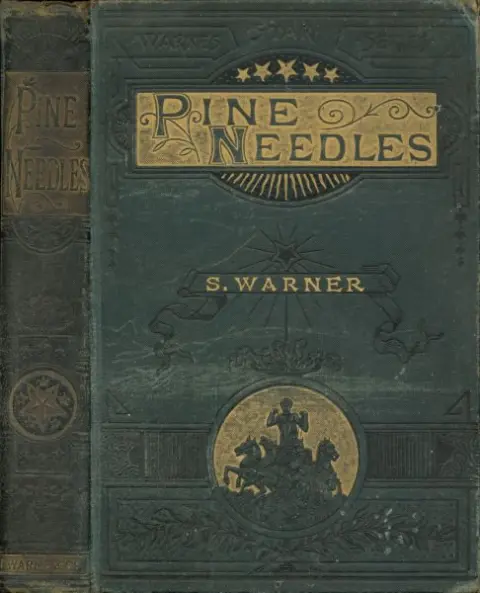
Pine Needles
Susan Warner & Louis Harms
THE CLASSIC COLLECTION · 1871
"Opportunities" by Susan Warner is a novel written in the late 19th century. It continues the story of Matilda Englefield, who has recently undergone baptism and is beginning to grapple with her responsibilities and duties as a member of the Church. The novel explores themes of service, charity, and personal growth as Matilda reflects on her newly assumed role and the expectations placed upon her by her family and society. The opening of the book introduces Matilda in a domestic setting where she and her sister Maria prepare breakfast. The atmosphere is tense due to Maria’s moodiness, setting the stage for Matilda’s kind and optimistic nature to shine through. While running an errand for ingredients, Matilda encounters a mischievous boy named Lem and engages him in a conversation that reflects her gentle spirit. The narrative further delves into Matilda’s thoughts about her baptization and her desire to fulfill her new role within the Church, which her Aunt Candy insists requires her to act with more maturity. Through her experiences and conversations, Matilda begins to understand the importance of serving others, teased by the burdens of the less fortunate, which increasingly weighs on her heart as the story unfolds.
Introduction adapted from the source catalogue; source summaries may be automatically generated.
Free to read · English · 59,015 words · No account needed
MAKE TIME FOR A GOOD BOOK
On by default. Untick to stop anonymous reading totals. Each page counts after 10 seconds in view. How this works.
Anonymous counting is on unless you have switched it off.
Matilda shook herself mentally, and went up-stairs with Mrs. Laval. Such easy, soft-going stairs! and then the wide light corridor with its great end window; and then Mrs. Laval went into a room which Matilda guessed was her own, and through that passed to another, smaller, but large enough still, where she paused.
"You shall be here," she said; "close by me; so that you cannot feel
lonely."
"Oh, I could not feel lonely," cried Matilda. "I have a room by myself
at home."
"But not far away from other people, I suppose. Your sister is near
you, is she not?"
"Oh, Maria is gone, long ago."
"Gone? What, entirely? Not out of the village?"
"She is in Poughkeepsie. I have not seen her in a great many weeks."
"Was that her own wish?"
"Oh no, ma'am; she was very sorry to go."
"Well, you must have been very sorry too. Now, dear, here are drawers for you; and see, here is a closet for hanging up things; and here is your washing closet with hot and cold water; the hot is the right hand one of these two faucets. And I hope you will be happy here, darling."
She spoke very kindly; so kindly that Matilda did not know how to answer. I suppose her face answered for her; for Mrs. Laval, instead of presently leading the way down-stairs again, sat down in a chair by one of the windows and drew Matilda into her arras. She took off her hat, and smoothed away the hair from her forehead, and looked in her face, with eyes that were curiously wistful and noteful of her. And Matilda's eyes, wondering, went over the mid-country to the blue mountains, as she thought what a new friend God had given her.
"Are you well, dear?" said the lady's voice in her ear softly.
"Quite well, ma'am."
"What has changed you so since last June?"
"I didn't know that I was changed," Matilda said, wondering again.
"Are you happy, my love?"
The question was put very softly, and yet Matilda started and looked into Mrs. Laval's eyes to see what her thought was.
"Yes," said the lady, smiling; "I asked you if you were quite happy.
How is it?"
Matilda's eyes went back to the blue mountains. How much ought she to
tell?
"I think--I suppose--I ought to be happy," she said at last.
"I think you always try to do what you think you ought to do; isn't
that so?"
"I try," said Matilda in a low voice.
"How happens it, then, dear, that you do not succeed in being happy?"
Your reading position is saved on this browser. Take it to another device with a library code. Reading pages adapt to text, rather than matching a printed edition.
Susan Warner & Louis Harms
Susan Warner
Susan Warner
Susan Warner
BEHIND THE BOOK
This eBook is for the use of anyone anywhere in the United States and most other parts of the world at no cost and with almost no restrictions whatsoever. You may copy it, give it away or re-use it under the terms of the Project Gutenberg License included with this eBook or online at www.gutenberg.org. If you are not located in the United States, you will have to check the laws of the country where you are located before using this eBook. Read the source licence.
The original source file, including credits and licence, is retained by this library. Request an original-format copy at no charge. Please include the book title and Project Gutenberg identifier #30147.
KEEP YOUR CURIOSITY GOING
Coulson Kernahan

Maurice Baring
Frances Wright
Cécile Tormay

Frederic Jesup Stimson

W. H. P. (William Henry Pope) Jarvis