THE CLASSIC COLLECTION✦An outlaw’s diary: the CommuneCLASSIC FREE BOOKS
An outlaw’s diary: the Commune
Cécile Tormay
THE CLASSIC COLLECTION · 1911
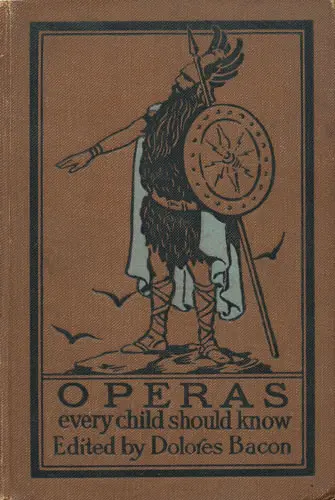
"Operas Every Child Should Know" by Mary Schell Hoke Bacon is a collection of descriptions and explorations of famous operas aimed at children, likely written in the early 20th century. The book focuses on some of the most notable operatic masterpieces and aims to make them accessible to young audiences, offering insights into their stories and music, while embracing the beauty and complexity of opera as a genre. The opening of the book introduces the foreword, which discusses the challenges of selecting specific operas to include and reflects on the subjective nature of operatic quality and popularity. The author emphasizes that the goal is not just to present great works but also to give children a sense of the rich tapestry of operatic storytelling and music. It mentions various operas and composers that will be covered, setting the stage for a journey through the world of opera, imparting an appreciation for its history, diversity, and emotional resonance. The author asserts that understanding the stories behind the music enhances the overall experience of opera.
Introduction adapted from the source catalogue; source summaries may be automatically generated.
Free to read · English · 116,975 words · No account needed
MAKE TIME FOR A GOOD BOOK
On by default. Untick to stop anonymous reading totals. Each page counts after 10 seconds in view. How this works.
Anonymous counting is on unless you have switched it off.
"The Countess has a jealous husband, Rigoletto; pray what do you
advise?"
"Why, that you carry her off, to be sure; or else get rid of her husband the Count; maybe that would be the easiest way."
The Duke was wild enough to undertake almost anything, and so with the help of Rigoletto he was ready to undertake that. Hence, he made desperate love to the Countess all the evening, while the Count became more and more angry, and followed the pair continually about.
Even the courtiers were a good deal disgusted with the Duke's conduct, and they especially hated Rigoletto, who they thought was the real author of most of the Duke's misconduct.
"I don't know what we are coming to," Marullo exclaimed.
Yes, and 'tis here but as elsewhere! 'Tis gambling and feasting, duelling and dancing; And love-making always, wherever he goes. To-day he's for pastime, besieging the countess, While we watch the husband and laugh at his woes!
This condition of things exactly suited the malevolent dwarf,
however.
After the Count had followed the Duke and Countess about the palace half the night, the Duke came into the room in a rage.
"What am I to do with this Count? I'd like to fight him and kill him. He torments me to death. If you don't think out a way to rid me of him while I am making love to the Countess, I'll get some other fellow to make life gay for me, Rigoletto," he cried to the dwarf.
"Well, have I not told you--run off with her."
"Oh, yes, that's easy enough to say."
"It's easy enough to do. Try it to-night!"
"But what about her husband?"
"Oh, I don't know--let him be arrested."
"No, no, that won't do; he's of noble birth. You are going too far."
"All right! If he is too good to be arrested, then exile him," the dwarf obligingly arranges, showing thereby his notion of the fitness of things.
"No! that would hardly do, either," the Duke exclaimed impatiently.
"Well, cut off his head, then." Rigoletto thought that should be an ending dignified enough for any one. Meantime Ceprano overheard that pleasing conversation.
"They are black-hearted villains," he muttered aside.
"Cut off that head so unbending," the Duke exclaimed, looking at Ceprano, who was really a noble-appearing aristocrat.
"Aye--we have discovered its use. Cut it off; that will make it pliant," the charming dwarf said, facetiously; and that being a bit too much for any noble to put up with, the Count drew his sword.
"Enough! you ribald hunchback," he cried; at which the Duke became
uneasy.
Your reading position is saved on this browser. Take it to another device with a library code. Reading pages adapt to text, rather than matching a printed edition.
BEHIND THE BOOK
This eBook is for the use of anyone anywhere in the United States and most other parts of the world at no cost and with almost no restrictions whatsoever. You may copy it, give it away or re-use it under the terms of the Project Gutenberg License included with this eBook or online at www.gutenberg.org. If you are not located in the United States, you will have to check the laws of the country where you are located before using this eBook. Read the source licence.
The original source file, including credits and licence, is retained by this library. Request an original-format copy at no charge. Please include the book title and Project Gutenberg identifier #28711.
KEEP YOUR CURIOSITY GOING
Cécile Tormay

Moritz Busch
John L. Ransom
Frances Wright
Cécile Tormay

Mabel Potter Daggett