THE CLASSIC COLLECTION✦My diaries, being a personal narrative of events 1888-1914, Part 2 (1900-1914)CLASSIC FREE BOOKS
My diaries, being a personal narrative of events 1888-1914, Part 2 (1900-1914)
Wilfrid Scawen Blunt
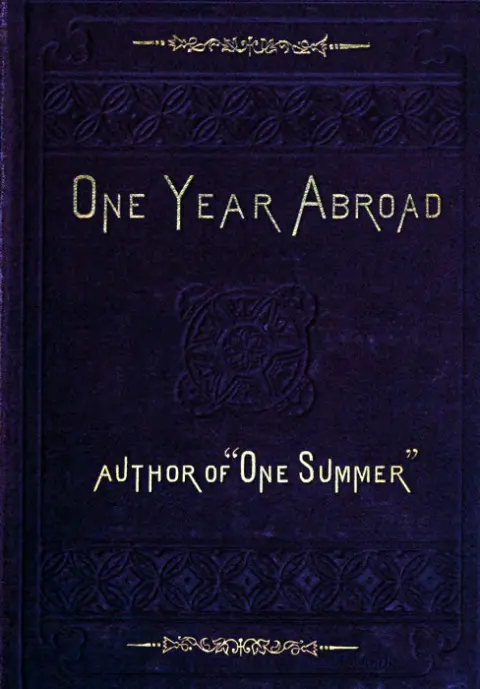
THE CLASSIC COLLECTION · 1877
"One Year Abroad" by Blanche Willis Howard is a travel narrative written in the late 19th century. This work captures the essence of various European cities and landscapes, through the eyes of a reflective traveler who shares her observations and experiences journeying from Hamburg to Heidelberg and beyond. The narrative combines personal insights with vivid descriptions, inviting readers to explore the cultures and histories of these locales. The opening of "One Year Abroad" introduces us to the author's voyage across the sea, filled with trepidation but transformed into exhilaration upon arrival in Germany. The author muses over the impracticality of guidebooks and emphasizes the importance of engaging with one’s surroundings through spontaneity and imagination. As she arrives in Hamburg, she observes the unique blend of the quaint and the commercial, while sharing anecdotes about the sights and sounds that stir her curiosity about the stories behind them. The vivid imagery of peasant costumes, children’s interactions, and the contrasts between modern life and historical memory set the stage for a journey that is both enlightening and introspective.
Introduction adapted from the source catalogue; source summaries may be automatically generated.
Free to read · English · 62,707 words · No account needed
MAKE TIME FOR A GOOD BOOK
On by default. Untick to stop anonymous reading totals. Each page counts after 10 seconds in view. How this works.
Anonymous counting is on unless you have switched it off.
It was, then, scarcely surprising that a girl married at sixteen to a fossil like Leutrum, who neglected and abused her, should be bewildered by the distinguished attention offered by her prince. Meanwhile Leutrum waxed more and more jealous, until one day in a rage, on account of remarks of the courtiers, he struck his wife in the face.
The duke, furious at this, insisted upon taking Franciska under his protection. But she, though agonized with fear and abhorrence of her husband, yet knowing too well her feeling for the duke, chose to leave the court at once and return with Leutrum to their castle.
Carl Eugen, never scrupulous as to means when he had anything to gain, caused a wheel of Leutrum's coach to be put into a state of precarious weakness, so that, going through some woods not far from Pforzheim, the carriage broke down, when the duke appeared, rode off with the trembling, miserable, happy Franciska, leaving Von Leutrum alone with his broken carriage and his rage.
The duke had been married for political reasons at eighteen to a princess of Bavaria, with whom he had lived but a year or two, their natures being strongly incompatible. He, however, a Roman Catholic, could not free himself from his first marriage until the death of his wife released him in 1784, when he married Franciska.
The remarkable thing in her history is, that the voice of no contemporary is raised against her. Noble ladies of unblemished name visited her as "Graefin von Hohenheim," and all testimony unites in praising her wisdom, sweetness, and grace, and her almost miraculous influence for good upon the duke.
"He found in her womanly grace and devoted love, the deepest appreciation of the beautiful and good, exquisite taste and tact, a strong, warm interest in his career and calling, wise counsel given in her soft, womanly words, and a heart for his people.
"In love and sorrow, in matters earnest and light, in his difficult affairs of state, in enjoyment of the beautiful in art and nature, she was ever by his side, filled with perfect appreciation of all that moved him."
She taught him gradually his duty towards his folk, which the wild, haughty duke had sadly ignored, and she, herself, was always loved and revered by them.
She was graceful and sparkling in society, not wearing her sorrows upon her sleeve, but in her private life and letters are marks of lifelong grief.
Your reading position is saved on this browser. Take it to another device with a library code. Reading pages adapt to text, rather than matching a printed edition.
BEHIND THE BOOK
This eBook is for the use of anyone anywhere in the United States and most other parts of the world at no cost and with almost no restrictions whatsoever. You may copy it, give it away or re-use it under the terms of the Project Gutenberg License included with this eBook or online at www.gutenberg.org. If you are not located in the United States, you will have to check the laws of the country where you are located before using this eBook. Read the source licence.
The original source file, including credits and licence, is retained by this library. Request an original-format copy at no charge. Please include the book title and Project Gutenberg identifier #35680.
KEEP YOUR CURIOSITY GOING
Wilfrid Scawen Blunt
Wilfrid Scawen Blunt

E. W. (Edgar Watson) Howe
Francis Greenleaf Allinson & Anne C. E. (Anne Crosby Emery) Allinson
Cyrenus Cole

John Martineau