THE CLASSIC COLLECTION✦My diaries, being a personal narrative of events 1888-1914, Part 2 (1900-1914)CLASSIC FREE BOOKS
My diaries, being a personal narrative of events 1888-1914, Part 2 (1900-1914)
Wilfrid Scawen Blunt
THE CLASSIC COLLECTION · 1877
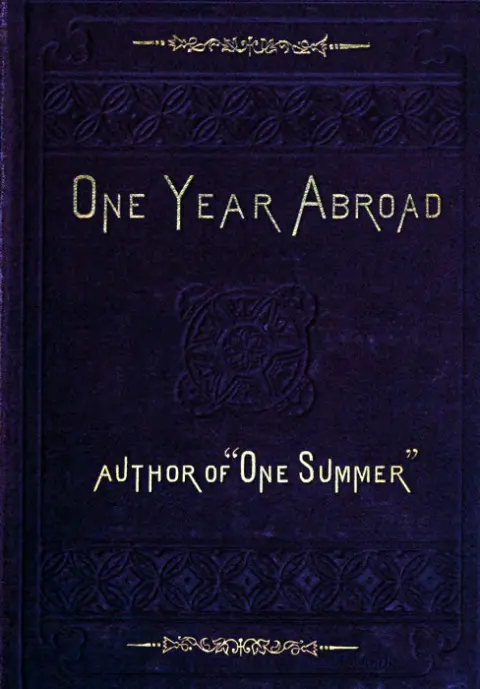
"One Year Abroad" by Blanche Willis Howard is a travel narrative written in the late 19th century. This work captures the essence of various European cities and landscapes, through the eyes of a reflective traveler who shares her observations and experiences journeying from Hamburg to Heidelberg and beyond. The narrative combines personal insights with vivid descriptions, inviting readers to explore the cultures and histories of these locales. The opening of "One Year Abroad" introduces us to the author's voyage across the sea, filled with trepidation but transformed into exhilaration upon arrival in Germany. The author muses over the impracticality of guidebooks and emphasizes the importance of engaging with one’s surroundings through spontaneity and imagination. As she arrives in Hamburg, she observes the unique blend of the quaint and the commercial, while sharing anecdotes about the sights and sounds that stir her curiosity about the stories behind them. The vivid imagery of peasant costumes, children’s interactions, and the contrasts between modern life and historical memory set the stage for a journey that is both enlightening and introspective.
Introduction adapted from the source catalogue; source summaries may be automatically generated.
Free to read · English · 62,707 words · No account needed
MAKE TIME FOR A GOOD BOOK
On by default. Untick to stop anonymous reading totals. Each page counts after 10 seconds in view. How this works.
Anonymous counting is on unless you have switched it off.
"We have no such legends," she begins slowly, when a blessed inspiration comes to her relief, and she goes on with dignity,--"we have no such legends, to be sure; but then, you know, we have--the Indians."
"Ah, yes; that is true," said the German, respectfully, knowing as much of the Indians as of the inhabitants of some remote planet, while the American, trusting the vague, mysterious term will induce a change of subject, yet not knowing what may come, rapidly revolves in her mind every item of Indian lore she has ever known, from Pocahontas to Young-Man-Afraid-of-his-Horses, determined, should she be called upon to tell a wild Indian tale, to do it in a manner that will not disgrace the stars and stripes.
But I grieve to say that America is not always victorious. Our table-talk, upon whatever subject it may begin, invariably ends in a controversy, more or less earnest, about the merits of the several nations represented.
A Swiss student with strong French sympathies charges valiantly at three Germans, and having routed their entire army, heaped all manner of abuse upon Kaiser Wilhelm, reduced the crown prince to beggary, and beheaded Bismarck, suddenly turns, elated with his victory, and hurls his missiles at the American eagle.
O, how we suffer for our country!
Some sarcasm from our student neighbor calls forth from us,--
"America is the hope of the ages."
We think this sounds well. We remember we heard a Fourth-of-July orator say it. Then it is not too long for us to attempt, with our small command of the German tongue.
"A forlorn hope that has not long to live," quickly retorts our
adversary.
He continues, contemptuously,--
"America is too raw."
"America is young. She's a child compared with your old nations, but a promising, glorious child. Her faults are only the faults of youth," we respond with some difficulty as to our pronouns and adjectives.
"She's a very bad child. She needs a whipping," chuckles our saucy
neighbor.
America's banner trails in the dust, and Helvetia triumphs over all foes. In silence and chagrin America's feeble champion retires to the window, watches the birds picking up bread-crumbs on the balcony, and meditates a grand revenge when her German vocabulary shall be equal to her zeal. Helvetia's son being, in this instance, a very clever, merry boy, soon laughingly sues for reconciliation, on the ground that, "after all, sister republics must not quarrel," and the two, in noble alliance, advance with renewed vigor, and speedily sweep from the face of the earth all tyrannous monarchical governments.
Your reading position is saved on this browser. Take it to another device with a library code. Reading pages adapt to text, rather than matching a printed edition.
BEHIND THE BOOK
This eBook is for the use of anyone anywhere in the United States and most other parts of the world at no cost and with almost no restrictions whatsoever. You may copy it, give it away or re-use it under the terms of the Project Gutenberg License included with this eBook or online at www.gutenberg.org. If you are not located in the United States, you will have to check the laws of the country where you are located before using this eBook. Read the source licence.
The original source file, including credits and licence, is retained by this library. Request an original-format copy at no charge. Please include the book title and Project Gutenberg identifier #35680.
KEEP YOUR CURIOSITY GOING
Wilfrid Scawen Blunt
Wilfrid Scawen Blunt

E. W. (Edgar Watson) Howe
Francis Greenleaf Allinson & Anne C. E. (Anne Crosby Emery) Allinson
Cyrenus Cole

John Martineau