THE CLASSIC COLLECTION✦Joan and Co.CLASSIC FREE BOOKS
Joan and Co.
Frederick Orin Bartlett
THE CLASSIC COLLECTION · 1911
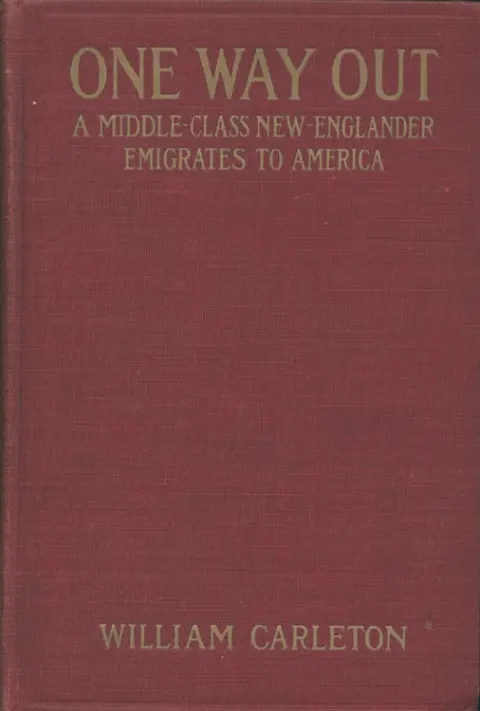
"One Way Out: A Middle-class New-Englander Emigrates to America" by William Carleton is a memoir written in the early 20th century. The book chronicles the author's journey from a middling existence in New England to a bold new life in America, highlighting the struggles and triumphs that come with such a transition. The central figure, referred to as Carleton, navigates the complexities of day-to-day life, shedding light on his family's history and the societal pressures of his upbringing, all while seeking a better future for himself and his loved ones. The opening of the memoir establishes Carleton's deep roots in New England, detailing his lineage of service to the country through wars, yet it also reveals his sense of entrapment within the middle class. After the death of his father and feeling burdened by financial constraints, Carleton's soul-searching culminates in the decision to emigrate to America, an idea fueled by inspirational letters from others seeking a way out. He recounts moments of personal hardship, reflecting on the heavy emotions surrounding his father's death and the struggle to carve out a successful path amidst the constraints of his middle-class upbringing. As he considers the prospect of change, readers sense his resolve to reclaim his narrative and seek opportunities beyond the limitations of his past.
Introduction adapted from the source catalogue; source summaries may be automatically generated.
Free to read · English · 62,150 words · No account needed
MAKE TIME FOR A GOOD BOOK
On by default. Untick to stop anonymous reading totals. Each page counts after 10 seconds in view. How this works.
Anonymous counting is on unless you have switched it off.
On Saturday night of that first week I came home with nine dollars in my pocket. I'll never be prouder again than I was when I handed them over to Ruth. And Ruth will never again be prouder than she was when, after she had laid aside three of them for the rent and five for current expenses, she picked out a one-dollar bill and, crossing the room, placed it in the ginger jar. This was a little blue affair in which we had always dropped what pennies and nickels we could spare.
"There's our nest-egg," she announced.
"You don't mean to tell me you're that much ahead of the game the
first week?"
"Look here, Billy," she answered.
She brought out an itemized list of everything she had bought from last Monday, including Sunday's dinner. I've kept that list. Many of the things she had bought were not yet used up but she had computed the cost of the amount actually used. Here it is as I copied it off:
Flour, .25
Lard, .15
Cream of tartar and soda, .05
Oat meal, .04
Molasses, .05
Sugar, .12
Potatoes, .20
Rice, .06
Milk, 1.12
Eggs, .24
Rye bread, .10
Sausages, .22
Lettuce, .03
Beans, .12
Salt pork, .15
Corn meal, .06
Graham meal, .05
Butter, .45
Cheese, .06
Shin of beef, .39
Fish, .22
Oil, .28
Soap, .09
Vinegar, salt and pepper, about .05
Can of corn, .07
Onions, .06
Total $4.68
In this account, too, Ruth was liberal in her margins. She did better than this later on. A fairer estimate could have been made at the end of the month and a still fairer even than that, at the end of the year. It sounded almost too good to be true but it was a fact. We had lived, and lived well on this amount and as yet Ruth was inexperienced. She hadn't learned all she learned later. For the benefit of those who may think we went hungry I have asked Ruth to write out the bill of fare for this week as nearly as she can remember it. One thing you must keep in mind is that of everything we had, we had enough. Neither Ruth, the boy, nor myself ever left the table or dinner pail unsatisfied. Here's what we had and it was better even than it sounds for whatever Ruth made, she made well. I copy it as she wrote it out.
Monday.
Breakfast: oatmeal, griddle-cakes with molasses, cream of tartar
biscuits, milk.
Luncheon: for Billy: cold biscuits, two hard-boiled eggs, bowl of rice, cold coffee; for Dick and me: cold biscuits, milk, rice.
Dinner: baked potatoes, griddle-cakes, milk.
Tuesday.
Breakfast: baked potatoes, graham muffins, oatmeal, milk.
Luncheon: for Billy: cold muffins, two hard-boiled eggs, rice, milk; for Dick and me: cold muffins, rice and milk.
Your reading position is saved on this browser. Take it to another device with a library code. Reading pages adapt to text, rather than matching a printed edition.
Frederick Orin Bartlett
Frederick Orin Bartlett
Frederick Orin Bartlett
Frederick Orin Bartlett
BEHIND THE BOOK
This eBook is for the use of anyone anywhere in the United States and most other parts of the world at no cost and with almost no restrictions whatsoever. You may copy it, give it away or re-use it under the terms of the Project Gutenberg License included with this eBook or online at www.gutenberg.org. If you are not located in the United States, you will have to check the laws of the country where you are located before using this eBook. Read the source licence.
The original source file, including credits and licence, is retained by this library. Request an original-format copy at no charge. Please include the book title and Project Gutenberg identifier #28315.
KEEP YOUR CURIOSITY GOING
Coulson Kernahan

Maurice Baring
Frances Wright
Cécile Tormay

Frederic Jesup Stimson

W. H. P. (William Henry Pope) Jarvis