THE CLASSIC COLLECTION✦The story of the Philippines, for use in the schools of the Philippine IslandsCLASSIC FREE BOOKS
The story of the Philippines, for use in the schools of the Philippine Islands
Adeline Knapp
THE CLASSIC COLLECTION · 1894
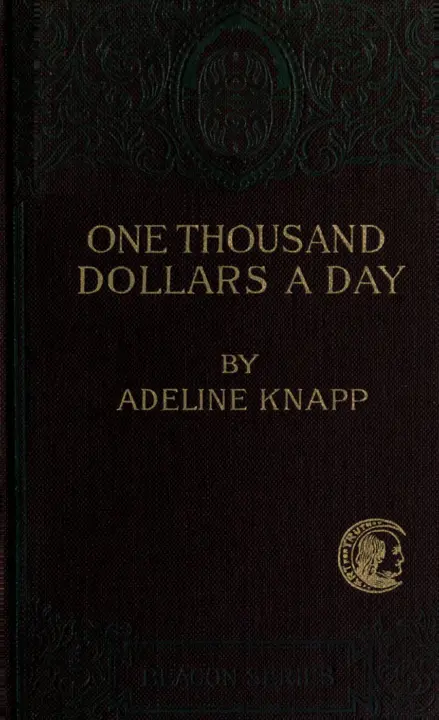
"One Thousand Dollars a Day: Studies in Practical Economics" by Adeline Knapp is a collection of essays and fables that delve into the complexities of economics and societal structures, written in the late 19th century. This book combines literary elements with socio-economic commentary, likely intended for readers interested in understanding the practical implications of economic theory on everyday lives. The underlying topic examines the interplay between labor and capital in a rapidly industrializing society, reflecting the challenges and inequalities of that era. The book presents several distinct pieces, among them a fictional narrative about a financial experiment that distributes wealth to citizens, leading to unforeseen societal chaos. Knapp explores human behavior in response to sudden wealth and critiques the capitalist system, illustrating through her characters the disconnect between the rich and the poor, as well as the alienation laborers feel despite being essential to production. Other essays in the collection address themes of community, the nature of work, and the moral responsibilities of capitalism, leaving readers to ponder the necessary balance between economic gain and social equity. Overall, Knapp's work serves as a reflective critique on the economic and ethical dilemmas of her time, resonant with contemporary discussions about wealth distribution and labor rights.
Introduction adapted from the source catalogue; source summaries may be automatically generated.
Free to read · English · 16,036 words · No account needed
MAKE TIME FOR A GOOD BOOK
On by default. Untick to stop anonymous reading totals. Each page counts after 10 seconds in view. How this works.
Anonymous counting is on unless you have switched it off.
The Judge (a peace justice always receives that title from dwellers in our rural districts) looked sympathetically at his officer. He had a small, shrewd face with pale blue eyes, set very close together, and the air of a politician. Like all his neighbors he was a farmer, but of late years had taken considerable interest in township politics, and having, during the last campaign, secured the nomination and election to his present position, he was already turning his attention to the next higher round of the political ladder, and had his eye on a minor county office. His court-room was situated in a little shanty that stood at a corner of the main street in the incipient country town where I was staying. It had once been used for a barber shop, and sundry shelves, bottles and other paraphernalia still remained mutely in evidence of that earlier use. Half a dozen half-grown boys and one or two men had strolled in, attracted by the unusual sight, in that peaceful community, of a prisoner; a setter dog was sniffing inquiringly around the legs of the assembled throng, and stopping in front of the manacled prisoner the animal began to lick the swollen hands and wrists, wagging his tail, and by look and gesture expressing his wonderful sympathy as plainly as though he had spoken. I was writing up that section of the country for an eastern publication, and had been talking with the postmaster of the little town when the prisoner was brought in from the outlying country. That official had asked me to go to the court-room to witness this variation in the usual monotony of the town’s life, and accepting the invitation, I at once became interested in the—to me—entirely new experience.
The Justice took his seat at a little stained wooden table and called his primitive court to order. The whole scene at once assumed an air of solemnity that seemed to impress everybody but the prisoner. Apparently he was the only one present who was unaware that the strong arm of the law was about to perform its function. The agent began to tell his story. He was a tall man who would have presented the appearance of great physical power, but for a certain shambling looseness about his build. While he had occupied his chair he had “sat on his backbone” in genuine American style. Standing erect his hands hung limply at his sides and his shoulders bent forward, not as if the man had acquired a stoop, but rather as though the spirit within him had long since ceased to take enough interest in its habitation to maintain it erect. He had prominent eyes and a projecting under lip, a well-shaped head with short, clay-colored hair, and when he spoke he had a trick of only moving one-half of his upper lip, which was long and very thin. His face was smooth-shaven, and he presented, in his well-brushed city garments and sleek hat, a strong contrast to the country people surrounding him. He was bland and courteous, even mildly facetious, as he related his case. He expatiated upon the wealth and power of the syndicate he represented, the confidence the men composing it had shown in the future of our great State in investing their capital here, although they themselves resided abroad. He reminded the Justice that the entire people of California owed it to these trusting capitalists to uphold peace and order in the State. If anarchy and rebellion were suffered to go unpunished in our midst, it would render capital timid about investing money among us, and the industrial future of the State would be blighted. Rassmussen, the Dane, had rented the land of him for the past two years, but had proven a troublesome tenant, and having secured a better one he had given the man notice to quit; had even come up from the city himself, instead of writing, in order to make the matter clear to him and offer him the rental of another piece of land, should he desire it. His kindly effort had, however, only resulted in disaster to himself, for Rassmussen, as he could bring witnesses to prove, had assaulted him violently, so that he was forced to retire, fearing serious bodily injury had he remained to finish his business with the dangerous man. Mr. Brien, the constable, could testify also to the violence with which the Dane had resisted the process of the law, when the officer would have arrested him. He was very sorry to proceed to harsh measures against Rassmussen, but in no other way could he get him off the premises. He understood that the Dane was a notoriously quarrelsome fellow, whose rage seemed directed particularly against those who, by superior industry and enterprise, had acquired a larger share than he possessed of this world’s goods. There was no crime in competence. Rassmussen himself had doubtless come to this country for the purpose of making money. Apparently, however, he desired no one else to make any. He quarreled with the superintendent on the ranch of the largest land-owner and the wealthiest man in the section, and had been driven from the orchard by his fellow-laborers. He had trouble with the railroad company over a freight bill, and now the agent had himself experienced his violence and dangerous propensities. Clearly, such a man was a detriment to any community, and deeply as he regretted the duty he had to perform in the matter, he trusted that the Justice would uphold him in his attempt to bring such a ruffian to punishment. He was sure, in fact, that the Justice would sustain him. A man who had been selected by a community of clear-headed, honest farmers to maintain the majesty of the law among them would never be false to his trust, and he was sure he would not regret the confidence he had placed in the Justice’s uprightness of intention and determination to see right done.
Your reading position is saved on this browser. Take it to another device with a library code. Reading pages adapt to text, rather than matching a printed edition.
Adeline Knapp
Adeline Knapp
Adeline Knapp

Adeline Knapp
BEHIND THE BOOK
This eBook is for the use of anyone anywhere in the United States and most other parts of the world at no cost and with almost no restrictions whatsoever. You may copy it, give it away or re-use it under the terms of the Project Gutenberg License included with this eBook or online at www.gutenberg.org. If you are not located in the United States, you will have to check the laws of the country where you are located before using this eBook. Read the source licence.
The original source file, including credits and licence, is retained by this library. Request an original-format copy at no charge. Please include the book title and Project Gutenberg identifier #62983.
KEEP YOUR CURIOSITY GOING

David Patterson (Spirit) Hatch

David Patterson (Spirit) Hatch

David Patterson (Spirit) Hatch
Coulson Kernahan

Ralph Waldo Emerson

Maurice Baring