THE CLASSIC COLLECTION✦The story of the Philippines, for use in the schools of the Philippine IslandsCLASSIC FREE BOOKS
The story of the Philippines, for use in the schools of the Philippine Islands
Adeline Knapp
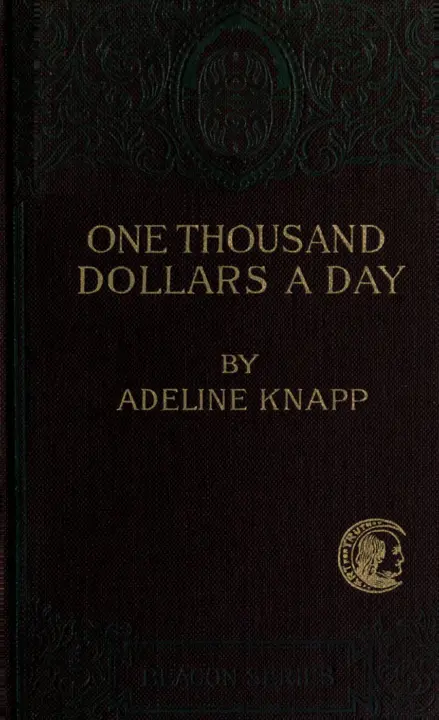
THE CLASSIC COLLECTION · 1894
"One Thousand Dollars a Day: Studies in Practical Economics" by Adeline Knapp is a collection of essays and fables that delve into the complexities of economics and societal structures, written in the late 19th century. This book combines literary elements with socio-economic commentary, likely intended for readers interested in understanding the practical implications of economic theory on everyday lives. The underlying topic examines the interplay between labor and capital in a rapidly industrializing society, reflecting the challenges and inequalities of that era. The book presents several distinct pieces, among them a fictional narrative about a financial experiment that distributes wealth to citizens, leading to unforeseen societal chaos. Knapp explores human behavior in response to sudden wealth and critiques the capitalist system, illustrating through her characters the disconnect between the rich and the poor, as well as the alienation laborers feel despite being essential to production. Other essays in the collection address themes of community, the nature of work, and the moral responsibilities of capitalism, leaving readers to ponder the necessary balance between economic gain and social equity. Overall, Knapp's work serves as a reflective critique on the economic and ethical dilemmas of her time, resonant with contemporary discussions about wealth distribution and labor rights.
Introduction adapted from the source catalogue; source summaries may be automatically generated.
Free to read · English · 16,036 words · No account needed
MAKE TIME FOR A GOOD BOOK
On by default. Untick to stop anonymous reading totals. Each page counts after 10 seconds in view. How this works.
Anonymous counting is on unless you have switched it off.
“Why,” said the machine, “I have been working for you, now, for over a year. Through me your business has been more than doubled. You say yourself, that in the item of saved labor alone, I have nearly paid for myself. I heard you say that, the other day, to the two gentlemen who came in to visit me, and yet, in all these months, you have not paid me one penny for my services.”
“Paid you!” gasped Hyde.
“PAID you!” exclaimed Horne.
And then, both together, the partners cried:
“Why, you have cost us an enormous sum! We expended eighteen thousand dollars for you, outright, from the capital of the business.”
“You have more than had that back through my services,” said the machine, sturdily, “in the item of saved labor alone.”
“Yes, yes, I know,” interrupted Horne, hastily,—“but we really have paid you money, you know. Just let me get the machinery expense book, and I’ll show you;” and hastening to the office, he returned with a little record book, from which he proceeded to read, turning over leaf by leaf, to find the various items. “Here I have charged you an item of fifty dollars for a new shaft,” he said, triumphantly.
“That was broken by the fool boy you hired to look after me the week Jim left, because you cut his wages down,” replied the machine. “I needed that shaft to do your work with. I got nothing for myself.”
“You have had several hundred dollars’ worth of coal,” suggested Hyde.
“Coal is my food,” retorted the machine. “I could not do your work
without it.”
“We have spent fourteen dollars for oil for you,” said Horne, after a
little computation.
“Pshaw! that’s nothing. If I had not had the oil, where would your work have been? I might have got smoking hot; perhaps burned up your factory.”
“But we have kept you housed, fed and repaired,” said Hyde, “and you have been wasteful and extravagant. You have required the very best oil, the most expensive coal, the first quality of belts and fixtures of every sort. You have not taken half the interest in your own work that we have done and do. But for our supervision and management you would not work at all. Your very existence, in fact, is due to our industry and enterprise.”
“That all may be,” said the machine, sullenly, “but your fortune and enterprise depends very largely upon my efforts.”
Your reading position is saved on this browser. Take it to another device with a library code. Reading pages adapt to text, rather than matching a printed edition.
Adeline Knapp
Adeline Knapp
Adeline Knapp

Adeline Knapp
BEHIND THE BOOK
This eBook is for the use of anyone anywhere in the United States and most other parts of the world at no cost and with almost no restrictions whatsoever. You may copy it, give it away or re-use it under the terms of the Project Gutenberg License included with this eBook or online at www.gutenberg.org. If you are not located in the United States, you will have to check the laws of the country where you are located before using this eBook. Read the source licence.
The original source file, including credits and licence, is retained by this library. Request an original-format copy at no charge. Please include the book title and Project Gutenberg identifier #62983.
KEEP YOUR CURIOSITY GOING

David Patterson (Spirit) Hatch

David Patterson (Spirit) Hatch

David Patterson (Spirit) Hatch
Coulson Kernahan

Ralph Waldo Emerson

Maurice Baring