
The Cretan Insurrection of 1866-7-8
William James Stillman
THE CLASSIC COLLECTION · 1887
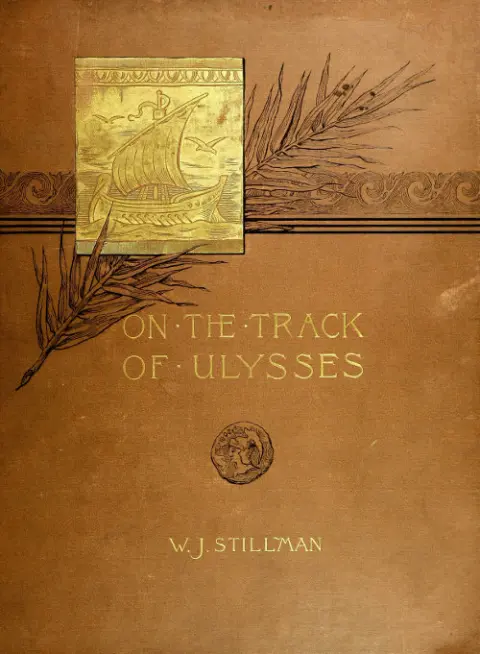
"On the Track of Ulysses; Together with an Excursion in Quest of the So-called Venus of Melos" by W. J. Stillman is a scholarly work that combines travel literature and archaeological studies, written during the late 19th century. This text appears to explore both the legendary journey of Ulysses as depicted in Homer's "Odyssey" and the archaeological significance of the famed Venus de Milo. The author's intent is to connect literary history with real geographical explorations of the Greek islands, blending mythology with historical inquiry. At the start of this work, the author reflects on the main themes of exploration and rediscovery, considering the remnants of ancient civilizations and their connections to contemporary geography. He embarks on a voyage through the sites associated with the journey of Ulysses, contemplating how myth intertwines with reality. The narrative introduces the intricate path of Ulysses, outlining significant locations such as Ogygia, the land of the Phaeacians, and includes historical conjectures about his adventures, setting the stage for a deeper exploration of identity and history within these storied landscapes. The author’s observations weave rich detail while pondering the archaeological challenges and the misidentifications commonly encountered in these ancient locales.
Introduction adapted from the source catalogue; source summaries may be automatically generated.
Free to read · English · 32,663 words · No account needed
MAKE TIME FOR A GOOD BOOK
On by default. Untick to stop anonymous reading totals. Each page counts after 10 seconds in view. How this works.
Anonymous counting is on unless you have switched it off.
The capital of Alcinoüs was, we are told by Homer, founded by his father Nausithoüs. His people were formerly inhabitants of Hyperia, “near the Cyclops,” and were by these latter so ravaged and overborne that they emigrated to Phæacia. The generally accepted location of the Cyclops in Sicily suggests that Hyperia was probably there or in Italy; and that the Phæacians may have been related to the Siculi; since the Pelasgi, who invaded Italy from the north, and, uniting with the Umbri, spread over the whole of southern Italy, expelling the aborigines, are continually confounded by the earliest traditions with the Cyclops. As, from all we know, the Tyrrhene Pelasgi were the earliest metal-workers in that part of Europe,[5] and as the Cyclops, the children of Hephaistos, the great metal-worker, are a mythological idealization of a race of smiths who had a habit of covering the eyes, for protection from sparks, with a screen in which a single hole was cut to see through, which was transmogrified into a single eye in the middle of the forehead, there is nothing unlikely in the inference that the Pelasgi and Cyclops were identical, and that the Phæacians were refugees from the conquest of southern Italy by that formidable people. That they were not Greeks we know by their absence from the catalogue of the “Iliad,” where all the Hellenic tribes were recorded in their places in the league.
The Corfiotes of to-day boast of descent from the Phœnicians, and certainly they are not to be measured by the same standard as the Greek race in general. Their reputation for dishonesty has given rise to a Greek proverb, which relegates a person of more than usual craftiness and bad faith to the “Corfiotes.” “He behaves like a Corfiote” is the greatest reproach the continental Greek can bring against a man who is too clever in business matters. In character as well as history the Corfiote has little in common with Greece. As he had no place inside the line drawn around the Hellenic world at the great critical, even if mythical, epoch assigned to the siege of Troy, so in his latest history he has always maintained a position more or less apart. Diodorus Siculus makes the Homeric name of the city, Phæacia, to have been derived from Phæacus, son of Poseidon, and places his reign contemporary with the Argonauts, as Phæacus protected Jason against the king of Iolcus when, returning from Colchis with Medea, he took refuge at Scheria. Mythology begins with it in the combat of Zeus and Poseidon in their struggle for supremacy in the government of the universe, and finishes with Ulysses’ visit. History commences with the arrival of a colony of Corinthians under Chersicrates, who built a city which he called Chrysopolis. This was probably Corfu, for, as the immigration of Nausithoüs, coming from Italian shores, first established itself on the coast looking toward their old home, so the Corinthians, coming by the islands and the Epirote shores, would find their first landing in the spacious and tranquil bay formed by the crescent-shaped island, which, at its extremes, approaches the mainland. The Hellene of Corinth brought all the seeds of the virtues and vices of his national temperament to the fertile soil of Corcyra, as it is henceforward called by the Hellenic chronicles, colonization and war with their neighbors filling all their early history. They founded, according to their tradition, Apollonia and other cities on the mainland; but, as among the ruins of those cities there are Pelasgic remains, it is not to be supposed that they were the first colonists, but that they merely colonized, as the Romans did in the later times, with a dominant population, cities in decline or too weak to maintain their independence. This is, in ancient Greek history, oftener the meaning of the word colonize than the founding of a new city. To get a clear idea of the condition of this part of the world at the beginning of historical, or even heroic record, we must take into consideration that an epoch of civilization, perhaps of empire, had long preceded the awakening of the Hellenic national life; an epoch which ought, perhaps, to be measured by centuries, if we could measure it at all, and whose record is preserved in the stupendous ruins we call Pelasgic, a name applied by the Greeks to a people who preceded them, derived possibly from the Greek name of the stork, indicating a migrating or wandering people,—wandering, probably, because their empire had been broken up by some newer and stronger race, but which the various remaining traditions accord in asserting to have once held great rule in Italy, where they were known also as Tyrrhenians, in the Peloponnesus, and in Crete. We shall see presently some indications of the correctness of the assumption that they preceded by an infinite period the great assemblage of Greeks, which the expedition to Troy perhaps marks, perhaps symbolizes; but at present I have only to do with the history and mythology of Corfu, which is in no way that we can discover connected with the Pelasgi.
Your reading position is saved on this browser. Take it to another device with a library code. Reading pages adapt to text, rather than matching a printed edition.
William James Stillman
BEHIND THE BOOK
This eBook is for the use of anyone anywhere in the United States and most other parts of the world at no cost and with almost no restrictions whatsoever. You may copy it, give it away or re-use it under the terms of the Project Gutenberg License included with this eBook or online at www.gutenberg.org. If you are not located in the United States, you will have to check the laws of the country where you are located before using this eBook. Read the source licence.
The original source file, including credits and licence, is retained by this library. Request an original-format copy at no charge. Please include the book title and Project Gutenberg identifier #61025.
KEEP YOUR CURIOSITY GOING
Wilfrid Scawen Blunt
Wilfrid Scawen Blunt

E. W. (Edgar Watson) Howe

Maurice Baring
Francis Greenleaf Allinson & Anne C. E. (Anne Crosby Emery) Allinson
Cyrenus Cole