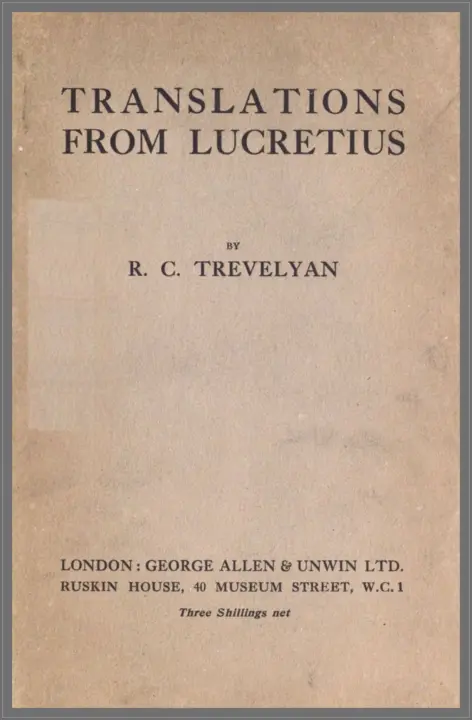
Translations from Lucretius
Titus Lucretius Carus
THE CLASSIC COLLECTION · 1921
"On the Nature of Things" by Titus Lucretius Carus is a didactic poem written in the first century BC. Spanning 7,400 verses across six books, this work aims to explain Epicurean philosophy to Roman readers through poetic language. Lucretius explores atomism, the nature of mind and soul, and celestial phenomena, arguing that the universe operates by physical principles and chance rather than divine intervention. The poem seeks to free readers from religious fear by demonstrating that natural laws, not gods, govern existence.
Introduction adapted from the source catalogue; source summaries may be automatically generated.
Free to read · English · 73,942 words · No account needed
MAKE TIME FOR A GOOD BOOK
On by default. Untick to stop anonymous reading totals. Each page counts after 10 seconds in view. How this works.
Anonymous counting is on unless you have switched it off.
To which be added too,
They squander powers and with the travail wane;
Be added too, they spend their futile years
Under another's beck and call; their duties
Neglected languish and their honest name
Reeleth sick, sick; and meantime their estates
Are lost in Babylonian tapestries;
And unguents and dainty Sicyonian shoes
Laugh on her feet; and (as ye may be sure)
Big emeralds of green light are set in gold;
And rich sea-purple dress by constant wear
Grows shabby and all soaked with Venus' sweat;
And the well-earned ancestral property
Becometh head-bands, coifs, and many a time
The cloaks, or garments Alidensian
Or of the Cean isle. And banquets, set
With rarest cloth and viands, are prepared--
And games of chance, and many a drinking cup,
And unguents, crowns and garlands. All in vain,
Since from amid the well-spring of delights
Bubbles some drop of bitter to torment
Among the very flowers--when haply mind
Gnaws into self, now stricken with remorse
For slothful years and ruin in baudels,
Or else because she's left him all in doubt
By launching some sly word, which still like fire
Lives wildly, cleaving to his eager heart;
Or else because he thinks she darts her eyes
Too much about and gazes at another,--
And in her face sees traces of a laugh.
These ills are found in prospering love and true;
But in crossed love and helpless there be such
As through shut eyelids thou canst still take in--
Uncounted ills; so that 'tis better far
To watch beforehand, in the way I've shown,
And guard against enticements. For to shun
A fall into the hunting-snares of love
Is not so hard, as to get out again,
When tangled in the very nets, and burst
The stoutly-knotted cords of Aphrodite.
Yet even when there enmeshed with tangled feet,
Still canst thou scape the danger-lest indeed
Thou standest in the way of thine own good,
And overlookest first all blemishes
Of mind and body of thy much preferred,
Desirable dame. For so men do,
Eyeless with passion, and assign to them
Graces not theirs in fact. And thus we see
Creatures in many a wise crooked and ugly
The prosperous sweethearts in a high esteem;
And lovers gird each other and advise
To placate Venus, since their friends are smit
With a base passion--miserable dupes
Who seldom mark their own worst bane of all.
The black-skinned girl is "tawny like the honey";
The filthy and the fetid's "negligee";
The cat-eyed she's "a little Pallas," she;
The sinewy and wizened's "a gazelle";
The pudgy and the pigmy is "piquant,
One of the Graces sure"; the big and bulky
O she's "an Admiration, imposante";
The stuttering and tongue-tied "sweetly lisps";
The mute girl's "modest"; and the garrulous,
The spiteful spit-fire, is "a sparkling wit";
And she who scarcely lives for scrawniness
Becomes "a slender darling"; "delicate"
Is she who's nearly dead of coughing-fit;
The pursy female with protuberant breasts
She is "like Ceres when the goddess gave
Young Bacchus suck"; the pug-nosed lady-love
"A Satyress, a feminine Silenus";
The blubber-lipped is "all one luscious kiss"--
A weary while it were to tell the whole.
But let her face possess what charm ye will,
Let Venus' glory rise from all her limbs,--
Forsooth there still are others; and forsooth
We lived before without her; and forsooth
She does the same things--and we know she does--
All, as the ugly creature, and she scents,
Yes she, her wretched self with vile perfumes;
Whom even her handmaids flee and giggle at
Behind her back. But he, the lover, in tears
Because shut out, covers her threshold o'er
Often with flowers and garlands, and anoints
Her haughty door-posts with the marjoram,
And prints, poor fellow, kisses on the doors--
Admitted at last, if haply but one whiff
Got to him on approaching, he would seek
Decent excuses to go out forthwith;
And his lament, long pondered, then would fall
Down at his heels; and there he'd damn himself
For his fatuity, observing how
He had assigned to that same lady more--
Than it is proper to concede to mortals.
And these our Venuses are 'ware of this.
Wherefore the more are they at pains to hide
All the-behind-the-scenes of life from those
Whom they desire to keep in bonds of love--
In vain, since ne'ertheless thou canst by thought
Drag all the matter forth into the light
And well search out the cause of all these smiles;
And if of graceful mind she be and kind,
Do thou, in thy turn, overlook the same,
And thus allow for poor mortality.
Nor sighs the woman always with feigned love,
Who links her body round man's body locked
And holds him fast, making his kisses wet
With lips sucked into lips; for oft she acts
Even from desire, and, seeking mutual joys,
Incites him there to run love's race-course through.
Nor otherwise can cattle, birds, wild beasts,
And sheep and mares submit unto the males,
Except that their own nature is in heat,
And burns abounding and with gladness takes
Once more the Venus of the mounting males.
And seest thou not how those whom mutual pleasure
Hath bound are tortured in their common bonds?
How often in the cross-roads dogs that pant
To get apart strain eagerly asunder
With utmost might?--When all the while they're fast
In the stout links of Venus. But they'd ne'er
So pull, except they knew those mutual joys--
So powerful to cast them unto snares
And hold them bound. Wherefore again, again,
Even as I say, there is a joint delight.
Your reading position is saved on this browser. Take it to another device with a library code. Reading pages adapt to text, rather than matching a printed edition.
Titus Lucretius Carus
BEHIND THE BOOK
This eBook is for the use of anyone anywhere in the United States and most other parts of the world at no cost and with almost no restrictions whatsoever. You may copy it, give it away or re-use it under the terms of the Project Gutenberg License included with this eBook or online at www.gutenberg.org. If you are not located in the United States, you will have to check the laws of the country where you are located before using this eBook. Read the source licence.
The original source file, including credits and licence, is retained by this library. Request an original-format copy at no charge. Please include the book title and Project Gutenberg identifier #785.
KEEP YOUR CURIOSITY GOING

David Patterson (Spirit) Hatch
Coulson Kernahan

Ralph Waldo Emerson
Frances Wright

Edwin Abbott Abbott

Joseph Droz