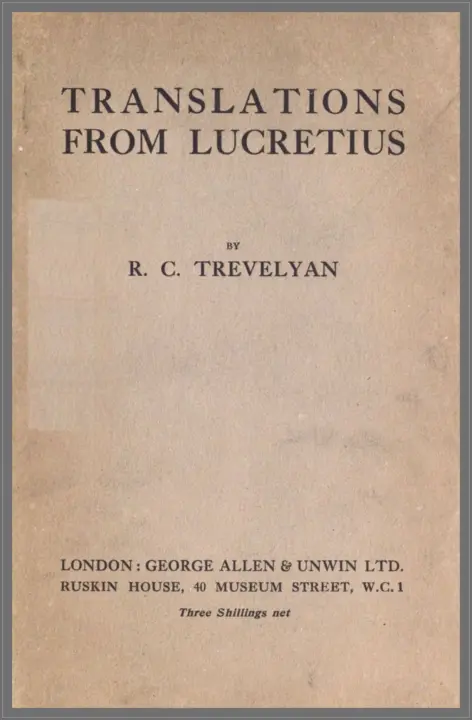
Translations from Lucretius
Titus Lucretius Carus
THE CLASSIC COLLECTION · 1921
"On the Nature of Things" by Titus Lucretius Carus is a didactic poem written in the first century BC. Spanning 7,400 verses across six books, this work aims to explain Epicurean philosophy to Roman readers through poetic language. Lucretius explores atomism, the nature of mind and soul, and celestial phenomena, arguing that the universe operates by physical principles and chance rather than divine intervention. The poem seeks to free readers from religious fear by demonstrating that natural laws, not gods, govern existence.
Introduction adapted from the source catalogue; source summaries may be automatically generated.
Free to read · English · 73,942 words · No account needed
MAKE TIME FOR A GOOD BOOK
On by default. Untick to stop anonymous reading totals. Each page counts after 10 seconds in view. How this works.
Anonymous counting is on unless you have switched it off.
And yet in this we don't at all concede
That eyes be cheated. For their task it is
To note in whatsoever place be light,
In what be shadow: whether or no the gleams
Be still the same, and whether the shadow which
Just now was here is that one passing thither,
Or whether the facts be what we said above,
'Tis after all the reasoning of mind
That must decide; nor can our eyeballs know
The nature of reality. And so
Attach thou not this fault of mind to eyes,
Nor lightly think our senses everywhere
Are tottering. The ship in which we sail
Is borne along, although it seems to stand;
The ship that bides in roadstead is supposed
There to be passing by. And hills and fields
Seem fleeing fast astern, past which we urge
The ship and fly under the bellying sails.
The stars, each one, do seem to pause, affixed
To the ethereal caverns, though they all
Forever are in motion, rising out
And thence revisiting their far descents
When they have measured with their bodies bright
The span of heaven. And likewise sun and moon
Seem biding in a roadstead,--objects which,
As plain fact proves, are really borne along.
Between two mountains far away aloft
From midst the whirl of waters open lies
A gaping exit for the fleet, and yet
They seem conjoined in a single isle.
When boys themselves have stopped their spinning round,
The halls still seem to whirl and posts to reel,
Until they now must almost think the roofs
Threaten to ruin down upon their heads.
And now, when nature begins to lift on high
The sun's red splendour and the tremulous fires,
And raise him o'er the mountain-tops, those mountains--
O'er which he seemeth then to thee to be,
His glowing self hard by atingeing them
With his own fire--are yet away from us
Scarcely two thousand arrow-shots, indeed
Oft scarce five hundred courses of a dart;
Although between those mountains and the sun
Lie the huge plains of ocean spread beneath
The vasty shores of ether, and intervene
A thousand lands, possessed by many a folk
And generations of wild beasts. Again,
A pool of water of but a finger's depth,
Which lies between the stones along the pave,
Offers a vision downward into earth
As far, as from the earth o'erspread on high
The gulfs of heaven; that thus thou seemest to view
Clouds down below and heavenly bodies plunged
Wondrously in heaven under earth.
Then too, when in the middle of the stream
Sticks fast our dashing horse, and down we gaze
Into the river's rapid waves, some force
Seems then to bear the body of the horse,
Though standing still, reversely from his course,
And swiftly push up-stream. And wheresoe'er
We cast our eyes across, all objects seem
Thus to be onward borne and flow along
In the same way as we. A portico,
Albeit it stands well propped from end to end
On equal columns, parallel and big,
Contracts by stages in a narrow cone,
When from one end the long, long whole is seen,--
Until, conjoining ceiling with the floor,
And the whole right side with the left, it draws
Together to a cone's nigh-viewless point.
To sailors on the main the sun he seems
From out the waves to rise, and in the waves
To set and bury his light--because indeed
They gaze on naught but water and the sky.
Again, to gazers ignorant of the sea,
Vessels in port seem, as with broken poops,
To lean upon the water, quite agog;
For any portion of the oars that's raised
Above the briny spray is straight, and straight
The rudders from above. But other parts,
Those sunk, immersed below the water-line,
Seem broken all and bended and inclined
Sloping to upwards, and turned back to float
Almost atop the water. And when the winds
Carry the scattered drifts along the sky
In the night-time, then seem to glide along
The radiant constellations 'gainst the clouds
And there on high to take far other course
From that whereon in truth they're borne. And then,
If haply our hand be set beneath one eye
And press below thereon, then to our gaze
Each object which we gaze on seems to be,
By some sensation twain--then twain the lights
Of lampions burgeoning in flowers of flame,
And twain the furniture in all the house,
Two-fold the visages of fellow-men,
And twain their bodies. And again, when sleep
Has bound our members down in slumber soft
And all the body lies in deep repose,
Yet then we seem to self to be awake
And move our members; and in night's blind gloom
We think to mark the daylight and the sun;
And, shut within a room, yet still we seem
To change our skies, our oceans, rivers, hills,
To cross the plains afoot, and hear new sounds,
Though still the austere silence of the night
Abides around us, and to speak replies,
Though voiceless. Other cases of the sort
Wondrously many do we see, which all
Seek, so to say, to injure faith in sense--
In vain, because the largest part of these
Deceives through mere opinions of the mind,
Which we do add ourselves, feigning to see
What by the senses are not seen at all.
For naught is harder than to separate
Plain facts from dubious, which the mind forthwith
Adds by itself.
Your reading position is saved on this browser. Take it to another device with a library code. Reading pages adapt to text, rather than matching a printed edition.
Titus Lucretius Carus
BEHIND THE BOOK
This eBook is for the use of anyone anywhere in the United States and most other parts of the world at no cost and with almost no restrictions whatsoever. You may copy it, give it away or re-use it under the terms of the Project Gutenberg License included with this eBook or online at www.gutenberg.org. If you are not located in the United States, you will have to check the laws of the country where you are located before using this eBook. Read the source licence.
The original source file, including credits and licence, is retained by this library. Request an original-format copy at no charge. Please include the book title and Project Gutenberg identifier #785.
KEEP YOUR CURIOSITY GOING

David Patterson (Spirit) Hatch
Coulson Kernahan

Ralph Waldo Emerson
Frances Wright

Edwin Abbott Abbott

Joseph Droz