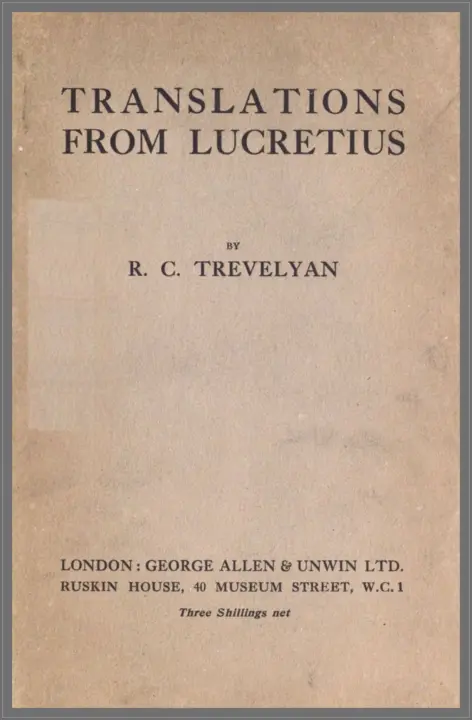
Translations from Lucretius
Titus Lucretius Carus
THE CLASSIC COLLECTION · 1921
"On the Nature of Things" by Titus Lucretius Carus is a didactic poem written in the first century BC. Spanning 7,400 verses across six books, this work aims to explain Epicurean philosophy to Roman readers through poetic language. Lucretius explores atomism, the nature of mind and soul, and celestial phenomena, arguing that the universe operates by physical principles and chance rather than divine intervention. The poem seeks to free readers from religious fear by demonstrating that natural laws, not gods, govern existence.
Introduction adapted from the source catalogue; source summaries may be automatically generated.
Free to read · English · 73,942 words · No account needed
MAKE TIME FOR A GOOD BOOK
On by default. Untick to stop anonymous reading totals. Each page counts after 10 seconds in view. How this works.
Anonymous counting is on unless you have switched it off.
Yet fancy not its nature simple so. For an impalpable aura, mixed with heat, Deserts the dying, and heat draws off the air; And heat there's none, unless commixed with air: For, since the nature of all heat is rare, Athrough it many seeds of air must move. Thus nature of mind is triple; yet those all Suffice not for creating sense--since mind Accepteth not that aught of these can cause Sense-bearing motions, and much less the thoughts A man revolves in mind. So unto these Must added be a somewhat, and a fourth; That somewhat's altogether void of name; Than which existeth naught more mobile, naught More an impalpable, of elements More small and smooth and round. That first transmits Sense-bearing motions through the frame, for that Is roused the first, composed of little shapes; Thence heat and viewless force of wind take up The motions, and thence air, and thence all things Are put in motion; the blood is strook, and then The vitals all begin to feel, and last To bones and marrow the sensation comes-- Pleasure or torment. Nor will pain for naught Enter so far, nor a sharp ill seep through, But all things be perturbed to that degree That room for life will fail, and parts of soul Will scatter through the body's every pore. Yet as a rule, almost upon the skin These motion aIl are stopped, and this is why We have the power to retain our life.
Now in my eagerness to tell thee how
They are commixed, through what unions fit
They function so, my country's pauper-speech
Constrains me sadly. As I can, however,
I'll touch some points and pass. In such a wise
Course these primordials 'mongst one another
With inter-motions that no one can be
From other sundered, nor its agency
Perform, if once divided by a space;
Like many powers in one body they work.
As in the flesh of any creature still
Is odour and savour and a certain warmth,
And yet from all of these one bulk of body
Is made complete, so, viewless force of wind
And warmth and air, commingled, do create
One nature, by that mobile energy
Assisted which from out itself to them
Imparts initial motion, whereby first
Sense-bearing motion along the vitals springs.
For lurks this essence far and deep and under,
Nor in our body is aught more shut from view,
And 'tis the very soul of all the soul.
And as within our members and whole frame
The energy of mind and power of soul
Is mixed and latent, since create it is
Of bodies small and few, so lurks this fourth,
This essence void of name, composed of small,
And seems the very soul of all the soul,
And holds dominion o'er the body all.
And by like reason wind and air and heat
Must function so, commingled through the frame,
And now the one subside and now another
In interchange of dominance, that thus
From all of them one nature be produced,
Lest heat and wind apart, and air apart,
Make sense to perish, by disseverment.
There is indeed in mind that heat it gets
When seething in rage, and flashes from the eyes
More swiftly fire; there is, again, that wind,
Much, and so cold, companion of all dread,
Which rouses the shudder in the shaken frame;
There is no less that state of air composed,
Making the tranquil breast, the serene face.
But more of hot have they whose restive hearts,
Whose minds of passion quickly seethe in rage--
Of which kind chief are fierce abounding lions,
Who often with roaring burst the breast o'erwrought,
Unable to hold the surging wrath within;
But the cold mind of stags has more of wind,
And speedier through their inwards rouses up
The icy currents which make their members quake.
But more the oxen live by tranquil air,
Nor e'er doth smoky torch of wrath applied,
O'erspreading with shadows of a darkling murk,
Rouse them too far; nor will they stiffen stark,
Pierced through by icy javelins of fear;
But have their place half-way between the two--
Stags and fierce lions. Thus the race of men:
Though training make them equally refined,
It leaves those pristine vestiges behind
Of each mind's nature. Nor may we suppose
Evil can e'er be rooted up so far
That one man's not more given to fits of wrath,
Another's not more quickly touched by fear,
A third not more long-suffering than he should.
And needs must differ in many things besides
The varied natures and resulting habits
Of humankind--of which not now can I
Expound the hidden causes, nor find names
Enough for all the divers shapes of those
Primordials whence this variation springs.
But this meseems I'm able to declare:
Those vestiges of natures left behind
Which reason cannot quite expel from us
Are still so slight that naught prevents a man
From living a life even worthy of the gods.
Your reading position is saved on this browser. Take it to another device with a library code. Reading pages adapt to text, rather than matching a printed edition.
Titus Lucretius Carus
BEHIND THE BOOK
This eBook is for the use of anyone anywhere in the United States and most other parts of the world at no cost and with almost no restrictions whatsoever. You may copy it, give it away or re-use it under the terms of the Project Gutenberg License included with this eBook or online at www.gutenberg.org. If you are not located in the United States, you will have to check the laws of the country where you are located before using this eBook. Read the source licence.
The original source file, including credits and licence, is retained by this library. Request an original-format copy at no charge. Please include the book title and Project Gutenberg identifier #785.
KEEP YOUR CURIOSITY GOING

David Patterson (Spirit) Hatch
Coulson Kernahan

Ralph Waldo Emerson
Frances Wright

Edwin Abbott Abbott

Joseph Droz