READ · DISCOVER · ENJOYClassic literature · Always free
THE CLASSIC COLLECTION✦On the Nature of ThingsTitus Lucretius CarusCLASSIC FREE BOOKS

THE CLASSIC COLLECTION · 1921

On the Nature of Things

"On the Nature of Things" by Titus Lucretius Carus is a didactic poem written in the first century BC. Spanning 7,400 verses across six books, this work aims to explain Epicurean philosophy to Roman readers through poetic language. Lucretius explores atomism, the nature of mind and soul, and celestial phenomena, arguing that the universe operates by physical principles and chance rather than divine intervention. The poem seeks to free readers from religious fear by demonstrating that natural laws, not gods, govern existence.

Introduction adapted from the source catalogue; source summaries may be automatically generated.

Start reading ↓

Free to read · English · 73,942 words · No account needed

MAKE TIME FOR A GOOD BOOK

On the Nature of Things

On by default. Untick to stop anonymous reading totals. Each page counts after 10 seconds in view. How this works.

Anonymous counting is on unless you have switched it off.

On the Nature of Things

Nor can those motions that bring death prevail
Forever, nor eternally entomb
The welfare of the world; nor, further, can
Those motions that give birth to things and growth
Keep them forever when created there.
Thus the long war, from everlasting waged,
With equal strife among the elements
Goes on and on. Now here, now there, prevail
The vital forces of the world--or fall.
Mixed with the funeral is the wildered wail
Of infants coming to the shores of light:
No night a day, no dawn a night hath followed
That heard not, mingling with the small birth-cries,
The wild laments, companions old of death
And the black rites.

This, too, in these affairs 'Tis fit thou hold well sealed, and keep consigned With no forgetting brain: nothing there is Whose nature is apparent out of hand That of one kind of elements consists-- Nothing there is that's not of mixed seed. And whatsoe'er possesses in itself More largely many powers and properties Shows thus that here within itself there are The largest number of kinds and differing shapes Of elements. And, chief of all, the earth Hath in herself first bodies whence the springs, Rolling chill waters, renew forevermore The unmeasured main; hath whence the fires arise-- For burns in many a spot her flamed crust, Whilst the impetuous Aetna raves indeed From more profounder fires--and she, again, Hath in herself the seed whence she can raise The shining grains and gladsome trees for men; Whence, also, rivers, fronds, and gladsome pastures Can she supply for mountain-roaming beasts. Wherefore great mother of gods, and mother of beasts, And parent of man hath she alone been named.

Her hymned the old and learned bards of Greece

*****

Seated in chariot o'er the realms of air
To drive her team of lions, teaching thus
That the great earth hangs poised and cannot lie
Resting on other earth. Unto her car
They've yoked the wild beasts, since a progeny,
However savage, must be tamed and chid
By care of parents. They have girt about
With turret-crown the summit of her head,
Since, fortressed in her goodly strongholds high,
'Tis she sustains the cities; now, adorned
With that same token, to-day is carried forth,
With solemn awe through many a mighty land,
The image of that mother, the divine.
Her the wide nations, after antique rite,
Do name Idaean Mother, giving her
Escort of Phrygian bands, since first, they say,
From out those regions 'twas that grain began
Through all the world. To her do they assign
The Galli, the emasculate, since thus
They wish to show that men who violate
The majesty of the mother and have proved
Ingrate to parents are to be adjudged
Unfit to give unto the shores of light
A living progeny. The Galli come:
And hollow cymbals, tight-skinned tambourines
Resound around to bangings of their hands;
The fierce horns threaten with a raucous bray;
The tubed pipe excites their maddened minds
In Phrygian measures; they bear before them knives,
Wild emblems of their frenzy, which have power
The rabble's ingrate heads and impious hearts
To panic with terror of the goddess' might.
And so, when through the mighty cities borne,
She blesses man with salutations mute,
They strew the highway of her journeyings
With coin of brass and silver, gifting her
With alms and largesse, and shower her and shade
With flowers of roses falling like the snow
Upon the Mother and her companion-bands.
Here is an armed troop, the which by Greeks
Are called the Phrygian Curetes. Since
Haply among themselves they use to play
In games of arms and leap in measure round
With bloody mirth and by their nodding shake
The terrorizing crests upon their heads,
This is the armed troop that represents
The arm'd Dictaean Curetes, who, in Crete,
As runs the story, whilom did out-drown
That infant cry of Zeus, what time their band,
Young boys, in a swift dance around the boy,
To measured step beat with the brass on brass,
That Saturn might not get him for his jaws,
And give its mother an eternal wound
Along her heart. And 'tis on this account
That armed they escort the mighty Mother,
Or else because they signify by this
That she, the goddess, teaches men to be
Eager with armed valour to defend
Their motherland, and ready to stand forth,
The guard and glory of their parents' years.
A tale, however beautifully wrought,
That's wide of reason by a long remove:
For all the gods must of themselves enjoy
Immortal aeons and supreme repose,
Withdrawn from our affairs, detached, afar:
Immune from peril and immune from pain,
Themselves abounding in riches of their own,
Needing not us, they are not touched by wrath
They are not taken by service or by gift.
Truly is earth insensate for all time;
But, by obtaining germs of many things,
In many a way she brings the many forth
Into the light of sun. And here, whoso
Decides to call the ocean Neptune, or
The grain-crop Ceres, and prefers to abuse
The name of Bacchus rather than pronounce
The liquor's proper designation, him
Let us permit to go on calling earth
Mother of Gods, if only he will spare
To taint his soul with foul religion.
So, too, the wooly flocks, and horned kine,
And brood of battle-eager horses, grazing
Often together along one grassy plain,
Under the cope of one blue sky, and slaking
From out one stream of water each its thirst,
All live their lives with face and form unlike,
Keeping the parents' nature, parents' habits,
Which, kind by kind, through ages they repeat.
So great in any sort of herb thou wilt,
So great again in any river of earth
Are the distinct diversities of matter.
Hence, further, every creature--any one
From out them all--compounded is the same
Of bones, blood, veins, heat, moisture, flesh, and thews--
All differing vastly in their forms, and built
Of elements dissimilar in shape.
Again, all things by fire consumed ablaze,
Within their frame lay up, if naught besides,
At least those atoms whence derives their power
To throw forth fire and send out light from under,
To shoot the sparks and scatter embers wide.
If, with like reasoning of mind, all else
Thou traverse through, thou wilt discover thus
That in their frame the seeds of many things
They hide, and divers shapes of seeds contain.
Further, thou markest much, to which are given
Along together colour and flavour and smell,
Among which, chief, are most burnt offerings.

Your reading position is saved on this browser. Take it to another device with a library code. Reading pages adapt to text, rather than matching a printed edition.

More from this author

BEHIND THE WORDS

About Titus Lucretius Carus

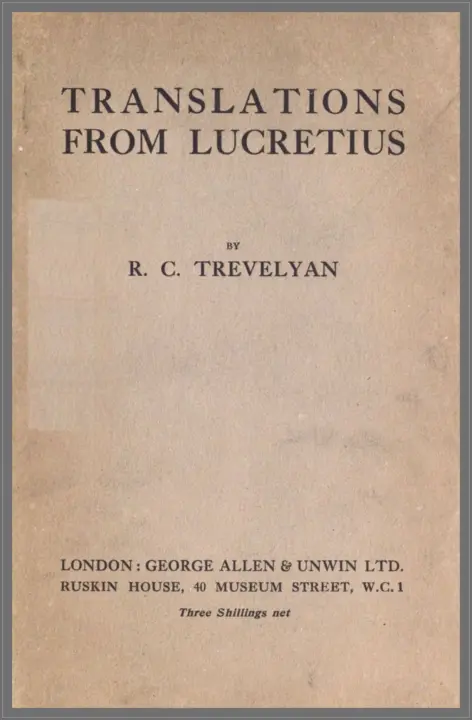
Titus Lucretius Carus (-95–-55). Explore Translations from Lucretius, On the Nature of Things in this collection. These books span philosophy, poetry.

Explore this author’s books →

THE READERS’ VERDICT

How did this story stay with you?

Not rated yet
Your rating for On the Nature of Things

Be the first to share your verdict.

One rating per browser, which you can change or remove. A necessary browser identifier remembers your vote. How ratings work

A GOOD STORY DESERVES COMPANY

Pass this book along.

A great read is even better when it’s shared.

SEND A LITTLE INSPIRATION

Share this book

BEHIND THE BOOK

Edition & source details.

Title
On the Nature of Things
Author
Titus Lucretius Carus
First publication (Open Library catalogue match)
1921
Digital edition publisher
Project Gutenberg
Gutenberg release date
1997-01-01
Language
English
Source edition imprint
Not stated in source catalogue
Source identifier
Project Gutenberg #785
Contributors
William Ellery Leonard (trl)

Public-domain source & licence

This eBook is for the use of anyone anywhere in the United States and most other parts of the world at no cost and with almost no restrictions whatsoever. You may copy it, give it away or re-use it under the terms of the Project Gutenberg License included with this eBook or online at www.gutenberg.org. If you are not located in the United States, you will have to check the laws of the country where you are located before using this eBook. Read the source licence.

Full source licence and obtaining an original copy

The original source file, including credits and licence, is retained by this library. Request an original-format copy at no charge. Please include the book title and Project Gutenberg identifier #785.

the full Project Gutenberg License must appear
prominently whenever any copy of a Project Gutenberg work (any work
on which the phrase “Project Gutenberg” appears, or with which the
phrase “Project Gutenberg” is associated) is accessed, displayed,
performed, viewed, copied or distributed:

This eBook is for the use of anyone anywhere in the United States and most
other parts of the world at no cost and with almost no restrictions
whatsoever. You may copy it, give it away or re-use it under the terms
of the Project Gutenberg™ License included with this eBook or online
at www.gutenberg.org. If you
are not located in the United States, you will have to check the laws
of the country where you are located before using this eBook.

1.E.2. If an individual Project Gutenberg electronic work is
derived from texts not protected by U.S. copyright law (does not
contain a notice indicating that it is posted with permission of the
copyright holder), the work can be copied and distributed to anyone in
the United States without paying any fees or charges. If you are
redistributing or providing access to a work with the phrase “Project
Gutenberg” associated with or appearing on the work, you must comply
either with the requirements of paragraphs 1.E.1 through 1.E.7 or
obtain permission for the use of the work and the Project Gutenberg
trademark as set forth in paragraphs 1.E.8 or 1.E.9.

1.E.3. If an individual Project Gutenberg electronic work is posted
with the permission of the copyright holder, your use and distribution
must comply with both paragraphs 1.E.1 through 1.E.7 and any
additional terms imposed by the copyright holder. Additional terms
will be linked to the Project Gutenberg License for all works
posted with the permission of the copyright holder found at the
beginning of this work.

1.E.4. Do not unlink or detach or remove the full Project Gutenberg
License terms from this work, or any files containing a part of this
work or any other work associated with Project Gutenberg.

1.E.5. Do not copy, display, perform, distribute or redistribute this
electronic work, or any part of this electronic work, without
prominently displaying the sentence set forth in paragraph 1.E.1 with
active links or immediate access to the full terms of the Project
Gutenberg License.

1.E.6. You may convert to and distribute this work in any binary,
compressed, marked up, nonproprietary or proprietary form, including
any word processing or hypertext form. However, if you provide access
to or distribute copies of a Project Gutenberg work in a format
other than “Plain Vanilla ASCII” or other format used in the official
version posted on the official Project Gutenberg website
(www.gutenberg.org), you must, at no additional cost, fee or expense
to the user, provide a copy, a means of exporting a copy, or a means
of obtaining a copy upon request, of the work in its original “Plain
Vanilla ASCII” or other form. Any alternate format must include the
full Project Gutenberg License as specified in paragraph 1.E.1.

1.E.7. Do not charge a fee for access to, viewing, displaying,
performing, copying or distributing any Project Gutenberg works
unless you comply with paragraph 1.E.8 or 1.E.9.

1.E.8. You may charge a reasonable fee for copies of or providing
access to or distributing Project Gutenberg electronic works
provided that:

• You pay a royalty fee of 20% of the gross profits you derive from
the use of Project Gutenberg works calculated using the method
you already use to calculate your applicable taxes. The fee is owed
to the owner of the Project Gutenberg trademark, but he has
agreed to donate royalties under this paragraph to the Project
Gutenberg Literary Archive Foundation. Royalty payments must be paid
within 60 days following each date on which you prepare (or are
legally required to prepare) your periodic tax returns. Royalty
payments should be clearly marked as such and sent to the Project
Gutenberg Literary Archive Foundation at the address specified in
Section 4, “Information about donations to the Project Gutenberg
Literary Archive Foundation.”

• You provide a full refund of any money paid by a user who notifies
you in writing (or by e-mail) within 30 days of receipt that s/he
does not agree to the terms of the full Project Gutenberg™
License. You must require such a user to return or destroy all
copies of the works possessed in a physical medium and discontinue
all use of and all access to other copies of Project Gutenberg™
works.

• You provide, in accordance with paragraph 1.F.3, a full refund of
any money paid for a work or a replacement copy, if a defect in the
electronic work is discovered and reported to you within 90 days of
receipt of the work.

• You comply with all other terms of this agreement for free
distribution of Project Gutenberg™ works.


1.E.9. If you wish to charge a fee or distribute a Project
Gutenberg™ electronic work or group of works on different terms than
are set forth in this agreement, you must obtain permission in writing
from the Project Gutenberg Literary Archive Foundation, the manager of
the Project Gutenberg™ trademark. Contact the Foundation as set
forth in Section 3 below.

1.F.

1.F.1. Project Gutenberg volunteers and employees expend considerable
effort to identify, do copyright research on, transcribe and proofread
works not protected by U.S. copyright law in creating the Project
Gutenberg™ collection. Despite these efforts, Project Gutenberg™
electronic works, and the medium on which they may be stored, may
contain “Defects,” such as, but not limited to, incomplete, inaccurate
or corrupt data, transcription errors, a copyright or other
intellectual property infringement, a defective or damaged disk or
other medium, a computer virus, or computer codes that damage or
cannot be read by your equipment.

1.F.2. LIMITED WARRANTY, DISCLAIMER OF DAMAGES - Except for the “Right
of Replacement or Refund” described in paragraph 1.F.3, the Project
Gutenberg Literary Archive Foundation, the owner of the Project
Gutenberg™ trademark, and any other party distributing a Project
Gutenberg™ electronic work under this agreement, disclaim all
liability to you for damages, costs and expenses, including legal
fees. YOU AGREE THAT YOU HAVE NO REMEDIES FOR NEGLIGENCE, STRICT
LIABILITY, BREACH OF WARRANTY OR BREACH OF CONTRACT EXCEPT THOSE
PROVIDED IN PARAGRAPH 1.F.3. YOU AGREE THAT THE FOUNDATION, THE
TRADEMARK OWNER, AND ANY DISTRIBUTOR UNDER THIS AGREEMENT WILL NOT BE
LIABLE TO YOU FOR ACTUAL, DIRECT, INDIRECT, CONSEQUENTIAL, PUNITIVE OR
INCIDENTAL DAMAGES EVEN IF YOU GIVE NOTICE OF THE POSSIBILITY OF SUCH
DAMAGE.

1.F.3. LIMITED RIGHT OF REPLACEMENT OR REFUND - If you discover a
defect in this electronic work within 90 days of receiving it, you can
receive a refund of the money (if any) you paid for it by sending a
written explanation to the person you received the work from. If you
received the work on a physical medium, you must return the medium
with your written explanation. The person or entity that provided you
with the defective work may elect to provide a replacement copy in
lieu of a refund. If you received the work electronically, the person
or entity providing it to you may choose to give you a second
opportunity to receive the work electronically in lieu of a refund. If
the second copy is also defective, you may demand a refund in writing
without further opportunities to fix the problem.

1.F.4. Except for the limited right of replacement or refund set forth
in paragraph 1.F.3, this work is provided to you ‘AS-IS’, WITH NO
OTHER WARRANTIES OF ANY KIND, EXPRESS OR IMPLIED, INCLUDING BUT NOT
LIMITED TO WARRANTIES OF MERCHANTABILITY OR FITNESS FOR ANY PURPOSE.

1.F.5. Some states do not allow disclaimers of certain implied
warranties or the exclusion or limitation of certain types of
damages. If any disclaimer or limitation set forth in this agreement
violates the law of the state applicable to this agreement, the
agreement shall be interpreted to make the maximum disclaimer or
limitation permitted by the applicable state law. The invalidity or
unenforceability of any provision of this agreement shall not void the
remaining provisions.

1.F.6. INDEMNITY - You agree to indemnify and hold the Foundation, the
trademark owner, any agent or employee of the Foundation, anyone
providing copies of Project Gutenberg™ electronic works in
accordance with this agreement, and any volunteers associated with the
production, promotion and distribution of Project Gutenberg™
electronic works, harmless from all liability, costs and expenses,
including legal fees, that arise directly or indirectly from any of
the following which you do or cause to occur: (a) distribution of this
or any Project Gutenberg work, (b) alteration, modification, or
additions or deletions to any Project Gutenberg work, and (c) any
Defect you cause.

Section 2. Information about the Mission of Project Gutenberg

Project Gutenberg is synonymous with the free distribution of
electronic works in formats readable by the widest variety of
computers including obsolete, old, middle-aged and new computers. It
exists because of the efforts of hundreds of volunteers and donations
from people in all walks of life.

Volunteers and financial support to provide volunteers with the
assistance they need are critical to reaching Project Gutenberg’s
goals and ensuring that the Project Gutenberg collection will
remain freely available for generations to come. In 2001, the Project
Gutenberg Literary Archive Foundation was created to provide a secure
and permanent future for Project Gutenberg and future
generations. To learn more about the Project Gutenberg Literary
Archive Foundation and how your efforts and donations can help, see
Sections 3 and 4 and the Foundation information page at www.gutenberg.org.

Section 3. Information about the Project Gutenberg Literary Archive Foundation

The Project Gutenberg Literary Archive Foundation is a non-profit
501(c)(3) educational corporation organized under the laws of the
state of Mississippi and granted tax exempt status by the Internal
Revenue Service. The Foundation’s EIN or federal tax identification
number is 64-6221541. Contributions to the Project Gutenberg Literary
Archive Foundation are tax deductible to the full extent permitted by
U.S. federal laws and your state’s laws.

The Foundation’s business office is located at 41 Watchung Plaza #516,
Montclair NJ 07042, USA, +1 (862) 621-9288. Email contact links and up
to date contact information can be found at the Foundation’s website
and official page at www.gutenberg.org/contact

Section 4. Information about Donations to the Project Gutenberg
Literary Archive Foundation

Project Gutenberg™ depends upon and cannot survive without widespread
public support and donations to carry out its mission of
increasing the number of public domain and licensed works that can be
freely distributed in machine-readable form accessible by the widest
array of equipment including outdated equipment. Many small donations
($1 to $5,000) are particularly important to maintaining tax exempt
status with the IRS.

The Foundation is committed to complying with the laws regulating
charities and charitable donations in all 50 states of the United
States. Compliance requirements are not uniform and it takes a
considerable effort, much paperwork and many fees to meet and keep up
with these requirements. We do not solicit donations in locations
where we have not received written confirmation of compliance. To SEND
DONATIONS or determine the status of compliance for any particular state
visit www.gutenberg.org/donate.

While we cannot and do not solicit contributions from states where we
have not met the solicitation requirements, we know of no prohibition
against accepting unsolicited donations from donors in such states who
approach us with offers to donate.

International donations are gratefully accepted, but we cannot make
any statements concerning tax treatment of donations received from
outside the United States. U.S. laws alone swamp our small staff.

Please check the Project Gutenberg web pages for current donation
methods and addresses. Donations are accepted in a number of other
ways including checks, online payments and credit card donations. To
donate, please visit: www.gutenberg.org/donate.

Section 5. General Information About Project Gutenberg electronic works

Professor Michael S. Hart was the originator of the Project
Gutenberg concept of a library of electronic works that could be
freely shared with anyone. For forty years, he produced and
distributed Project Gutenberg eBooks with only a loose network of
volunteer support.

Project Gutenberg eBooks are often created from several printed
editions, all of which are confirmed as not protected by copyright in
the U.S. unless a copyright notice is included. Thus, we do not
necessarily keep eBooks in compliance with any particular paper
edition.

Most people start at our website which has the main PG search
facility: www.gutenberg.org.

This website includes information about Project Gutenberg,
including how to make donations to the Project Gutenberg Literary
Archive Foundation, how to help produce our new eBooks, and how to
subscribe to our email newsletter to hear about new eBooks.


KEEP YOUR CURIOSITY GOING

Your next chapter awaits.



